项目由 erda、erda-ui、erda-proto、erda-infra 等多个仓库组成,需按架构分别获取;安装需依赖 Kubernetes 环境并参考 Helm 安装文档,README 未给出单条命令;本地快速开始需按 Docker 安装文档操作,并非直接运行二进制

erda
erda-projectApache-2.0活跃维护面向 Kubernetes 的企业级云原生应用平台,把 CI/CD、DevOps、APM 和容器管理整合在一起,帮团队统一管理微服务的构建、部署与监控。
An enterprise-grade Cloud-Native application platform for Kubernetes.
v2.2.0发布于 2022-06-30 08:25 UTC2,758star379fork同步于 2026-11-10 11:43 UTC
请从 https://github.com/erda-project/erda/releases 下载 Erda release 二进制,并按 https://docs.erda.cloud/latest/manual/install/helm-install/introduction.html 安装;本地体验参见 https://docs.erda.cloud/latest/manual/install/docker-install.html 硬件要求按 README 说明
README 未说明具体硬件要求,仅说明支持单节点或多节点部署,且平台基于 Kubernetes 运行
基于 Kubernetes 的企业级云原生应用平台,整合 DevOps、微服务治理与多云管理
面向 Kubernetes 的企业级云原生应用平台,把 CI/CD、DevOps、APM 和容器管理整合在一起,帮团队统一管理微服务的构建、部署与监控。
核心能力
- 提供 DevOps 流水线,支持从源码到部署的自动化
- 集成 APM、监控、日志分析与 API 网关的微服务治理
- 基于 Kubernetes 的多云管理与边缘计算能力
- 后端按微服务架构拆分为多个组件,提供 RESTful 与 gRPC 接口
- 配套 erda-infra 轻量框架,内置 Redis、Kafka、etcd 等中间件接入
容易踩的坑
内容由模型根据 README 生成,可能不完整或不准确,以官方文档为准。看原文 README
- v2.2.0最新正式版2022-06-30 · 2022-06-30 08:25 UTC
Erda v2.2.0 has been released.🎉 Welcome to use and feedback.
New Features
-
[DevOps] Task R&D workflow
- Support branch policy custom configuration and R&D mode configuration save, best practices for R&D mode based on feature branch with built-in Gitflow one erda.
- The developer worked based on the task. Through the code submission, construction and deployment in the task workflow, the developer were truly immersed in task-based development.

-
[DevOps] Support for temporary merging of feature branches, different branches of the same application can be deployed and tested in the same environment.
-
[Gallery] New application Gallery
- Based on the Actions and Addons, Gallery supports the release of products of projects/applications within the organization.

- Based on the Actions and Addons, Gallery supports the release of products of projects/applications within the organization.
Improvements
- [Collaboration] Optimized worklist interaction, support for labels and custom states
- [Collaboration] Added the description of Deployment Blocking in project settings
- [Collaboration] Fields such as reopening times, creator and creation time are added to defect field information
- [QA] The reports of unit test support module-level coverage statistics
- [QA] The automated test scenario set name is case-sensitive
- [Artifact] Optimize project artifact creation/deployment filters
- [Pipeline] Application pipeline standardizes unified interaction according to application scenarios
- [Pipeline] The assembly line details page supports sharing
- [Pipeline] Action supports disable management and OOM promption
- [Pipeline] Supported execution record switching on the details page
- [Pipeline] Avoid pipeline log errors caused by network jitter
- [Deployment] Optimized pre-check, support check repeat deploy and image verification
- [Deployment] Supported Dice.yml format verification
- [Deployment] Supported switching between applications among Runtime pages
- [Deployment] The deployment center supported information about the workflow configuration
- [Performance] Optimization slow SQL
- [Performance] Optimization of ES Tracing related indicators performance problems
- [Monitor alert] Recovery notification is enabled by default for alarm rules
- [Log] Resolved logs cannot be downloaded after being degraded
- [Log] Supports traffic limiting on the log collection
- [Internaltional] Optimized platform i18n
-
- v2.1.02022-05-13 · 2022-05-13 08:30 UTC
查看更新说明
Erda v2.1.0 has been released.🎉 Welcome to use and feedback.
New Features
- [Collaboration] Automate the workflow of collaboration issues
- The task automatically turns to in progress when an MR is associated
- The requirement automatically turns to in progress when any issue in its todo list is in progress
- [Collaboration] Improve the operational experience and information synchronization of issues
- Support quick editing of status and other attributes in the todo list, with iteration information revealed
- Synchronize changes to issues in the todo list in a semi-automated way after the requirement iteration or label changes, by giving a prompt to users

- [Collaboration] Support issue statistics on the iteration details page

- [Collaboration] The deadline of all issues in the iteration cannot be empty, otherwise, the system will automatically assign a value
- Rule: If the start date of the iteration is later than the current date, the system will automatically set the start date as the issue deadline, otherwise, the current date is the deadline
- Purpose: To let members make plans at an earlier stage of the iteration or of the current day, and to arrange issues reasonably
- [Collaboration] Support new interaction of issue details

- [Artifact] Enhance project artifact capabilities with one project artifact adapting to multiple deployment scenarios
- [Artifact] Support viewing addon information in the project artifact details

- [Artifact] Support label management for artifacts
- [Pipeline] Support classification management of pipelines (the platform provides built-in classification configuration now and custom configuration is coming soon), allowing pipeline creation with one click if a pipeline file is found in the code repository

- [Pipeline] Enhance the configuration capacity of project-level pipelines with pipeline parameter configuration and management supported

- [Deployment] Support job types in project artifacts
- [Deployment] Support addon addition or reuse according to the environment, reducing the maintenance cost of addons
- [Microservice observation and governance] Support cross-environment migration of custom dashboards by importing and exporting
- [Stability] Support configuration of container emptyDir and temporary storage available capacity in dice.yml

Improvements
- [Collaboration] Support quick switching to other iterations on the iteration details page
- [Collaboration] Optimize the categorization and sorting of filter criteria, to put commonly used fields on the left and person and date on the right
- [Collaboration] Remove the milestone
- [Artifact] Enhance the application filtering features when creating project artifacts
- [Pipeline] Optimize the pipeline details page to show the latest execution record after clicking
- [Pipeline] Optimize the default compensation mechanism for pipeline periodic scheduling, which is to stop according to the final status
- [Pipeline] Optimize the project pipeline page performance
- [Personal workbench] Improve the page loading performance
- [Microservice observation and governance] Connect the whole link from e
- [Collaboration] Automate the workflow of collaboration issues
- v2.0.02022-03-09 · 2022-03-09 06:54 UTC
查看更新说明
Erda v2.0 is officially released with the following features: totally new visual interaction to optimize user experience deeply; new project-level R&D process to support project-level pipelines, artifacts and deployments based on CI/CD of a single application, making product development and delivery easier and more elegant.


Full Changelog
New Features
- Support new UI and optimize the user experience. #2443
- Optimize the path for new users by adding a landing page and project home page. #2567
- Support new R&D process with features of project-level pipeline, artifact and environmental deployment.
- Improve CLI tools with project initialization and code push supported.
- Support project-level artifact management and batch deployment. #4025 #4034
- Support artifact display in time order. #2843 #3813 #3941 #4150
- Support display of source file information in the pipeline list. #2998 #4135
- Support issue management in merge requests. #2965 #4094
- Support new service monitoring with features of tracing query, resource monitoring and call monitoring. #2363 #2478 #2556 #2586
- Support new front-end monitoring overview. #2597
- Support new alarm center. #3995
- Support new filter. #2825
- Support new menu layout for applications. #2941
- Optimize artifact upload and audit. #2519
- Enhance security with traffic limit of file download interface. #4089
- Use protobuf in artifact management. #3708 #4117
Bug Fixes
- (71416) [Deployment] Cross-cluster deployment is not supported for artifacts. #1999 #2031
- (263463) Format error in project collaboration (1440px screen) #3974
- (269792) Cache information not updated when the edge cluster is added again. #3773
- (273037) When adding a new issue, the custom field is unavailable and the issue cannot be saved. #2862
- (279349) [Org Center] Incorrect member statistics in the project list. #4015
- (281291) Failed to view the password of MySQL addon account. [#4193](https://github.com/
- v1.5.02022-01-07 · 2022-01-07 03:33 UTC
查看更新说明
Erda v1.5 is officially released with a total of 202 new features and improvements, such as Gantt chart, a powerful tool for task planning in project management, and efficiency measure of requirements and tasks, allowing you to have a clearer picture of the progress and risks of iteration. For microservice governance, Erda supports new topology for services and flame graph for tracing analysis, making it easier for you to understand the overall service architecture of the product with cool visual effects. For more information, please get the latest version and gain new experiences of Erda. Thanks again to each of you who contributes to Erda. We will pay attention to and adopt suggestions from the community continuously, to promote the further development of Erda. Look forward to hearing from you!
Exciting New Features 🎉
The following will introduce some key features of the new version in details.
1. R&D efficiency measure - Requirement and task analysis
Based on the efficiency measure of version 1.4, the new version supports requirement and task analysis, to help you analyze progress, risks and issue workflow via burn down chart and cumulative flow diagram.The burn down chart shows the possible problems of your team by iteration filtering. Through the chart exception or deviation from the ideal curve, you can see problems such as progress ahead or behind, task overloaded or unsaturated, requirement granularity too low, task estimated inaccurately, requirement changes and progress updated untimely.
Path: DevOps platform > (Select project) > Projects > Efficiency measure
 The cumulative flow diagram helps you view and analyze the cycle time, throughput rate and predicted release date of iterations of requirements and tasks in each workflow status.

2. Project plan management - Gantt chart
In project management, it is essential to make plans, manage task distribution and follow tasks. For this reason, Erda supports Gantt chart in this version, which allows team managers to have a global view on task distribution, allocate and manage tasks reasonably, and view the cost of each issue clearly, and team members to view the distribution and due status of their tasks conveniently. In addition, the chart shows the progress and risks of tasks that may affect others, and tells the reason why some tasks are delayed.
Path: DevOps platform > (Select project) > Projects > Project collaboration
- v1.4.02021-11-16 · 2021-11-16 09:26 UTC
查看更新说明
Erda v1.4.0 has been released.🎉 Welcome to use and feedback.
New Features
- Support parallel scene sets in automated testing. #2173
- Support scene set importing and exporting in automated testing. #2470
- Support step copying and pasting in automated testing. #2481
- Support step enabling and disabling in automated testing. #2453
- Accelerate the loading of manual test related pages. #2910
- Support issue dashboard with history data displayed in bar chart, pie chart, etc. #2294 #2462
- Support setting resource quotas according to the project's workspace granularity in the management center. #2283
- Support resource usage ranking of projects in the cloud management platform. #2525
- Support sending SMS alerts through custom notification channels in microservice and cloud management platforms. #2460
- Support Elasticsearch as a backend storage in the microservice platform. #2861
- Support automatically adding the .yml suffix to the file name when user creates a pipeline in the DevOps platform. #2685
- Support K8s versions below 1.16 in the Kubernetes dashboard of cloud management platform.#2852
- Support dynamic configuration search depth of git search interface in the DevOps platform.#2872
- Optimize the alarm trigger conditions and alarm expressions in the microservice platform. #2739
- Support service analysis of microservice&DevOps projects in the microservice platform.#2782 #2833
Bug Fixes
- Fix the bug that action will not automatically synchronize the latest version of GitHub. #2507
- Fix the bug that it is not checked whether there is a cycle in the scene set when it is moved. #2309
- Fix the bug that the execution action of automated test plan cannot monitor whether the plan is executed. #2407
- Fix the bug that the .yml suffix is not added when creating a pipeline. #2685
- Fix the bug of incorrect calculation of execution time of pipeline loop task. #2816
- Fix the bug that the pipeline with the same ID is scheduled repeatedly. #2921
- Fix the bug of slower requests as automated testing tasks apply for a large number of tokens. #2991
- Fix the bug that application deletion failed without returning an error message. #2613
- Fix the bug that add a unique index to the application table to avoid applications with the same name. #2611
- Optimize the audit message for org update. #2706
- Fix the bug that the parent context is recycled from which the child context gets data, causing the gittar component to panic. #2348
- Optimize the API statistics of automated testing. [#2806](https://github.com/erda-pro
用户点评
登录用户的真实使用记录,可按版本和硬件筛选共 0 条
还没有人点评。第一个说出真实体验的人最有价值。

An enterprise-grade Cloud-Native application platform


Introduction | Quick Start | Installation | Documentation | CHANGELOG | Contributing
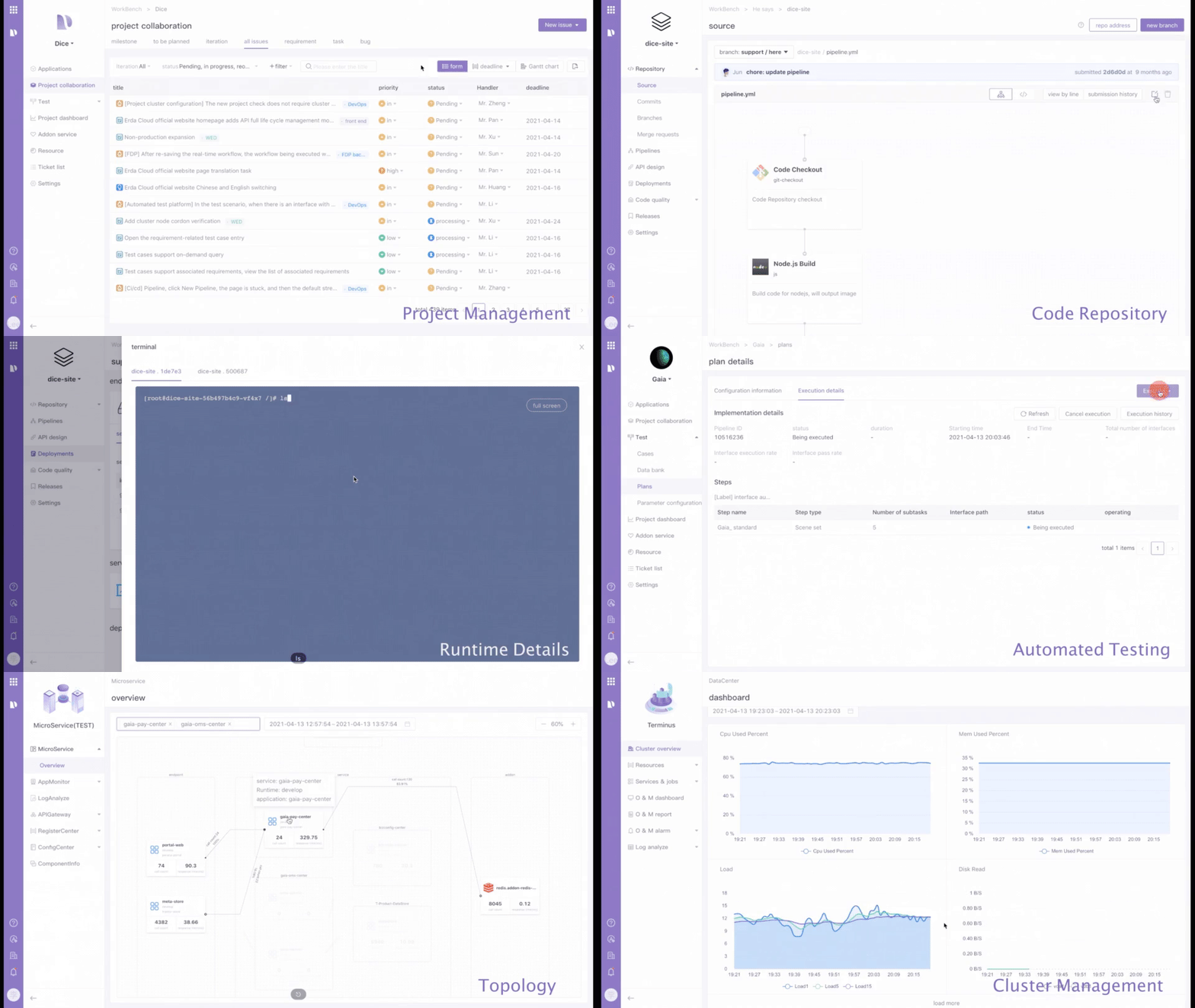
Demo
Introduction
Erda is an open-source platform created by Terminus to ensure the development of microservice applications. It provides DevOps, microservice governance, and multi-cloud management capabilities. The multi-cloud architecture based on Kubernetes and application-centric DevOps and microservice governance can make the development, operation, monitoring, and problem diagnosis of complex business applications simpler and more efficient.
Functional Architecture

Erda is mainly composed of the following parts:
- DevOps
- Microservice Governance, including Application Performance Management, Monitoring, Log Analysis, API Gateway, etc.
- Multi-Cloud Management
- Edge Computing
- FastData Management
Vision: Build any application, Deploy anywhere, Monitor anything

Architecture

The Erda project consists of multiple repsitories according to different functions. The key repositories are erda, erda-ui, erda-proto, erda-infra, erda-actions, erda-addons.
erda
It is the core repository that implements all the RESTful and gRPC interfaces of the backend services of Erda platform by multiple components in microservice architecture.
erda-ui
It is the graphical user portal of Erda platform built with React with the help of which users can work upon Erda platform very easily. It talks with erda backend services in RESTful APIs.
erda-proto
It defines a part of the communication protocols among erda backend services using Protocol Buffers. All the other protocols among erda backend services will be migrated here in the near future.
erda-infra
It is a lightweight microservices framework implements by golang. It provides many popular middleware providers such as Redis, KafKa, etcd, etc., so that developers can build a module-driven application quickly with help of it. It is also integrated into almost all the backend components in erda.
erda-actions
It holds the definition for the official Pipeline Actions of the Erda Action Marketplace as found at https://www.erda.cloud/market/action. A Pipeline Action plays as a mininal runnable unit in Erda Pipelines such as checking out source code in github, buiding a docker image, creating a deployment in a Kubernetes cluster etc.
erda-addons
It holds the definition for the official Addons of the Erda Addon Marketplace as found at https://www.erda.cloud/market/addon. An Addon holds the configration of a middleware like MySQL, Redis, etc. or a third-party service and it can be shared to different environments of applications, so that developers would not need to import the same configurations again and again in different environments.
There are some extra repositories that plays as customized third-partiy independent components and tools in Erda project such as
- erda-proto-go generated code for Erda protobuf data modals and protocols.
- erda-analyzer is the streaming aggregator for metrics and alert data.
- erda-java-agent is the apm java agent in Erda platform.
- telegraf is the plugin-driven server agent for collecting & reporting metrics.
- kubeprober is a large-scale Kubernetes cluster diagnostic tool.
- beats is the lightweight shippers for Elasticsearch & Logstash.
- remotedialer is a reverse tunneling dialer.
- erda-bot is the bot handing Github webhooks.
Quick Start
To get started, see Local installation.
Installation
Erda can be deployed in either a single node or multi-node setup. Please download binaries of Erda release and follow Installation & Configuration Guide to install Erda.
User Manual
To start using Erda, please refer to the following documentation.
- English
- 简体中文
Contributing
Contributions are always welcomed. Please refer to Contributing to Erda for details.
Contact Us
If you have any questions, please feel free to contact us.
-
Email: [email protected]
-
Twitter: @ErdaProject
-
Zhihu:Erda技术团队 (A Chinese knowledge community, similar to Quora.)
-
WeChat Official Account:

-
DingTalk Group:

License
Erda is under the Apache 2.0 license. See the LICENSE file for details.

act
nektos·Go
在本地直接跑 GitHub Actions 工作流,不用每次改完都推到远端等 CI,调试 workflow 和排查失败步骤快很多。
GitHub Actions+4CI / CD
72626+532.1kv0.2.972026-11-04 16:29 UTC
shannon
KeygraphHQ·TypeScript
Shannon 是一款 AI 渗透测试工具,能分析 Web 应用和 API 的源码、定位攻击面,并在上线前实际执行漏洞利用来验证风险。
渗透测试+4CI / CD
51609+2536.0kv3.5.02026-11-10 04:39 UTC
harness
harness·Go
一套开源的端到端开发者平台,把代码托管、CI/CD 流水线、云端开发环境和制品仓库整合在一起,省去拼装多套工具的麻烦。
CI/CD+4CI / CD
38876+253.5kv2.28.22026-11-06 17:00 UTC
gitleaks
gitleaks·Go
扫描 Git 仓库和提交历史,自动找出硬编码的密钥、令牌等敏感信息,帮你在 CI/CD 流程里提前拦截泄露风险。
密钥扫描+4CI / CD
30853+932.4kv8.30.12026-10-28 04:14 UTC