不配置嵌入端点时默认走词法模式,语义检索需自行接 OpenAI 兼容的 embeddings 服务;cortexdb-grpc 只读 OPENAI_BASE_URL/OPENAI_API_KEY,不认 CORTEXDB_EMBED_BASE_URL;媒体处理依赖额外的 Ollama 视觉模型、转写端点和 ffmpeg。
cortexdb
liliang-cnMIT活跃维护把 AI 智能体的记忆全部存进单个 SQLite 文件,内置知识图谱、本体约束和可追溯推理,让本地优先的记忆管理不再依赖外部服务。
Local-first AI agent memory with a knowledge graph, ontology constraints, and traceable reasoning—all in one SQLite file.
v2.148.2发布于 2026-11-10 00:35 UTC478star +2 / 7 天27fork同步于 2026-11-10 06:02 UTC
go get github.com/liliang-cn/cortexdb/v2 硬件要求按 README 说明
README 未说明显存或 GPU 要求;纯 Go 实现,无需运行外部服务,不配嵌入模型时以词法模式工作,另提供面向小设备的 EmbeddedConfig。
单文件 SQLite 里的 AI 记忆与知识图谱,纯 Go 实现,无需部署服务
把 AI 智能体的记忆全部存进单个 SQLite 文件,内置知识图谱、本体约束和可追溯推理,让本地优先的记忆管理不再依赖外部服务。
核心能力
- 用 HNSW、IVF、flat、binary 多种向量索引加 FTS5 做混合与图检索
- 内置 RDF 1.2 知识图谱,支持 SPARQL、SHACL、OWL 2 RL 推理与只读 Cypher
- 带来源的上下文包,区分已验证记忆与猜测,召回时分开处理
- 100+ 工具,可进程内调用或经 MCP 暴露给 Claude Code、Codex
- 变更流按序恰好一次记录每次写入,并带 traceparent 全链路追踪
容易踩的坑
内容由模型根据 README 生成,可能不完整或不准确,以官方文档为准。看原文 README
这个条目还没有人工点评。如果它对你很有用,欢迎到 提交仓库 页写下你的使用经验。
用户点评
登录用户的真实使用记录,可按版本和硬件筛选共 0 条
还没有人点评。第一个说出真实体验的人最有价值。
- v2.148.2最新正式版2026-11-10 · 2026-11-10 00:35 UTC
What's Changed
- fix(recall): don't recall for a background task's notification by @liliang-cn in https://github.com/liliang-cn/cortexdb/pull/147
Full Changelog: https://github.com/liliang-cn/cortexdb/compare/v2.148.1...v2.148.2
- v2.148.12026-11-09 · 2026-11-09 13:41 UTC
查看更新说明
What's Changed
- fix(recall): ask with the last reply again, and skip desktop images by @liliang-cn in https://github.com/liliang-cn/cortexdb/pull/145
Full Changelog: https://github.com/liliang-cn/cortexdb/compare/v2.148.0...v2.148.1
- v2.148.02026-11-09 · 2026-11-09 12:54 UTC
查看更新说明
What's Changed
- Recall: a screenshot is not recalled for, the last reply only orders the hits; capture leaves what the file memory says by @liliang-cn in https://github.com/liliang-cn/cortexdb/pull/143
Full Changelog: https://github.com/liliang-cn/cortexdb/compare/v2.147.1...v2.148.0
- v2.147.12026-11-09 · 2026-11-09 01:26 UTC
查看更新说明
What's Changed
- fix(core): rewriting a chunk no longer leaves a ghost in the full-text indexes by @lfoletti in https://github.com/liliang-cn/cortexdb/pull/141
Full Changelog: https://github.com/liliang-cn/cortexdb/compare/v2.147.0...v2.147.1
- v2.147.02026-11-07 · 2026-11-07 06:12 UTC
查看更新说明
What's Changed
- Live view: a host can leave pages out (#137) by @liliang-cn in https://github.com/liliang-cn/cortexdb/pull/138
- Live view: an ontology report with no enforcement shows no badge (#139) by @liliang-cn in https://github.com/liliang-cn/cortexdb/pull/140
Full Changelog: https://github.com/liliang-cn/cortexdb/compare/v2.146.0...v2.147.0
CortexDB


AI memory and a knowledge graph in one SQLite file. Pure Go, no service to run, works without an embedding model.

Install
| Go library | go get github.com/liliang-cn/cortexdb/v2 |
| Claude Code | /plugin marketplace add liliang-cn/cortexdb, then /plugin install cortexdb@cortexdb |
| Codex | codex plugin marketplace add liliang-cn/cortexdb && codex plugin add cortexdb@cortexdb |
| Claude Code mod (optional) | /plugin install cortexdb-live@cortexdb |
| DeepSeek Harness | dsh plugin --profile web add "github:liliang-cn/cortexdb#semver:^2&path:/plugins/dsh-cortexdb-memory" (guide) |
| Obsidian | unzip a release's cortexdb-obsidian.zip into <vault>/.obsidian/plugins/ (guide) |
| Shared-brain server | go install github.com/liliang-cn/cortexdb/v2/cmd/cortexdb-grpc@latest |
| Clients | cargo add cortexdb-client · pip install cortexdb-client · npm install cortexdb-client |
Use
db, _ := cortexdb.Open(cortexdb.DefaultConfig("brain.db"))
defer db.Close()
brain := db.KnowledgeMemory()
_, _ = brain.Remember(ctx, cortexdb.KnowledgeMemoryRememberRequest{MemoryID: "alice-tabs", UserID: "alice", Scope: "user", Content: "Alice prefers tabs."})
rec, _ := brain.Recall(ctx, cortexdb.KnowledgeMemoryRecallRequest{Query: "what does Alice prefer?", UserID: "alice"})
fmt.Println(rec.ContextPack.Text)
The plugin gives Claude Code and Codex one global brain at ~/.cortexdb/cortexdb.db, /remember, /recall and an auto-recall hook. A session starts with an index of what the brain knows about its project, an agent about to open a file is told what happened to it before, and a session's durable facts are captured with <private> text and credentials kept out. Point several agents or machines at one cortexdb-grpc and they share the same memory and graph.
In Codex, review and trust the plugin hooks in /hooks to activate automatic
recall. See the plugin guide for setup and
cortexdb-mcp --doctor --self-test diagnostics (v2.119.0+).
Claude Code mod
cortexdb-live is an optional mod that runs inside Claude Code on top of the cortexdb plugin. Install it after the plugin:
/plugin install cortexdb-live@cortexdb
The mod calls three of the plugin's tools itself, and a hook gets no permission prompt, so allow them once in ~/.claude/settings.json (not needed in bypass mode):
"permissions": {
  "allow": [
    "mcp__plugin_cortexdb_cortexdb__knowledge_memory_recall",
    "mcp__plugin_cortexdb_cortexdb__graph_statistics",
    "mcp__plugin_cortexdb_cortexdb__memory_save"
  ]
}
Without them the status line names the missing rules.
- Planned recall. Before the brain is searched, haiku turns each prompt into keywords in Chinese and English, aliases, entity names and a retrieval mode. A bare "ok" or "go ahead" searches nothing. The band above the prompt shows what was recalled; expand it to see the plan and every hit. Hide lasts until the next recall;
/cortexdb-showbrings the hidden one back. - Status line. Which brain the session uses, its node count and how long the last recall took, or why the brain can't be reached.
- Capture. 90 seconds after a session goes idle, haiku distils the new part of the conversation into durable memories (
auto:<session>:<slug>). Each later pass replaces a memory under the same slug rather than adding a copy. Older memories a new one makes untrue (a host moved, a decision reversed) are marked superseded: kept, but no longer recalled as current.
Haiku runs on Claude Code's own model access, so no API key is needed. Language: /config → cortexdb-live → language (auto, zh, en). The mod honours the plugin's own switches: cortexdb-recall --disable and cortexdb-session-end --disable turn recall and capture off for both. While the mod runs, the plugin's shell recall and capture hooks stand down, so nothing is done twice. Codex keeps those hooks. Mods are an early-access Claude Code feature.
What's inside
- Vectors (HNSW, IVF, flat, binary codes), FTS5 full-text search, hybrid and graph retrieval
EmbeddedConfigfor small devices: an SQ8 index, bounded SQLite caches, snapshots that survive a power cut — 100k 768-d vectors open in 0.28 s with a 193 MB heap- RAG knowledge, scoped agent memory, context packs with sources — memories say whether they were verified or are a guess, and recall keeps the two apart
- RDF 1.2 knowledge graph: SPARQL 1.1/1.2, RDFS + OWL 2 RL inference, SHACL Core + SHACL-SPARQL, RDF/XML import — passing the W3C SPARQL 1.1/1.2, RDF 1.2 (Turtle, TriG, N-Triples, N-Quads, RDF/XML) and SHACL test suites; RDFS and OWL 2 RL are covered by the repo's own tests — and read-only Cypher
- Palantir-style ontology with governed actions
- 100+ tools, in-process or over MCP
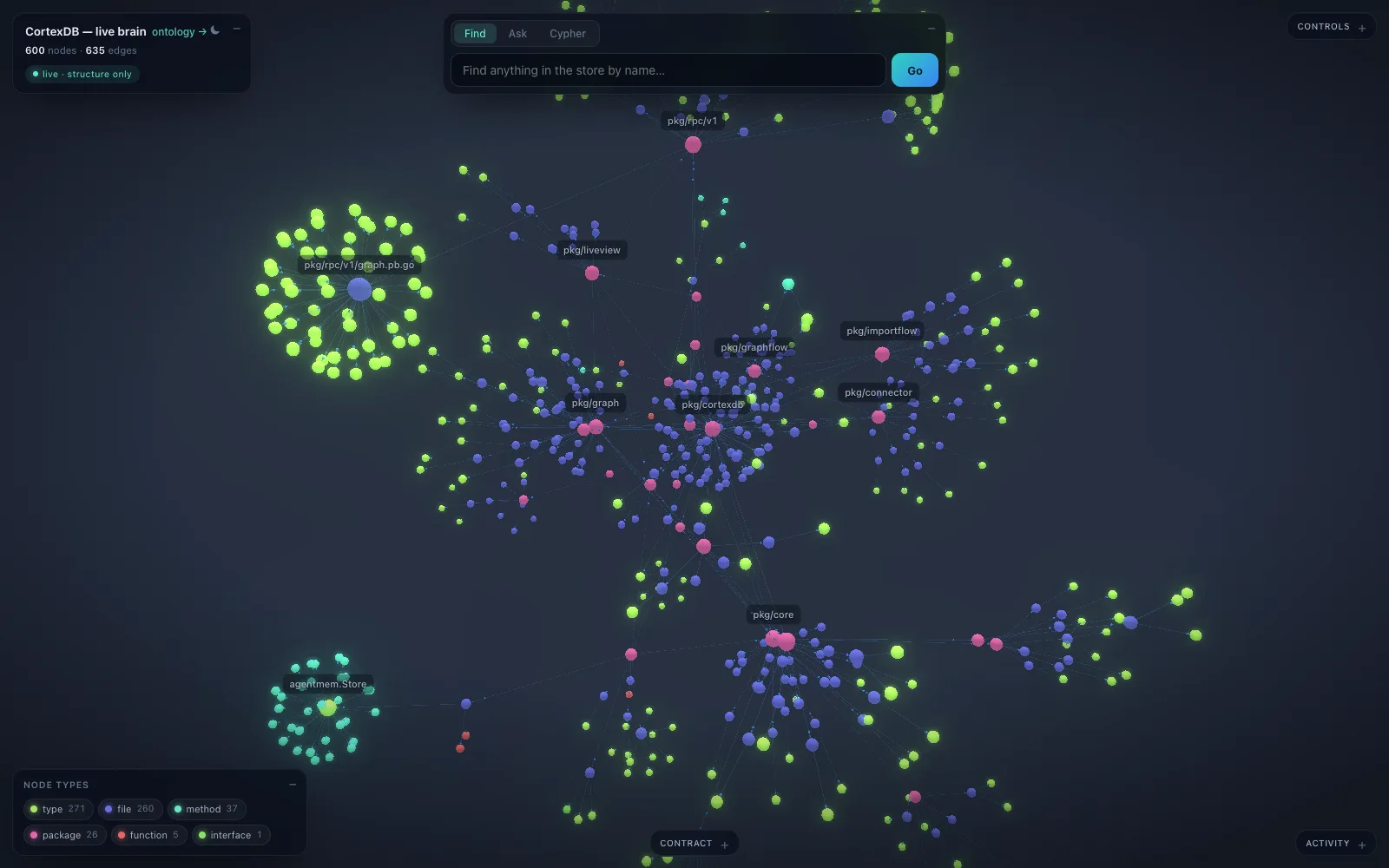
serve_graph_3d: a live 3D view to find, ask, query and expand, on desktop or phone, with a Changes page that says in words what was added, replaced or retracted as it happens, and an Entity page with each relation, why its value is in effect and what it replaced; or the same brain as a library, each memory a book on its project's shelfimport_agent_memory: bring in what Claude Code, Codex and DeepSeek Harness already remember — memory notes,CLAUDE.md/AGENTS.md, Codex's memories, and optionally past sessions distilled into memories — into a local or shared brain- Change feed: every committed write, in order, exactly once
- Observability: a request id and a W3C trace (
traceparent) from MCP through gRPC to the trace and the recall log, recalls that explain themselves and say when they were degraded, embedder health in/metricsand/healthz, and an opt-in recall log with a/recallspage - Images, recordings and videos (
ingest_media): found by a text question through their caption, visible text and transcript, a hit saying where in the file — with or without an embedder; with a CLIP-style media embedder also by what they show, and by an image (search_media) - History of the graph and the ontology: for an entity, relation, triple or schema, every version, when and why it changed, and which one is in effect and why (
graph_history,knowledge_graph_history,ontology_history);as_ofon SPARQL, find, expand and Cypher; an entity timeline, an As of pin and an ontology version list in the live view - SQLite by default, PostgreSQL + pgvector with a
postgres://DSN
Environment
| Variable | Meaning |
|---|---|
CORTEXDB_PATH | Database file (default ~/.cortexdb/cortexdb.db) |
CORTEXDB_REMOTE | Use a shared cortexdb-grpc at host:port (plaintext) or https://host (TLS, behind a proxy) instead of a local file |
CORTEXDB_GRPC_TOKEN | Bearer token for that server |
CORTEXDB_GRPC_ADDR | Server listen address (default 127.0.0.1:47821) |
CORTEXDB_EMBED_BASE_URL / CORTEXDB_EMBED_API_KEY | cortexdb-mcp-stdio: OpenAI-compatible embeddings endpoint and its key (fall back to OPENAI_BASE_URL / OPENAI_API_KEY); unset = lexical mode |
OPENAI_BASE_URL / OPENAI_API_KEY | Server: the embeddings endpoint and key (cortexdb-grpc reads only these, not CORTEXDB_EMBED_BASE_URL); unset = lexical mode |
CORTEXDB_EMBED_MODEL / CORTEXDB_EMBED_DIM | Embedding model and dimension, for both (default text-embedding-3-small / 1536) |
CORTEXDB_VECTOR_INDEX / CORTEXDB_BINARY_OVERSAMPLE | Server: hnsw (default) or, on a SQLite store, binary (1-bit codes in memory, 1/32 of the vectors, each search rescored from the stored vectors, no snapshot); the oversample is the binary shortlist multiplier, from 1 to 1000 (default 8) |
CORTEXDB_REVIEW_GATE | Server and cortexdb-mcp-stdio: 1 leaves proposed and rejected documents and memories out of search and recall (default off; a curation filter, not access control) |
CORTEXDB_SLOW_MS | Server: log calls slower than this, with the time each stage took (default 1000, 0 = none) |
CORTEXDB_TRACE / CORTEXDB_TRACE_FILE | Server: log every call; also append the records to a JSON-lines file |
CORTEXDB_LOG_FORMAT / CORTEXDB_LOG_LEVEL | Server: text (logfmt, default) or json; debug, info (default), warn, error |
CORTEXDB_TRACE_MAX_MB / CORTEXDB_TRACE_KEEP / CORTEXDB_TRACE_MAX_AGE_DAYS | Server: rotate the trace file at this size (100), keep this many old files (5) for at most this many days (30) |
CORTEXDB_EMBED_PROBE_SECONDS | Server: probe the embedder this often, for /healthz and /metrics (default 60, 0 = off) |
CORTEXDB_RECALL_LOG | Server and cortexdb-mcp-stdio: 1 keeps a log of recalls — queries included — for the /recalls page and the recall_log_* tools (default off) |
CORTEXDB_RECALL_LOG_DAYS / CORTEXDB_RECALL_LOG_MAX_ROWS | How long (30 days) and how many (100000) recalls the log keeps |
CORTEXDB_MEDIA_VISION_URL / CORTEXDB_MEDIA_VISION_MODEL | Server and cortexdb-mcp-stdio: an Ollama vision model that captions images and video frames for ingest_media (e.g. http://localhost:11434 / qwen3.5:4b) |
CORTEXDB_MEDIA_TRANSCRIBE_URL / CORTEXDB_MEDIA_TRANSCRIBE_MODEL / CORTEXDB_MEDIA_TRANSCRIBE_API_KEY | An OpenAI-compatible …/v1 transcription endpoint for audio and the sound of videos (OpenAI, or whisper.cpp's whisper-server --inference-path /v1/audio/transcriptions --convert) |
CORTEXDB_MEDIA_EMBED_URL / CORTEXDB_MEDIA_EMBED_MODEL / CORTEXDB_MEDIA_EMBED_API_KEY | A CLIP-style embedding endpoint (infinity's /embeddings with modality) that puts images, video frames and text in one space, so an image is found by what it shows and search_media takes an image as the query |
CORTEXDB_MEDIA_EMBED_AUDIO / CORTEXDB_MEDIA_EMBED_MIN_SCORE | 1 when that model embeds sound too (CLAP); the cosine a media vector must reach to be a hit (0.2) |
CORTEXDB_MEDIA_FRAME_INTERVAL / CORTEXDB_MEDIA_MAX_BYTES | Seconds between the video frames captioned (10, 0 = none; needs ffmpeg), and the size cap of one file (32 MiB) |
Docs
Website · Guide (full feature reference) · Examples · Changelog · 中文
License
MIT
supabase
supabase·TypeScript
基于 Postgres 的一站式后端开发平台,提供专用数据库、认证、存储和向量检索能力,可替代 Firebase 快速搭建 Web、移动和 AI 应用。
Postgres+4向量化 / 重排服务
114723+10215kv1.26.082026-11-10 05:15 UTC

Langchain-Chatchat
chatchat-space·Python
基于 Langchain 和 ChatGLM、Qwen、Llama 等本地大模型搭建的知识库问答应用,支持 RAG 检索增强与 Agent 能力,可离线部署私有文档问答系统。
知识库问答+4向量化 / 重排服务
387116.3kv0.3.12025-11-10 09:27 UTC
WeKnora
Tencent·Go
把原始文档变成可查询的 RAG、自主推理 Agent 和自维护 Wiki 的开源 LLM 知识平台,适合搭建企业知识库与智能问答。
知识库+4向量化 / 重排服务
37037+2925.1kv0.9.02026-11-09 15:19 UTC

TencentDB-Agent-Memory
TencentCloud·TypeScript
把对话、文档和代码沉淀成聊天记忆、技能、LLM-Wiki、代码图谱四类可复用记忆资产,让多个 AI Agent 跨框架共享和治理长期记忆。
长期记忆+4向量化 / 重排服务
30717+993.0kv2.0.32026-11-09 10:14 UTC