这是资源清单仓库,不是可安装的软件,没有可运行代码;条目多为外链,需自行前往各项目仓库查看依赖与用法
awesome-edge-machine-learning
Bisonai活跃维护一份边缘机器学习资源清单,汇总了研究论文、推理引擎、竞赛、书籍和线下活动,方便快速找到在嵌入式与移动端部署模型的相关资料。
A curated list of awesome edge machine learning resources, including research papers, inference engines, challenges, books, meetups and others.
暂无版本281star57fork同步于 2026-11-10 18:03 UTC
一份汇总边缘机器学习论文、推理引擎、芯片与开发工具的精选资源清单
一份边缘机器学习资源清单,汇总了研究论文、推理引擎、竞赛、书籍和线下活动,方便快速找到在嵌入式与移动端部署模型的相关资料。
核心能力
- 按量化、剪枝、AutoML、联邦学习等主题分类收录论文
- 列出 TensorFlow Lite、NCNN、MNN、MACE 等边缘推理引擎
- 整理 STM32、NXP eIQ、TI TIDL 等 MCU/MPU 软件包
- 汇总边缘 AI 芯片、数据集、书籍与竞赛资源
容易踩的坑
内容由模型根据 README 生成,可能不完整或不准确,以官方文档为准。看原文 README
暂无 release 数据(可能没有发版,或尚未同步)。
用户点评
登录用户的真实使用记录,可按版本和硬件筛选共 0 条
还没有人点评。第一个说出真实体验的人最有价值。
Awesome Edge Machine Learning

A curated list of awesome edge machine learning resources, including research papers, inference engines, challenges, books, meetups and others.
Table of Contents
- Papers
- Datasets
- Inference Engines
- MCU and MPU Software Packages
- AI Chips
- Books
- Challenges
- Other Resources
- Contribute
- LicenseBlock
Papers
Applications
There is a countless number of possible edge machine learning applications. Here, we collect papers that describe specific solutions.
AutoML
Automated machine learning (AutoML) is the process of automating the end-to-end process of applying machine learning to real-world problems.Wikipedia AutoML is for example used to design new efficient neural architectures with a constraint on a computational budget (defined either as a number of FLOPS or as an inference time measured on real device) or a size of the architecture.
Efficient Architectures
Efficient architectures represent neural networks with small memory footprint and fast inference time when measured on edge devices.
Federated Learning
Federated Learning enables mobile phones to collaboratively learn a shared prediction model while keeping all the training data on device, decoupling the ability to do machine learning from the need to store the data in the cloud.Google AI blog: Federated Learning
ML Algorithms For Edge
Standard machine learning algorithms are not always able to run on edge devices due to large computational requirements and space complexity. This section introduces optimized machine learning algorithms.
Network Pruning
Pruning is a common method to derive a compact network – after training, some structural portion of the parameters is removed, along with its associated computations.Importance Estimation for Neural Network Pruning
Others
This section contains papers that are related to edge machine learning but are not part of any major group. These papers often deal with deployment issues (i.e. optimizing inference on target platform).
Quantization
Quantization is the process of reducing a precision (from 32 bit floating point into lower bit depth representations) of weights and/or activations in a neural network. The advantages of this method are reduced model size and faster model inference on hardware that support arithmetic operations in lower precision.
Datasets
Visual Wake Words Dataset
Visual Wake Words represents a common microcontroller vision use-case of identifying whether a person is present in the image or not, and provides a realistic benchmark for tiny vision models. Within a limited memory footprint of 250 KB, several state-of-the-art mobile models achieve accuracy of 85-90% on the Visual Wake Words dataset.
Inference Engines
List of machine learning inference engines and APIs that are optimized for execution and/or training on edge devices.
Arm Compute Library
- Source code: https://github.com/ARM-software/ComputeLibrary
- Arm
BakeNN
- Source code: https://github.com/scienthoon/bakeNN
- Documentation: https://github.com/scienthoon/bakeNN#readme
- BakeNN Contributors
Bender
- Source code: https://github.com/xmartlabs/Bender
- Documentation: https://xmartlabs.github.io/Bender/
- Xmartlabs
Caffe 2
- Source code: https://github.com/pytorch/pytorch/tree/master/caffe2
- Documentation: https://caffe2.ai/
CoreML
- Documentation: https://developer.apple.com/documentation/coreml
- Apple
CosmoEdge
- Source code: https://github.com/cosmo-wander-ai/cosmo-edge
- Documentation: https://www.cosmowander.ai/docs/
- CosmoEdge Contributors
Deeplearning4j
- Documentation: https://deeplearning4j.org/docs/latest/deeplearning4j-android
- Skymind
Embedded Learning Library
- Source code: https://github.com/Microsoft/ELL
- Documentation: https://microsoft.github.io/ELL
- Microsoft
Feather CNN
- Source code: https://github.com/Tencent/FeatherCNN
- Tencent
MACE
- Source code: https://github.com/XiaoMi/mace
- Documentation: https://mace.readthedocs.io/
- XiaoMi
MNN
- Source code: https://github.com/alibaba/MNN
- Alibaba
MXNet
- Documentation: https://mxnet.incubator.apache.org/versions/master/faq/smart_device.html
- Amazon
NCNN
- Source code: https://github.com/tencent/ncnn
- Tencent
Neural Networks API
- Documentation: https://developer.android.com/ndk/guides/neuralnetworks/
Paddle Mobile
- Source code: https://github.com/PaddlePaddle/paddle-mobile
- Baidu
Qualcomm Neural Processing SDK for AI
- Source code: https://developer.qualcomm.com/software/qualcomm-neural-processing-sdk
- Qualcomm
Tengine
- Source code: https://github.com/OAID/Tengine
- OAID
TensorFlow Lite
- Source code: https://github.com/tensorflow/tensorflow/tree/master/tensorflow/lite
- Documentation: https://www.tensorflow.org/lite/
dabnn
- Source code: https://github.com/JDAI-CV/dabnn
- JDAI Computer Vision
MCU and MPU Software Packages
List of software packages for AI development on MCU and MPU
FP-AI-Sensing
STM32Cube function pack for ultra-low power IoT node with artificial intelligence (AI) application based on audio and motion sensing
FP-AI-VISION1
FP-AI-VISION1 is an STM32Cube function pack featuring examples of computer vision applications based on Convolutional Neural Network (CNN)
Processor SDK Linux for AM57x
TIDL software framework leverages a highly optimized neural network implementation on TI’s Sitara AM57x processors, making use of hardware acceleration on the device
X-LINUX-AI-CV
X-LINUX-AI-CV is an STM32 MPU OpenSTLinux Expansion Package that targets Artificial Intelligence for computer vision applications based on Convolutional Neural Network (CNN)
e-AI Checker
Based on the output result from the translator, the ROM/RAM mounting size and the inference execution processing time are calculated while referring to the information of the selected MCU/MPU
e-AI Translator
Tool for converting Caffe and TensorFlow models to MCU/MPU development environment
eIQ Auto deep learning (DL) toolkit
The NXP eIQ™ Auto deep learning (DL) toolkit enables developers to introduce DL algorithms into their applications and to continue satisfying automotive standards
eIQ ML Software Development Environment
The NXP® eIQ™ machine learning software development environment enables the use of ML algorithms on NXP MCUs, i.MX RT crossover MCUs, and i.MX family SoCs. eIQ software includes inference engines, neural network compilers and optimized libraries
eIQ™ Software for Arm® NN Inference Engine
eIQ™ for Arm® CMSIS-NN
eIQ™ for Glow Neural Network Compiler
eIQ™ for TensorFlow Lite
AI Chips
List of resources about AI Chips
AI Chip (ICs and IPs)
A list of ICs and IPs for AI, Machine Learning and Deep Learning
Books
List of books with focus on on-device (e.g., edge or mobile) machine learning.
TinyML: Machine Learning with TensorFlow on Arduino, and Ultra-Low Power Micro-Controllers
- Authors: Pete Warden, Daniel Situnayake
- Published: 2020
Machine Learning by Tutorials: Beginning machine learning for Apple and iOS
- Author: Matthijs Hollemans
- Published: 2019
Core ML Survival Guide
- Author: Matthijs Hollemans
- Published: 2018
Building Mobile Applications with TensorFlow
- Author: Pete Warden
- Published: 2017
Challenges
Low Power Recognition Challenge (LPIRC)
Competition with focus on the best vision solutions that can simultaneously achieve high accuracy in computer vision and energy efficiency. LPIRC is regularly held during computer vision conferences (CVPR, ICCV and others) since 2015 and the winners’ solutions have already improved 24 times in the ratio of accuracy divided by energy.
Other Resources
Awesome EMDL
Embedded and mobile deep learning research resources
Awesome Pruning
A curated list of neural network pruning resources
Efficient DNNs
Collection of recent methods on DNN compression and acceleration
Machine Think
Machine learning tutorials targeted for iOS devices
Pete Warden's blog
Contribute
Unlike other awesome list, we are storing data in YAML format and markdown files are generated with awesome.py script.
Every directory contains data.yaml which stores data we want to display and config.yaml which stores its metadata (e.g. way of sorting data). The way how data will be presented is defined in renderer.py.
LicenseBlock

To the extent possible under law, Bisonai has waived all copyright and related or neighboring rights to this work.
raylib
raysan5·C
用 C 写的轻量级游戏编程库,封装 OpenGL 等底层图形接口,让开发者不用折腾窗口、输入和渲染细节,专注写游戏逻辑,支持桌面、移动端和嵌入式平台。
游戏编程库+4IoT / 固件
35626+443.4k6.22026-11-10 08:11 UTC
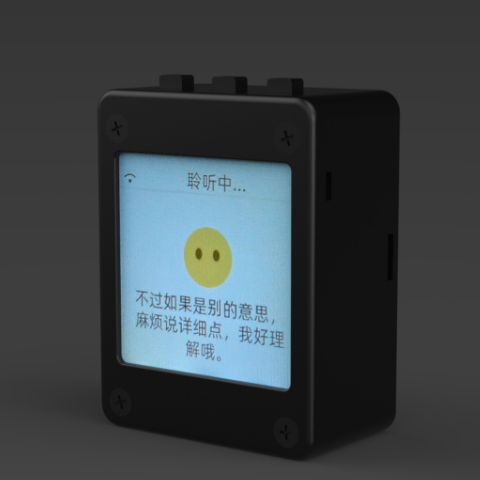
xiaozhi-esp32
78·C++
基于 MCP 协议、跑在 ESP32 上的聊天机器人固件,让单片机也能接入大模型对话与工具调用。
聊天机器人+4IoT / 固件
33006+1647.8kv2.5.22026-11-07 04:14 UTC
DeepSpeech
mozilla·C++
DeepSpeech is an open source embedded (offline, on-device) speech-to-text engine which can run in real time on devices ranging from a Raspberry Pi 4 to high power GPU servers.
IoT / 固件
267724.1k2025-06-19 12:52 UTC
Tasmota
arendst·C
给 ESP8266/ESP32 设备刷的替代固件,通过网页配置、OTA 升级和定时/规则自动化,用 MQTT、HTTP、串口或 KNX 实现完全本地控制。
ESP32+4IoT / 固件
24976+65.2kv16.0.02026-11-10 16:33 UTC