Transformers 路径需锁定 transformers==5.17.0 与 torch==2.10.0 等版本;llama.cpp 路径的 fsmn-vad.gguf 不在 Nano GGUF 仓库内需另行下载;FunASR 路径需 trust_remote_code=True 并指定 remote_code;Nano 与 MLT 是两个独立 checkpoint,多语种需换用 MLT。
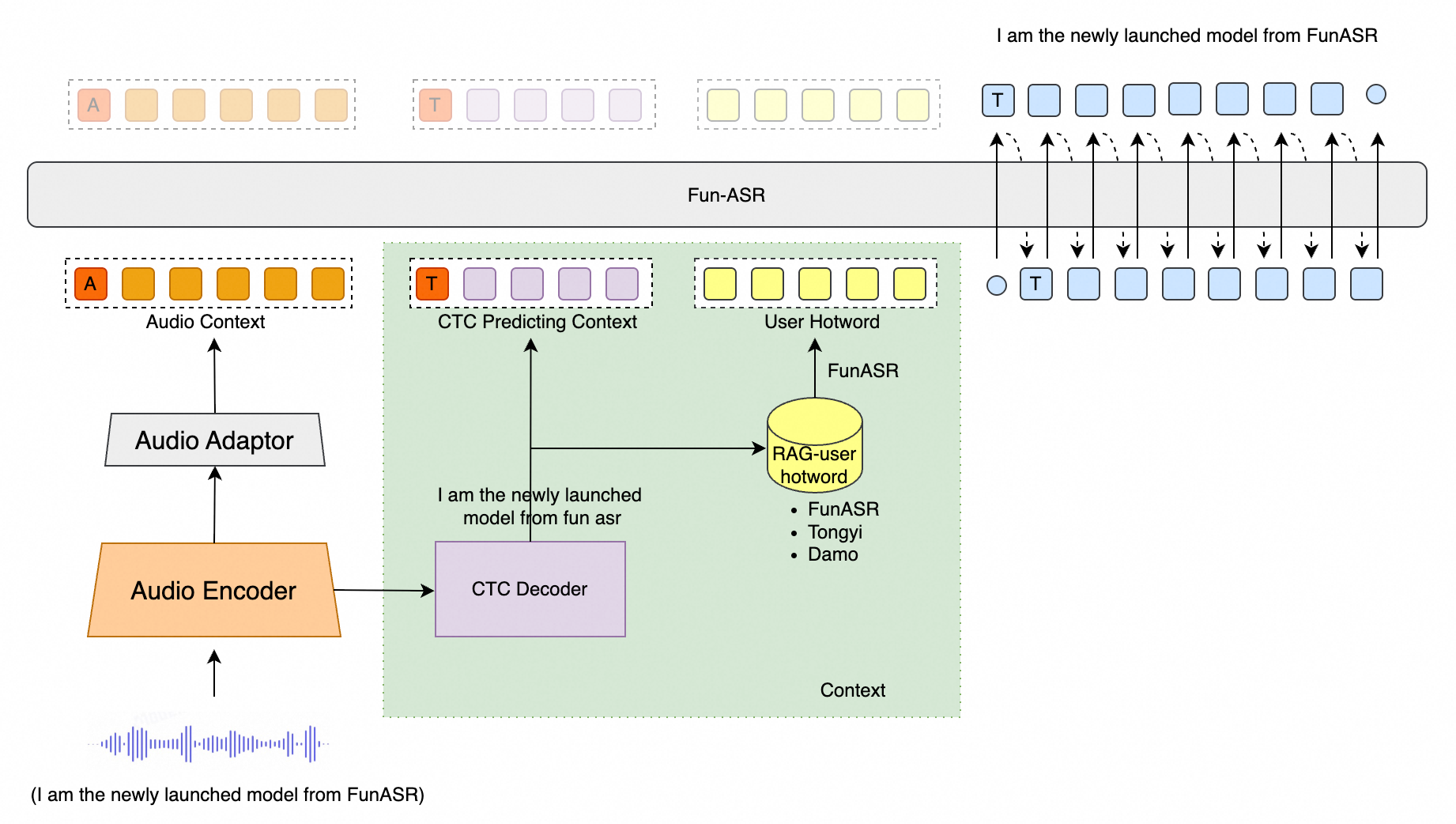
Fun-ASR
QwenAudioApache-2.0活跃维护Fun-ASR 是支持 31 种语言和中文方言的语音识别模型,提供 Nano 轻量版,并支持 Transformers、FunASR、vLLM、llama.cpp 多种部署方式,可端侧运行。
Fun-ASR speech recognition models, with native Hugging Face Transformers support for Fun-ASR-Nano and separate FunASR, vLLM and llama.cpp deployment paths.
runtime-llamacpp-v0.1.10发布于 2026-09-05 16:34 UTC1,602star +3 / 7 天161fork同步于 2026-11-10 11:47 UTC
python -m pip install 'transformers==5.17.0' 'torch==2.10.0' 'torchaudio==2.10.0' 'librosa==0.11.0' 'soundfile==0.13.1' 硬件要求按 README 说明
README 未说明具体显存要求;示例中 Transformers 路径可在 CPU 上以 float32 运行,llama.cpp/GGUF 路径明确无需 GPU,FunASR 示例使用 cuda:0,性能数据基于单张 H100。
纯 CPU 可运行多卡 / 张量并行
通义实验室的端到端语音识别模型,支持中英日及多语种,提供 Transformers、FunASR、vLLM、llama.cpp 多条部署路径
Fun-ASR 是支持 31 种语言和中文方言的语音识别模型,提供 Nano 轻量版,并支持 Transformers、FunASR、vLLM、llama.cpp 多种部署方式,可端侧运行。
核心能力
- Fun-ASR-Nano 覆盖中英日、7 种方言和 26 种口音
- Fun-ASR-MLT-Nano 支持 31 种语言的多语种识别
- 原生 Hugging Face Transformers 直接推理,无需安装工具包
- llama.cpp/GGUF 单二进制在 CPU 上跑,内置 FSMN-VAD
- 支持热词、itn、说话人分离与批量转录
容易踩的坑
内容由模型根据 README 生成,可能不完整或不准确,以官方文档为准。看原文 README
- runtime-llamacpp-v0.1.10FunASR llama.cpp runtime v0.1.10最新正式版2026-09-05 · 2026-09-05 16:34 UTC
macOS arm64 package rebuilt from b716d80 (#170): llama-funasr-cli gains --stream realtime mode (stdin s16le PCM -> LOCKED/PARTIAL/DONE, mirroring serve_realtime_ws.py RealtimeASRSession semantics), plus --lang support. Offline behaviour unchanged (regression goldens PASS: vad, nano, nano-stream, nano-stream-final, nano-stream-align vs DynamicStreamingVAD).
llama-funasr-{vad,encoder,embd} rebuilt with the streaming-capable funasr_vad.h (offline output unchanged); llama-funasr-{sensevoice,paraformer} carried over from v0.1.9 unchanged.
Windows / Linux assets: unchanged from v0.1.9 for now (carry over the v0.1.9 packages in your pin table); rebuild on those platforms to get --stream there.
- runtime-llamacpp-v0.2.1FunASR llama.cpp runtime v0.2.12026-08-27 · 2026-08-27 13:45 UTC
查看更新说明
Prebuilt self-contained binaries for the FunASR llama.cpp / GGUF runtime, including Fun-ASR-Nano, SenseVoice, and Paraformer with built-in FSMN-VAD.
v0.2.1
- Fixes Vulkan selection when a requested device is reported as an integrated GPU (
GGML_BACKEND_DEVICE_TYPE_IGPU). - Prefers a matching discrete GPU and falls back to a matching integrated GPU.
- Provides nine desktop archives for Linux, macOS, and Windows, including Vulkan and Windows CUDA variants.
- The Windows Vulkan package is ready for Radeon 780M retesting. This selector fix does not claim to resolve the separate Radeon RX 9070 XT
0xC0000005initialization crash. - Android/Mali is not an official prebuilt or validated target in this release.
Quick start
pip install -U huggingface_hub
bash download-funasr-model.sh nano
Then run
llama-funasr-cli. Use the default x64 asset for broad CPU compatibility, the x64-avx2 asset on CPUs with AVX2/FMA/F16C/BMI2, or a Vulkan/CUDA asset only with a compatible driver. The Windows CUDA asset targets architecture 86; build from source for other GPU architectures.Provenance
These nine binaries are byte-for-byte identical to the digest-verified assets from the canonical
modelscope/FunASRruntime v0.2.1. They were built from exact FunASR commitc69e69a0b78fb9becc8b2be91db8ae57d2a41f3cby Actions run 32991388379. GitHub's generated source archives on this mirror tag are snapshots of the Fun-ASR repository; use the canonical FunASR commit above for the native runtime source.Canonical documentation: https://www.funasr.com/en/deploy/llama-cpp.html
SHA-256
9657e519986a5db72082aab508439559987fd4e563733d11da4662f898c75c45 funasr-llamacpp-linux-arm64.tar.gz 32e459673297fc01fcda6901ca7d63cc9e64896a43a3c9edcb7a8e1ef70fcd04 funasr-llamacpp-linux-x64-avx2.tar.gz d45d3acb77e05c4bae94d818ed4a5c66852be87b22c52723bd576377c055c6e6 funasr-llamacpp-linux-x64-vulkan.tar.gz 1bc83dd36d11b1a2b9a45faaf77a5d1014000ac641c93dfec73d24d71ec51caf funasr-llamacpp-linux-x64.tar.gz bc63c4d4b96f2465f1d258600668a971f4f600d661f1859b03797cefaa417167 funasr-llamacpp-macos-arm64.tar.gz 67e428a91614f8a0c1d53dc2d79cce8efc7916c030ae2ddce2cbcf667ec1c502 funasr-llamacpp-windows-x64-avx2.zip af32e0ef352880fcfd5589e0152c44038bc81f462f42c7a6ca91a0d9879bac58 funasr-llamacpp-windows-x64-cuda.zip 5fd179c6aefc18477eb79fa6235c70d131a96eba621318bb84e901ae85035578 funasr-llamacpp-windows-x64-vulkan.zip b8f2b8f241b57921d82d64068d9b5695629779f3db5f3205a730cb3810232bb4 funasr-llamacpp-windows-x64.zip - Fixes Vulkan selection when a requested device is reported as an integrated GPU (
- runtime-llamacpp-v0.1.9FunASR llama.cpp runtime v0.1.92026-07-24 · 2026-07-24 13:39 UTC
查看更新说明
Prebuilt self-contained binaries for the FunASR llama.cpp / GGUF runtime, with Fun-ASR-Nano, SenseVoice, and Paraformer support plus built-in FSMN-VAD.
This release updates the Fun-ASR Latest Release from runtime v0.1.4 to v0.1.9 and adds the previously missing Vulkan and Windows CUDA packages. Its source snapshot also contains the corrected bilingual vLLM guide: users now clone the canonical
modelscope/FunASRservice scripts before runningserve_vllm.pyorserve_realtime_ws.py.Choose an asset
- Default
linux-x64/windows-x64: maximum CPU compatibility. linux-x64-avx2/windows-x64-avx2: higher throughput on CPUs with AVX2, FMA, F16C, and BMI2.linux-x64-vulkan/windows-x64-vulkan: Vulkan backend; requires a working Vulkan driver and ICD.windows-x64-cuda: CUDA backend targeting architecture 86; build from source for other GPU architectures.- Native
linux-arm64andmacos-arm64packages are included.
Download a default quantized model with:
pip install -U huggingface_hub
bash download-funasr-model.sh nano
Then run
llama-funasr-cli; no Python ASR runtime or local compilation is required.All nine files are byte-for-byte identical to the digest-verified assets from
modelscope/FunASRruntime v0.1.9.Documentation: https://github.com/QwenAudio/Fun-ASR/blob/runtime-llamacpp-v0.1.9/runtime/llama.cpp/README.md
- Default
- runtime-llamacpp-v0.1.4FunASR llama.cpp runtime v0.1.42026-06-29 · 2026-06-29 13:24 UTC
查看更新说明
Prebuilt self-contained binaries for the FunASR llama.cpp / GGUF runtime.
This release keeps the default x64 assets conservative for maximum CPU compatibility and adds explicit
x64-avx2assets for CPUs with AVX2/FMA/F16C/BMI2. If v0.1.3 fixed SIGILL but was too slow on your machine, tryfunasr-llamacpp-windows-x64-avx2.zip.Use the default x64 package if the AVX2 package fails with
Illegal instruction/SIGILL. - runtime-llamacpp-v0.1.3FunASR llama.cpp runtime v0.1.32026-06-28 · 2026-06-28 17:26 UTC
查看更新说明
Portable rebuild of the FunASR llama.cpp / GGUF runtime binaries.
This release rebuilds the v0.1.2 runtime with conservative CPU flags for the generic x64 assets. In particular, it disables ggml native CPU tuning and high-ISA AVX/AVX2/AVX512/VNNI/FMA/F16C/BMI2 flags so the prebuilt binaries do not depend on the GitHub Actions runner CPU instruction set.
Use this version if v0.1.2 crashes with
Illegal instruction,SIGILL, or Windows error0xC000001D.
用户点评
登录用户的真实使用记录,可按版本和硬件筛选共 0 条
还没有人点评。第一个说出真实体验的人最有价值。
Fun-ASR
Fun-ASR is a family of end-to-end speech recognition models from Tongyi Lab. Checkpoint capabilities are distinct: Fun-ASR-Nano-2512 is trained on tens of millions of hours of speech and supports Chinese, English, Japanese, and Chinese dialects and accents; Fun-ASR-MLT-Nano-2512 is an 800M multilingual checkpoint trained on hundreds of thousands of hours and supports 31 languages. Both checkpoints integrate with FunASR for inference and serving.
Model repositories: Fun-ASR-Nano (ModelScope, HF / Transformers · HF / FunASR) · Fun-ASR-MLT-Nano (ModelScope, Hugging Face)
Online Experience: ModelScope Community Space, huggingface space

Runnable examples cover quickstart inference, direct inference, speaker diarization, vLLM batch inference, and the streaming SDK.
| Model Name | Task Details | Training Data | Parameters |
|---|---|---|---|
| Fun-ASR-Nano (⭐ HF / Transformers · HF / FunASR) | Speech recognition supports Chinese, English, and Japanese. Chinese includes support for 7 dialects (Wu, Cantonese, Min, Hakka, Gan, Xiang, Jin) and 26 regional accents (Henan, Shanxi, Hubei, Sichuan, Chongqing, Yunnan, Guizhou, Guangdong, Guangxi and more than 20 other regions). English and Japanese cover multiple regional accents. Additional features include lyric recognition and rap speech recognition. | Tens of millions of hours | 800M |
| Fun-ASR-MLT-Nano (⭐ 🤗) | Speech recognition supports Chinese, English, Cantonese, Japanese, Korean, Vietnamese, Indonesian, Thai, Malay, Filipino, Arabic, Hindi, Bulgarian, Croatian, Czech, Danish, Dutch, Estonian, Finnish, Greek, Hungarian, Irish, Latvian, Lithuanian, Maltese, Polish, Portuguese, Romanian, Slovak, Slovenian, and Swedish: 31 languages in total. | Hundreds of thousands of hours | 800M |
What's New 🔥
- FunASR 1.4.15 is the current Python release for source installs, MOSS discovery, and realtime or industrial deployment. Install with
python -m pip install -U "funasr==1.4.15". Release -> - MOSS-Transcribe-Diarize is a third-party OpenMOSS model for offline long-form transcription, timestamps, and anonymous speaker labels, with FunASR service, Docker, Kubernetes, vLLM, SGLang, LocalAI, and FunClip deployment paths. Deploy MOSS ->
- Production deployment covers realtime WebSocket serving, native vLLM batch/streaming paths, and verified llama.cpp / GGUF packages for Linux, macOS, and Windows. Runtime v0.2.6 -> · vLLM guide ->
Native Transformers quickstart
Transcribe with the released Transformers 5.17.0 package. No toolkit installation or remote Python code is needed. Base Nano supports Chinese, English and Japanese; the 31-language MLT checkpoint is separate.
python -m pip install 'transformers==5.17.0' 'torch==2.10.0' 'torchaudio==2.10.0' 'librosa==0.11.0' 'soundfile==0.13.1'
Full Python recipe · Local audio, batches and keywords · Notebook · Space
import torch
from transformers import AutoModelForSpeechSeq2Seq, AutoProcessor

torch.set_num_threads(4)
model_id = "FunAudioLLM/Fun-ASR-Nano-2512-hf"
revision = "d93b302ee7fd505e1b3576120fc142fc6f7820e1"
audio = "https://huggingface.co/FunAudioLLM/Fun-ASR-Nano-2512/resolve/272c57b82523ada6fd87095e955f8e29100979ab/example/en.mp3"

processor = AutoProcessor.from_pretrained(
    model_id, revision=revision, trust_remote_code=False, token=False
)
model = AutoModelForSpeechSeq2Seq.from_pretrained(
    model_id, revision=revision, trust_remote_code=False, token=False,
    dtype=torch.float32,
).to("cpu").eval()
inputs = processor.apply_transcription_request(
    audio=audio, language="en",
    processor_kwargs={
        "return_tensors": "pt",
        "audio_kwargs": {"sampling_rate": 16000},
        "text_kwargs": {"padding": True},
    },
)
with torch.inference_mode():
    generated = model.generate(**inputs, max_new_tokens=128, do_sample=False)
new_tokens = generated[:, inputs.input_ids.shape[1]:]
print(processor.batch_decode(new_tokens, skip_special_tokens=True)[0])
Core Features 🎯
Fun-ASR focuses on high-precision speech recognition, checkpoint-specific multilingual support, and industry customization capabilities.
- Far-field High-noise Recognition: Deeply optimized for far-distance sound pickup and high-noise scenarios (such as conference rooms, in-vehicle environments, industrial sites, etc.), improving recognition accuracy to 93%.
- Chinese Dialects and Regional Accents:
- Supports 7 major dialects: Wu, Cantonese, Min, Hakka, Gan, Xiang, Jin
- Covers 26 regional accents: including Henan, Shaanxi, Hubei, Sichuan, Chongqing, Yunnan, Guizhou, Guangdong, Guangxi and more than 20 other regions
- Checkpoint-specific language coverage: Fun-ASR-Nano supports Chinese, English, Japanese, and Chinese dialects and accents. Fun-ASR-MLT-Nano supports 31 languages, with emphasis on East and Southeast Asian languages.
- Music Background Lyric Recognition: Enhanced speech recognition performance under music background interference, supporting accurate recognition of lyric content in songs.
Environment Setup 🐍
git clone https://github.com/QwenAudio/Fun-ASR.git
cd Fun-ASR
pip install -r requirements.txt
Capability boundaries
- Checkpoint-native character timestamps (hub-specific checkpoint state)
The current ModelScope
FunAudioLLM/Fun-ASR-Nano-2512checkpoint includes all 86 trainedctc_decoder.*/ctc.*tensors (model.ptSHA-25681fec8616083c69377f3ceef36aba3655660ee0ca69a5d4a1e9810cd340ca499) and produces native CTC timestamps. The Hugging Face checkpoint at revision272c57b82523ada6fd87095e955f8e29100979abis still the older text-only artifact (model.ptSHA-25655ae0d2fee369f0f11cce0795f6927934ad17cf11b278a7e56a51272074160bb) with no CTC tensors. When this repository's currentmodel.pyis used withfunasr>=1.3.26, incomplete checkpoints fail closed: transcription remains available, buttimestampsare omitted instead of returning random 60 ms alignments. Usehub="ms"for checkpoint-native timestamps until the Hugging Face artifact and remote code are synchronized. See issue #70 and FunASR #3496. - Checkpoint-native speaker diarization
Fun-ASR-Nano and Fun-ASR-MLT-Nano do not emit speaker labels by themselves. Compose them in FunASR with the separate
fsmn-vadandcam++models, as shown below. For one-pass anonymous diarization with transcription and timestamps, use the third-party OpenMOSS MOSS-Transcribe-Diarize deployment guide. It is a separate model rather than a Fun-ASR-Nano checkpoint feature. - Model training
Usage 🛠️
Inference
Run on CPU / edge — llama.cpp / GGUF (no GPU, no Python)
Run Fun-ASR-Nano as a single self-contained binary — like whisper.cpp but for FunASR, with strong Chinese accuracy. Built-in FSMN-VAD, no Python at runtime.
bash runtime/llama.cpp/download-funasr-model.sh nano ./gguf
llama-funasr-cli --enc ./gguf/funasr-encoder-f16.gguf -m ./gguf/qwen3-0.6b-q8_0.gguf -a audio.wav --vad ./gguf/fsmn-vad.gguf
fsmn-vad.gguf is hosted in the shared FunAudioLLM/fsmn-vad-GGUF repo, not inside the Nano GGUF repo. The nano downloader above fetches it automatically; to fetch only VAD from the Hugging Face UI/CLI, use:
hf download FunAudioLLM/fsmn-vad-GGUF --include "*.gguf" --local-dir ./gguf
Prebuilt binaries: Releases · Download & quickstart: funasr.com/llama-cpp · GGUF: Nano encoder/LLM · FSMN-VAD · Docs & benchmarks: runtime/llama.cpp/
Using funasr for inference
from funasr import AutoModel


def main():
    model_dir = "FunAudioLLM/Fun-ASR-Nano-2512"
    model = AutoModel(
        model=model_dir,
        trust_remote_code=True,
        remote_code="./model.py",
        device="cuda:0",
        # hub:download models from ms (for ModelScope) or hf (for Hugging Face).
        hub="hf"
    )

    wav_path = f"{model.model_path}/example/zh.mp3"
    res = model.generate(
        input=[wav_path],
        cache={},
        batch_size=1,
        hotwords=["开放时间"],
        # 中文、英文、日文 for Fun-ASR-Nano-2512
        # 中文、英文、粤语、日文、韩文、越南语、印尼语、泰语、马来语、菲律宾语、阿拉伯语、
        # 印地语、保加利亚语、克罗地亚语、捷克语、丹麦语、荷兰语、爱沙尼亚语、芬兰语、希腊语、
        # 匈牙利语、爱尔兰语、拉脱维亚语、立陶宛语、马耳他语、波兰语、葡萄牙语、罗马尼亚语、
        # 斯洛伐克语、斯洛文尼亚语、瑞典语 for Fun-ASR-MLT-Nano-2512
        language="中文",
        itn=True, # or False
    )
    text = res[0]["text"]
    print(text)

    model = AutoModel(
        model=model_dir,
        trust_remote_code=True,
        vad_model="fsmn-vad",
        vad_kwargs={"max_single_segment_time": 30000},
        remote_code="./model.py",
        device="cuda:0",
    )
    res = model.generate(input=[wav_path], cache={}, batch_size=1)
    text = res[0]["text"]
    print(text)


if __name__ == "__main__":
    main()
Faster batch transcription (no vLLM)
When transcribing long audio or many files on the funasr (PyTorch) path, pass
batch_size_s to batch the VAD segments through the LLM decoder together. This
greatly improves GPU utilization:
res = model.generate(
    input=[wav_path],
    cache={},
    language="中文",
    itn=True,
    batch_size_s=120,   # batch VAD segments up to ~120s of audio per LLM call
)
On Fun-ASR-Nano-2512 (184 Chinese files / 11,539 s, single H100) this is about 1.6x faster than the default per-segment decoding (RTFx 19.8 -> 31.8) with no loss in accuracy. For the highest throughput, use the vLLM path below.
Speaker Diarization
This example is a composed FunASR pipeline: FSMN-VAD segments the audio,
Fun-ASR-Nano transcribes it, CAM++ assigns speaker labels, and CT-Punc restores
punctuation. The start and end values are VAD segment boundaries, not
reliable checkpoint-native character timestamps.
from funasr import AutoModel


def main():
    model_dir = "FunAudioLLM/Fun-ASR-Nano-2512"
    model = AutoModel(
        model=model_dir,
        trust_remote_code=True,
        remote_code="./model.py",
        vad_model="fsmn-vad",
        vad_kwargs={"max_single_segment_time": 30000},
        spk_model="cam++",
        punc_model="ct-punc",
        device="cuda:0",
        hub="hf",
    )

    wav_path = f"{model.model_path}/example/zh.mp3"
    res = model.generate(input=[wav_path], cache={}, batch_size=1, language="中文")

    # Per-sentence results with speaker labels
    for sent in res[0]["sentence_info"]:
        print(f"Speaker {sent['spk']}: [{sent['start']}ms - {sent['end']}ms] {sent['sentence']}")


if __name__ == "__main__":
    main()
Direct Inference
from model import FunASRNano


def main():
    model_dir = "FunAudioLLM/Fun-ASR-Nano-2512"
    m, kwargs = FunASRNano.from_pretrained(model=model_dir, device="cuda:0")
    m.eval()

    wav_path = f"{kwargs['model_path']}/example/zh.mp3"
    res = m.inference(data_in=[wav_path], **kwargs)
    text = res[0][0]["text"]
    print(text)


if __name__ == "__main__":
    main()
model_dir: Model name or local disk model path.trust_remote_code: Whether to trust remote code for loading custom model implementations.remote_code: Specify the location of specific model code (e.g.,model.pyin the current directory), supporting both absolute and relative paths.device: Specify the device to use, such as "cuda:0" or "cpu".
vLLM High-Throughput Inference 🚀
Fun-ASR natively integrates the vLLM engine for high-throughput batch inference and production-grade real-time streaming service.
Full guide: docs/vllm_guide.md | API docs: modelscope.github.io/FunASR/vllm.html
Three Modes
| Mode | Use Case | Entry |
|---|---|---|
| Offline Batch | Large-scale transcription | AutoModelVLLM |
| Streaming SDK | Real-time subtitles | FunASRNanoStreamingVLLM |
| WebSocket Service | Production deployment | serve_realtime_ws.py |
Offline Batch Inference (3-5x faster)
from funasr.auto.auto_model_vllm import AutoModelVLLM

model = AutoModelVLLM(
    model="FunAudioLLM/Fun-ASR-Nano-2512",
    tensor_parallel_size=2,      # Multi-GPU
    gpu_memory_utilization=0.8,
)

results = model.generate(
    ["audio1.wav", "audio2.wav", "audio3.wav"],
    language="中文",
    hotwords=["张三", "北京"],
)
for r in results:
    print(f"[{r['key']}] {r['text']}")
Long audio:
AutoModelVLLMdecodes each input in a single pass, so a long recording (e.g. a multi-minute meeting) can be truncated — pre-segment it with VAD and pass the segments, or use the high-levelAutoModel(model=..., vad_model="fsmn-vad"), which segments long audio automatically.
Real-time WebSocket Service
# Start server (with dynamic VAD + speaker diarization)
python serve_realtime_ws.py --port 10095 --language 中文 --tensor-parallel-size 2

# Browser client
open client_mic.html

# Python client
python client_python.py --server ws://localhost:10095 --mic
WebSocket Protocol:
Client: "START" → Server: {"event":"started"}
Client: [audio bytes] → Server: {"sentences":[...], "partial":"..."}
Client: "STOP" → Server: {"sentences":[...], "is_final":true}
Streaming SDK
from funasr.models.fun_asr_nano.inference_vllm_streaming import FunASRNanoStreamingVLLM

engine = FunASRNanoStreamingVLLM.from_pretrained(
    model="FunAudioLLM/Fun-ASR-Nano-2512", chunk_ms=720
)

for result in engine.streaming_generate("audio.wav", language="中文"):
    print(f"[{result['audio_duration_ms']:.0f}ms] {result['fixed_text']}")
Performance
| Method | Time (184 files, 11,541s) | RTFx | CER |
|---|---|---|---|
| PyTorch native | 550s | 21x | 8.06% |
| vLLM (ours) | 34s | 340x | 8.20% |
16x faster than PyTorch with nearly identical accuracy (CER diff < 0.2%)
Install
pip install "funasr>=1.3.26" "vllm>=0.12.0"
Finetune
Please refer to docs/finetune.md
Performance 📝
We evaluated Fun-ASR against other state-of-the-art models on open-source benchmarks, Chinese dialect datasets, and industry-specific test sets. The results demonstrate that Fun-ASR achieves superior performance across various scenarios.
1. Open-Source Dataset Performance (WER %)
| Test set | GLM-ASR-nano | GLM-ASR-nano* | Whisper-large-v3 | Seed-ASR | Seed-ASR* | Kimi-Audio | Step-Audio2 | FireRed-ASR | Fun-ASR-nano | Fun-ASR |
|---|---|---|---|---|---|---|---|---|---|---|
| Model Size | 1.5B | 1.5B | 1.6B | - | - | - | - | 1.1B | 0.8B | 7.7B |
| OpenSource | ✅ | ✅ | ✅ | ❌ | ❌ | ✅ | ✅ | ✅ | ✅ | ❌ |
| AIShell1 | 1.81 | 2.17 | 4.72 | 0.68 | 1.63 | 0.71 | 0.63 | 0.54 | 1.80 | 1.22 |
| AIShell2 | - | 3.47 | 4.68 | 2.27 | 2.76 | 2.86 | 2.10 | 2.58 | 2.75 | 2.39 |
| Fleurs-zh | - | 3.65 | 5.18 | 3.43 | 3.23 | 3.11 | 2.68 | 4.81 | 2.56 | 2.53 |
| Fleurs-en | 5.78 | 6.95 | 6.23 | 9.39 | 9.39 | 6.99 | 3.03 | 10.79 | 5.96 | 4.74 |
| Librispeech-clean | 2.00 | 2.17 | 1.86 | 1.58 | 2.8 | 1.32 | 1.17 | 1.84 | 1.76 | 1.51 |
| Librispeech-other | 4.19 | 4.43 | 3.43 | 2.84 | 5.69 | 2.63 | 2.42 | 4.52 | 4.33 | 3.03 |
| WenetSpeech Meeting | 6.73 | 8.21 | 18.39 | 5.69 | 7.07 | 6.24 | 4.75 | 4.95 | 6.60 | 6.17 |
| WenetSpeech Net | - | 6.33 | 11.89 | 4.66 | 4.84 | 6.45 | 4.67 | 4.94 | 6.01 | 5.46 |
Note: Seed-ASR* results are evaluated using the official API on volcengine; GLM-ASR-nano* results are evaluated using the open-source checkpoint.
2. Industry Dataset Performance (WER %)
| Test set | GLM-ASR-Nano | Whisper-large-v3 | Seed-ASR | FireRed-ASR | Kimi-Audio | Paraformer v2 | Fun-ASR-nano | Fun-ASR |
|---|---|---|---|---|---|---|---|---|
| Model Size | 1.5B | 1.6B | - | 1.1B | 8B | 0.2B | 0.8B | 7.7B |
| OpenSource | ✅ | ✅ | ❌ | ✅ | ✅ | ✅ | ✅ | ❌ |
| Nearfield | 16.95 | 16.58 | 7.20 | 10.10 | 9.02 | 8.11 | 7.79 | 6.31 |
| Farfield | 9.44 | 22.21 | 4.59 | 7.49 | 10.95 | 9.55 | 5.79 | 4.34 |
| Complex Background | 23.79 | 32.57 | 12.90 | 15.56 | 15.56 | 15.19 | 14.59 | 11.45 |
| English General | 16.47 | 18.56 | 15.65 | 21.62 | 18.12 | 19.48 | 15.28 | 13.73 |
| Opensource | 4.67 | 7.05 | 3.83 | 5.31 | 3.79 | 6.23 | 4.22 | 3.38 |
| Dialect | 54.21 | 66.14 | 29.45 | 52.82 | 71.94 | 41.16 | 28.18 | 15.21 |
| Accent | 19.78 | 36.03 | 10.23 | 14.05 | 27.20 | 17.80 | 12.90 | 10.31 |
| Lyrics | 46.56 | 54.82 | 30.26 | 42.87 | 65.18 | 50.14 | 30.85 | 21.00 |
| Hiphop | 43.32 | 46.56 | 29.46 | 33.88 | 57.25 | 43.79 | 30.87 | 28.58 |
| Average | 26.13 | 33.39 | 15.95 | 22.63 | 31.00 | 23.49 | 16.72 | 12.70 |
Remarkable Third-Party Work
- Fun-ASR-vllm (@yuekaizhang) — a community vLLM implementation of Fun-ASR (~50% speedup over PyTorch), with batch inference and an NVIDIA Triton Inference Server integration for high-concurrency production deployment. See #34.
Native vLLM support is also built in — see vLLM High-Throughput Inference 🚀 above for the
AutoModelVLLMbatch engine, the streaming SDK, and the WebSocket service.
Ecosystem
Fun-ASR-Nano is part of the FunAudioLLM family:
| Project | Description | Stars |
|---|---|---|
| FunASR | Industrial speech recognition toolkit — VAD, ASR, punctuation, diarization |  |
| SenseVoice | Multilingual speech understanding — ASR + emotion + audio events |  |
| CosyVoice | Natural speech generation — multi-language, zero-shot cloning |  |
| FunClip | AI-powered video clipping with speech recognition |  |
License
- Source code in this repository is licensed under the Apache License 2.0.
- Model weights are distributed separately and follow the license metadata on their model cards. The official Fun-ASR-Nano and Fun-ASR-MLT-Nano cards currently list Apache-2.0; review the card for the specific artifact you download.
Citations
@misc{an2025funasrtechnicalreport,
      title={Fun-ASR Technical Report},
      author={Keyu An and Yanni Chen and Zhigao Chen and Chong Deng and Zhihao Du and Changfeng Gao and Zhifu Gao and Bo Gong and Xiangang Li and Yabin Li and Ying Liu and Xiang Lv and Yunjie Ji and Yiheng Jiang and Bin Ma and Haoneng Luo and Chongjia Ni and Zexu Pan and Yiping Peng and Zhendong Peng and Peiyao Wang and Hao Wang and Haoxu Wang and Wen Wang and Wupeng Wang and Yuzhong Wu and Biao Tian and Zhentao Tan and Nan Yang and Bin Yuan and Jieping Ye and Jixing Yu and Qinglin Zhang and Kun Zou and Han Zhao and Shengkui Zhao and Jingren Zhou and Yanqiao Zhu},
      year={2025},
      eprint={2509.12508},
      archivePrefix={arXiv},
      primaryClass={cs.CL},
      url={https://arxiv.org/abs/2509.12508},
}

VoiceStudio
debpalash·Python
本地运行的 ElevenLabs 开源替代品,支持声音克隆、语音设计、视频配音、听写、转写和有声书制作,覆盖 646 种语言。
语音克隆+4语音推理
106722+325512kv0.5.72026-11-10 10:53 UTC

voicebox
jamiepine·Python
开源 AI 语音工作室,支持声音克隆、语音听写和语音生成,基于 Qwen3-TTS 与 Whisper,可在 CUDA 或 MLX 上本地运行。
语音克隆+4语音推理
60349+5667.6kv0.5.02026-10-07 01:17 UTC
whisper.cpp
ggml-org·C++
OpenAI Whisper 语音识别模型的 C/C++ 移植版,无需 Python 和 GPU 依赖,在普通 CPU 上就能跑语音转文字。
语音识别+4语音推理
55060+696.3kv1.9.52026-11-10 08:39 UTC
faster-whisper
SYSTRAN·Python
基于 CTranslate2 重实现的 Whisper 语音转文字推理引擎,通过量化与高效推理大幅提速并降低显存占用,适合本地部署转录。
语音识别+4语音推理
26639+612.2kv1.2.12026-11-10 10:13 UTC