输入必须是 2-D float32 数组,其他 dtype 会直接报错而非静默转换;返回的是内积分数,要余弦相似度需自行归一化向量;维度必须是 8 的倍数且不超过 16384,位宽仅支持 2 和 4;它是全量扫描索引,没有 HNSW/IVF 图索引,也没有网络服务。
pip install turbovec 硬件要求按 README 说明
README 未说明显存或 GPU 要求;为纯 CPU 库,x86_64 构建基线为 x86-64-v2(SSE4.2),AVX2/AVX-512 内核在运行时按 CPU 特性选择,同时支持 ARM。
基于 TurboQuant 的进程内向量索引,用 2/4 bit 压缩把千万级 embedding 压进小内存并快速检索
基于 TurboQuant 量化算法、用 Rust 实现并带 Python 绑定的向量索引,面向 RAG 和嵌入检索场景,提供高压缩比、低内存的近似最近邻搜索。
核心能力
- 按 2 或 4 bit 每维量化存储向量,直接扫描压缩码
- 分阶段搜索:先扫一个 bit plane,再对候选精确重打分
- 无需训练与重建,codebook 由数学推导得出,增删即时生效
- sync(path) 只写增量变更,单次 fsync 且任意字节崩溃安全
- 支持 allowlist 或位掩码过滤,内核跳过被排除的 id
容易踩的坑
内容由模型根据 README 生成,可能不完整或不准确,以官方文档为准。看原文 README
暂无 release 数据(可能没有发版,或尚未同步)。
用户点评
登录用户的真实使用记录,可按版本和硬件筛选共 0 条
还没有人点评。第一个说出真实体验的人最有价值。
Ten million 768-dimensional embeddings take 31 GB of RAM as float32. turbovec holds them in 4 GB and searches them 4.4× faster than FAISS, at matching recall.
turbovec is an in-process vector index for Python and Rust. It stores each vector at 2 or 4 bits per dimension using Google Research's TurboQuant and searches that compressed form directly with agent-optimised SIMD kernels.
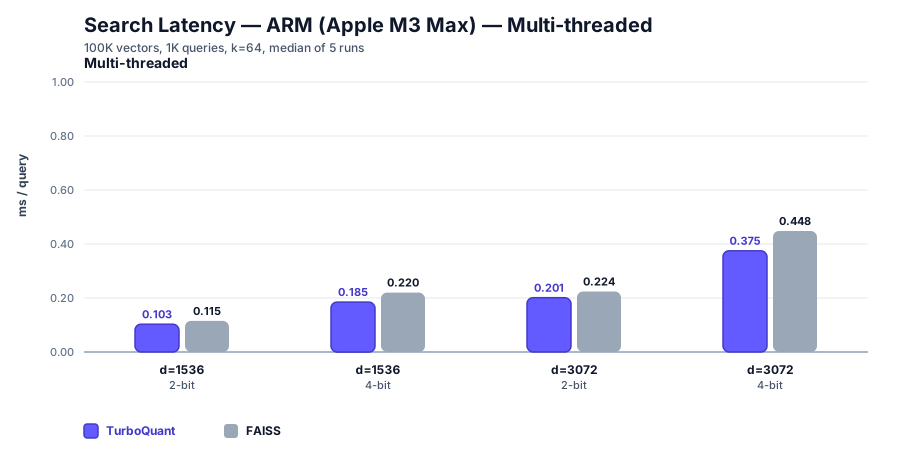
- Fast. 4.4× FAISS FastScan at 4-bit and 2.2× at 2-bit, on ARM and x86. A staged search scans one bit plane and rescores the shortlist exactly.
- Low memory. 7.8× smaller than float32 at 4-bit, 15.5× at 2-bit, at the same recall as FAISS.
- Online. No training step, no rebuilds: the codebook comes from the maths, not your data. Add a vector and it is searchable; remove one in microseconds.
- Incremental.
sync(path)writes only what changed since the last call — one fsync, crash-safe at any byte, milliseconds however large the index. - Local. A library, not a service: nothing leaves your process. Pair it with an open-source embedding model for a fully offline stack.
- Filtered. Pass an allowlist of ids or a bitmask; the kernel skips what the filter excludes and returns up to
kresults from the allowed set.
Python
pip install turbovec
import numpy as np
from turbovec import TurboQuantIndex

vectors = np.load("embeddings.npy").astype(np.float32)   # shape (n, 1536)

index = TurboQuantIndex(dim=1536, bit_width=4)
index.add(vectors)

scores, indices = index.search(vectors[:1], k=5)
print(indices)         # [[    0 86544  3385 84492 24967]]   int64 slot positions
print(scores.shape)    # (1, 5)                             float32 inner products

index.sync("index.tv")                  # first sync writes the file
index.add(more_vectors)
index.sync("index.tv")                  # later syncs write just the change, durably

index = TurboQuantIndex.load("index.tv")   # loads either a sync'd or a write() file
Inputs are 2-D float32 arrays of shape (n, dim); other dtypes raise rather than silently convert. Scores are inner products, so normalise your vectors if you want cosine similarity.
Need ids that survive deletes? IdMapIndex keys everything by your own uint64 ids:
from turbovec import IdMapIndex

index = IdMapIndex(dim=1536, bit_width=4)
index.add_with_ids(vectors, ids)               # ids: uint64 array, one per row

scores, ids = index.search(query, k=10)        # your ids, not slot positions
index.remove(1002)                             # O(1)

# Filter: only ids another system approved — a SQL predicate, an ACL, a time window.
allowed = np.array([1001, 1003, 1042], dtype=np.uint64)
scores, ids = index.search(query, k=10, allowlist=allowed)   # shape (1, min(k, 3))
Framework integrations are drop-in replacements for each framework's in-memory store — same public surface, same persistence, same retriever wiring:
LangChain (pip install turbovec[langchain]) ·
LlamaIndex (turbovec[llama-index]) ·
Haystack (turbovec[haystack]) ·
Agno (turbovec[agno]).
Rust
cargo add turbovec
use turbovec::{IdMapIndex, TurboQuantIndex};

let mut index = TurboQuantIndex::new(1536, 4)?;
index.add(&vectors);                          // &[f32], row-major, n × 1536
let results = index.search(&queries, 10);     // scores and slot indices, nq × 10
index.write("index.tv")?;
let index = TurboQuantIndex::load("index.tv")?;

let mut ids = IdMapIndex::new(1536, 4)?;
ids.add_with_ids(&vectors, &[1001, 1002, 1003])?;
let (scores, found) = ids.search(&queries, 10);
ids.remove(1002);
The Rust API mirrors the Python one; docs/api.md covers both, including the file formats, sync(), calibration and the staged search.
How it compares
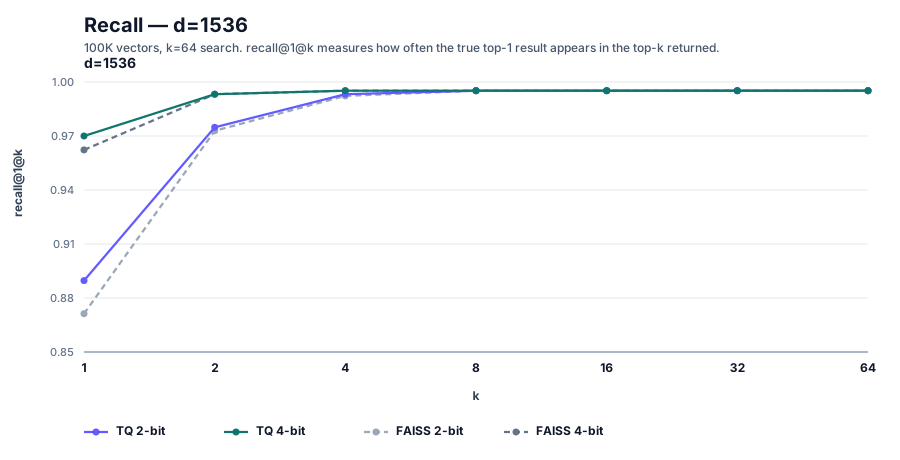
All figures: 100K OpenAI embeddings (d=1536 and d=3072) and GloVe (d=200), k=64, 1K queries, median of 5 runs, on a GCP c4a-standard-8 (ARM) and c3-standard-8 (x86), against FAISS at a matched bit rate. Scripts, raw JSON and every chart are in docs/benchmarks.md.
| turbovec | FAISS | ||
|---|---|---|---|
| Search, 4-bit | 3.8–5.1× faster across the eight cells (ARM 4.0×, x86 4.9×) | IndexPQFastScan | every cell |
| Search, 2-bit | 1.8–2.5× faster (ARM 2.05×, x86 2.35×) | IndexPQFastScan | every cell |
| Recall@1, OpenAI | 0.959 / 0.981 at 4-bit, 0.901 / 0.931 at 2-bit (d=1536 / d=3072) | 0.966 / 0.971, 0.876 / 0.911 | IndexPQ, m matched to bit rate |
| Recall@1, GloVe d=200 | 0.860 at 4-bit, 0.572 at 2-bit | 0.842, 0.565 | IndexPQ, m matched to bit rate |
| Memory, d=1536 | 75 MB at 4-bit, 38 MB at 2-bit | 586 MB float32 | 7.8× / 15.5× |
Single add() | 7.9–21.7 µs | 6.3–12.6× slower | into a trained, populated index |
remove(id) | 1.4–5.8 µs | 0.19–1.03 s | FAISS repacks all codes per call |
| Whole-file save | 1.0–1.4× slower than FAISS | write_index | turbovec fsyncs and renames atomically |
| Load → first search | 1.0–1.5× slower than FAISS | read_index | 40 vs 31 ms at d=1536 4-bit on x86 |
Both always return the true nearest neighbour within the first 8 results on the OpenAI corpora. The full suite — every chart, the raw JSON and the scripts to re-run it — is in docs/benchmarks.md.
When to use something else
- You need a graph index. turbovec scans every vector. At 100K vectors a query costs 0.13–0.25 ms on all eight cores of the benchmark boxes and 0.5–2.0 ms on one thread (k=64, 1,000-query batches, d=1536 to d=3072), and the cost grows linearly with the corpus. For hundreds of millions of vectors behind strict latency, an HNSW or IVF index in front of it is the right shape, and turbovec is not one.
- You need exact float results. Quantization is lossy. On the OpenAI corpora the top result matches the float ground truth 96–98% of the time at 4-bit (90–93% at 2-bit) and is always within the first 8 returned; low-dimensional embeddings such as GloVe d=200 lose more. Check recall on a sample of your own data.
- You need a server. turbovec is a library with a file format. There is no network API, replication or multi-tenant service; the integrations above are how it slots into a stack that has those.
- Your vectors are not multiples of 8 wide, or wider than 16,384. Those are the dimension limits. Bit widths are 2 and 4.
How it works
Normalise each vector and store its length. Rotate every vector by one shared random orthogonal matrix, after which each coordinate follows a known distribution whatever the input. Quantise each coordinate with a Lloyd-Max codebook computed for that distribution — 4 levels at 2-bit, 16 at 4-bit — and bit-pack. At search time the query is rotated once and scored against the codebook with SIMD lookup tables; a per-vector scalar fixed at encode time removes the inner-product bias quantization introduces. An optional one-shot calibrate(sample) fits two scalars per coordinate for data that drifts from the asymptotic distribution (low-dimensional and word-vector embeddings gain most).
The full walk-through, with the maths and the references, is in docs/how-it-works.md.
Building from source
pip install maturin
cd turbovec-python && maturin build --release && pip install target/wheels/*.whl
cargo build --release
x86_64 builds target x86-64-v2 (SSE4.2, Nehalem 2008+) via .cargo/config.toml; the AVX-512 and AVX2 kernels are #[target_feature]-gated and chosen at runtime with is_x86_feature_detected!, so one binary runs everywhere and uses what the CPU has. Running the benchmark suite is described in docs/benchmarks.md.
References
- TurboQuant: Online Vector Quantization with Near-optimal Distortion Rate (ICLR 2026) — the paper this implements
- RaBitQ: Quantizing High-Dimensional Vectors with a Theoretical Error Bound for Approximate Nearest Neighbor Search (SIGMOD 2024) — the per-vector length-renormalization correction
- FAISS Fast accumulation of PQ and AQ codes — turbovec's x86 kernel adapts FastScan's pack layout, nibble-LUT scoring and u16 accumulator strategy
daily_stock_analysis
ZhuLinsen·Python
用大模型自动分析 A 股等多市场股票,整合多源行情、实时新闻和决策看板,还能零成本定时跑并推送结果。
股票分析+4量化交易
69450+178957kv3.34.02026-11-09 14:14 UTC

Vibe-Trading
HKUDS·Python
用大模型智能体做量化交易,支持多智能体协作、策略回测和 MCP 接入,让个人也能搭起自己的自动交易助手。
量化交易+4量化交易
37987+1846.2kv0.1.192026-11-09 08:55 UTC
FinceptTerminal
Fincept-Corporation·C++
对标彭博终端的开源金融分析平台,集成行情分析、投资研究与经济数据工具,并内置 AI 智能体辅助数据驱动决策。
金融终端+4量化交易
33653+874.8kv4.5.22026-11-09 13:04 UTC
akshare
akfamily·Python
开箱即用的 Python 财经数据接口库,一行代码就能拉取股票、债券、期货、外汇和宏观经济等公开数据,省去到处爬数据、清洗数据的麻烦。
财经数据接口+4量化交易
23280+273.6kv1.20.372026-11-09 16:31 UTC