Anthropic API、llama.cpp-server 和 ollama 不支持多响应采样,可用技术受限;本地推理需额外下载 HuggingFace 模型,私有模型要设 HF_TOKEN;默认监听 8000 端口,客户端 base_url 需指向 http://localhost:8000/v1。
optillm
algorithmicsuperintelligenceApache-2.0活跃维护一个面向 LLM 的推理优化代理,通过 API 网关接入,自动套用思维链等推理策略来提升模型回答质量并降低调用成本。
Optimizing inference proxy for LLMs
v0.4.1发布于 2026-11-02 05:00 UTC4,341star +3 / 7 天401fork同步于 2026-11-10 11:38 UTC
pip install optillm
export OPENAI_API_KEY="your-key-here"
optillm 硬件要求按 README 说明
README 未说明具体显存要求;本地推理需设置 OPTILLM_API_KEY,可加载任意 HuggingFace 模型并叠加 LoRA 适配器,也可只做代理不跑本地模型。
有 Docker 镜像
OpenAI 兼容的推理优化代理,不改模型权重就能提升推理准确率
一个面向 LLM 的推理优化代理,通过 API 网关接入,自动套用思维链等推理策略来提升模型回答质量并降低调用成本。
核心能力
- 用模型名前缀或 extra_body 选择 20+ 推理优化技术
- 支持 & 串行流水线与 | 并行组合多种技术
- 内置本地推理服务,支持 logprobs 与 CoT/熵解码
- proxy 插件可当自托管 LLM 网关做负载均衡与故障转移
- 通过 LiteLLM 接入 OpenAI、Anthropic、Gemini 等多家模型
容易踩的坑
内容由模型根据 README 生成,可能不完整或不准确,以官方文档为准。看原文 README
- v0.4.1最新正式版2026-11-02 · 2026-11-02 05:00 UTC
What's Changed
Action required if you use these features
executecodeis now disabled by default (#337, #302). The plugin runs Python from requests and LLM responses with no sandboxing. To keep using it, start optillm with--enable-unsafe-plugins=executecodeor setOPTILLM_ENABLE_UNSAFE_PLUGINS=executecode. Only enable it in single-user, air-gapped environments.- MCP secrets could be written to logs. The MCP plugin wrote configured
envandheadersvalues, which can include API keys, to~/.optillm/logs/mcp_plugin.log. It now logs only the names. If you use the plugin, check that file for old secrets and rotate any you find.
New
- Streaming hints plugin (#352, #206):
streaming_hintswatches the model's reasoning as it is generated and injects relevant hints from a memory bank at moments of uncertainty. - Legacy completions endpoint: the inbuilt inference server now exposes
POST /v1/completions. - LLM gateway guide:
docs/llm-gateway.mdcovers using the proxy plugin for routing and inference optimization together.
Security
readurls: blocks SSRF destinations, including CGNAT/shared and multicast ranges.z3: statically gates solver code to the declared z3/sympy subset and closes string-based evasions of the AST attribute denylist.
Fixes
max_completion_tokens(#350): pass-through and proxy requests no longer addmax_tokens, which o-series and gpt-5 models reject with a 400. The local inference server now honorsmax_completion_tokens.mcts: follows tree selection through to a leaf.mars: populates diverse aggregation groups, preserves full agent IDs when applying verification, and matches solution authors across string and integer IDs.bon: excludes truncated and blank candidates.rstar: backpropagates rewards from evaluated rollout nodes and preserves signed and decimal answers.deepconf: votes and calibrates as in the DeepConf reference implementation.entropy_decoding: keeps the nucleus head and appliesmin_pin sampling.
Project
- CI now runs every test file, and MCP tests run on pull requests.
- The README has been streamlined.
Thanks to Parman Mohammadalizadeh, akushonkamen, ZY Liu, flyingdoubleG, and Daniel Peng for their contributions.
Full Changelog: https://github.com/algorithmicsuperintelligence/optillm/compare/v0.4.0...v0.4.1
- v0.4.02026-09-28 · 2026-09-28 02:27 UTC
查看更新说明
What's Changed
Fix: proxy plugin config, logging and agent clients (#330, #331)
- Proxy target ignored: without
~/.optillm/proxy_config.yaml, the proxy silently loaded the bundled example config and routed to its sample providers. It now creates an empty template instead. A single failed request no longer sends all later traffic to--base-url: 4xx errors don't mark a provider unhealthy, and unhealthy providers are retried before falling back. /v1/modelslists the configured providers' models (plusmodel_mapaliases) with--approach proxy.- Agent clients (e.g. Crush): the
noneand proxy approaches now forward the original conversation, includingtool_callsand tool results, instead of flattening it. Streamed responses carry tool calls, finish reason and usage.stream_optionsis no longer forwarded upstream, and messages withcontent: nullno longer crash parsing. - Logging:
--log/OPTILLM_LOGnow apply to all modules and are case-insensitive, so DEBUG logs from the proxy and other plugins show up.
MCP plugin ported to mcp 2.x
- Works with the MCP Python SDK 2.x (
MCPError, snake_case result fields). - New
streamable_httptransport, with headers and timeouts.
Breaking changes
- MCP
websockettransport removed (dropped from the MCP Python SDK in 2.x). Configs using"transport": "websocket"must switch tostreamable_httporsse. - Requires
mcp>=2,<3. Environments that also needmcp<2won't install. - The proxy no longer loads the bundled
example_config.yamlwhen~/.optillm/proxy_config.yamlis missing. Requests use the server's default client (--base-url) until you add providers. OPTILLM_LOG_LEVELremoved. Use--log/OPTILLM_LOG;monitoring.log_levelin the proxy config is an optional proxy-only override.
Thanks to @brettowe for the detailed report.
Full Changelog: https://github.com/algorithmicsuperintelligence/optillm/compare/v0.3.22...v0.4.0
- Proxy target ignored: without
- v0.3.222026-07-18 · 2026-07-18 12:38 UTC
查看更新说明
What's Changed
Fix: autothink, thinkdeeper and deepconf for transformers >= 5 (#320)
Since transformers 5,
apply_chat_template(return_tensors="pt")returns aBatchEncodingrather than a plain tensor, so passing the result straight tomodel(input_ids=...)raised. The tensor is now unwrapped via.input_ids:optillm/thinkdeeper.pyoptillm/autothink/processor.pyoptillm/deepconf/processor.py
The unwrap is chained with the existing device transfer (
.input_ids.to(self.model.device)) so tokens still land on the model's device —Tensor.to()returns a new tensor rather than mutating in place, so the assignment matters on CUDA/MPS.Thanks to @jacquerie for diagnosing and reporting this.
README: dropped the GitHub stars badge and switched the downloads badge to pepy.tech, which reports actual download counts.
Full Changelog: https://github.com/algorithmicsuperintelligence/optillm/compare/v0.3.21...v0.3.22
- v0.3.212026-07-05 · 2026-07-05 05:41 UTC
查看更新说明
What's Changed
Fix: broken PyPI wheel —
import optillmfailed withModuleNotFoundError: No module named 'math_verify'(#318)The published wheel is built from
pyproject.toml[project.dependencies], which had drifted fromrequirements.txt, sopip install optillmshipped a package that couldn't even start:math-verifywas missing frompyproject.toml—optillm/cepo/cepo.pyimports it at import time, so importing optillm crashed. (Affected 0.3.16–0.3.20.)transformerswas unpinned — the<5.13.0cap added in 0.3.19 only landed inrequirements.txt, so PyPI installs pulled transformers 5.13.0 and broke mlx-lm on Apple silicon.
Fix
Synced the runtime deps into
pyproject.toml: addedmath-verify, pinnedtransformers>=5.0.0,<5.13.0, andoutlines[transformers]>=1.2.3.Verified by building the wheel and installing it into a clean venv (only its declared deps) —
import optillmsucceeds and transformers resolves to 5.12.x.If you hit the
math_verifyimport error on 0.3.16–0.3.20, upgrade to 0.3.21.Full Changelog: https://github.com/algorithmicsuperintelligence/optillm/compare/v0.3.20...v0.3.21
- v0.3.202026-07-05 · 2026-07-05 04:02 UTC
查看更新说明
What's Changed
Fix: runaway local generation for models whose ChatML end token differs from their tokenizer EOS (#317)
Running such a model through optillm's built-in local inference never stopped early and generated the full
max_new_tokensdefault (4096) on every call that omittedmax_tokens— e.g. dhara-250m's chat ends at<|im_end|>(49154) but its tokenizereos_tokenis<|end_of_text|>(1), so it rambled ~800s/call.- Honor
generation_config.eos_token_id: generation now resolves EOS from the model's own generation config (merging the tokenizer EOS as a fallback) instead of hardcodingtokenizer.eos_token_id. Fixes any chat model with this mismatch; well-behaved models (e.g. Qwen2.5, whose tokenizer EOS already is<|im_end|>) are unchanged. OPTILLM_MAX_TOKENS: new env var to override the defaultmax_new_tokens(default stays 4096), bounding any request that sends nomax_tokens. An explicit requestmax_tokensstill takes precedence. Useful for small models that don't reliably emit an EOS token.
Only the local inference engine (
OPTILLM_API_KEY=optillm) is affected; proxied providers handle stopping themselves. Includes unit tests for both helpers.Full Changelog: https://github.com/algorithmicsuperintelligence/optillm/compare/v0.3.19...v0.3.20
- Honor
用户点评
登录用户的真实使用记录,可按版本和硬件筛选共 0 条
还没有人点评。第一个说出真实体验的人最有价值。
OptiLLM
OptiLLM is an OpenAI API-compatible optimizing inference proxy that implements 20+ state-of-the-art techniques to dramatically improve LLM accuracy and performance on reasoning tasks, without requiring any model training or fine-tuning.
It is possible to beat the frontier models using these techniques across diverse tasks by doing additional compute at inference time. A good example of how to combine such techniques is the CePO approach from Cerebras.
Key features
- Instant improvements: 2-10x better accuracy on math, coding, and logical reasoning
- Drop-in replacement: Works with any OpenAI-compatible API endpoint
- 20+ optimization techniques: From simple best-of-N to advanced MCTS and planning
- Zero training required: Just proxy your existing API calls through OptiLLM
- Production ready: Used in production by companies and researchers worldwide
- Multi-provider: Supports OpenAI, Anthropic, Google, Cerebras, and 100+ models via LiteLLM
Quick start
pip install optillm
export OPENAI_API_KEY="your-key-here"
optillm
Point any OpenAI client at the proxy and prefix the model name with a technique:
from openai import OpenAI

client = OpenAI(base_url="http://localhost:8000/v1")

response = client.chat.completions.create(
    model="moa-gpt-4o-mini",  # This gives you GPT-4o performance from GPT-4o-mini
    messages=[{"role": "user", "content": "Solve: If 2x + 3 = 7, what is x?"}],
)
Before OptiLLM: "x = 1"
After OptiLLM: "Let me work through this step by step: 2x + 3 = 7, so 2x = 4, therefore x = 2"
Results
| Technique | Base model | Improvement | Benchmark |
|---|---|---|---|
| MARS | Gemini 2.5 Flash Lite | +30.0 points | AIME 2025 (43.3 to 73.3) |
| CePO | Llama 3.3 70B | +18.6 points | Math-L5 (51.0 to 69.6) |
| LongCePO | Llama 3.3 70B | +13.6 points | InfiniteBench (58.0 to 71.6) |
| AutoThink | DeepSeek-R1-1.5B | +9.34 points | GPQA-Diamond (21.72 to 31.06) |
| PlanSearch | GPT-4o-mini | +20% pass@5 | LiveCodeBench |
| MOA | GPT-4o-mini | Matches GPT-4 | Arena-Hard-Auto |
See benchmark results for the full tables.
Installation
pip
pip install optillm
Docker
docker pull ghcr.io/algorithmicsuperintelligence/optillm:latest
docker run -p 8000:8000 ghcr.io/algorithmicsuperintelligence/optillm:latest
| Image tag | Contents |
|---|---|
latest | All dependencies for local inference and plugins |
latest-proxy | Lightweight image without local inference |
latest-offline | Self-contained image with pre-downloaded models (spaCy) for fully offline operation |
To build and run from the repository, set your keys in docker-compose.yaml or a .env file and run docker compose up -d.
From source
git clone https://github.com/algorithmicsuperintelligence/optillm.git
cd optillm
python3 -m venv .venv
source .venv/bin/activate
pip install -r requirements.txt
python optillm.py
Providers
Set the environment variable for your provider and the proxy picks the matching client.
| Provider | Required environment variables | Notes |
|---|---|---|
| OptiLLM | OPTILLM_API_KEY | Built-in local inference server; supports logprobs and decoding techniques such as cot_decoding and entropy_decoding |
| OpenAI | OPENAI_API_KEY | Also works with any OpenAI-compatible endpoint (e.g. OpenRouter) by setting --base-url |
| Cerebras | CEREBRAS_API_KEY | See the Cerebras docs |
| Azure OpenAI | AZURE_OPENAI_API_KEYAZURE_API_VERSIONAZURE_API_BASE | |
| Azure OpenAI (Managed Identity) | AZURE_API_VERSIONAZURE_API_BASE | Requires az login; see the Azure docs |
| LiteLLM | Depends on the model | See the LiteLLM docs |
Other models work through LiteLLM. For example, set GEMINI_API_KEY and call moa-gemini/gemini-1.5-flash-002.
Usage
Selecting a technique
When the server runs with the default auto approach, a technique can be selected in three ways, in this order of preference:
# 1. Model name prefix
client.chat.completions.create(model="moa-gpt-4o-mini", messages=messages)

# 2. extra_body field
client.chat.completions.create(
    model="gpt-4o-mini",
    messages=messages,
    extra_body={"optillm_approach": "bon|moa|mcts"},
)

# 3. Tag in the system or user prompt
client.chat.completions.create(
    model="gpt-4o-mini",
    messages=[{"role": "user", "content": "<optillm_approach>re2</optillm_approach> How many r's are there in strawberry?"}],
)
If the server is started with a specific --approach, set model to the model name only.
Combining techniques
&runs techniques as a pipeline from left to right, using each response as the request to the next stage:cot_reflection&moa|runs techniques in parallel and returns the responses as a list:bon|moa|mcts
How requests flow
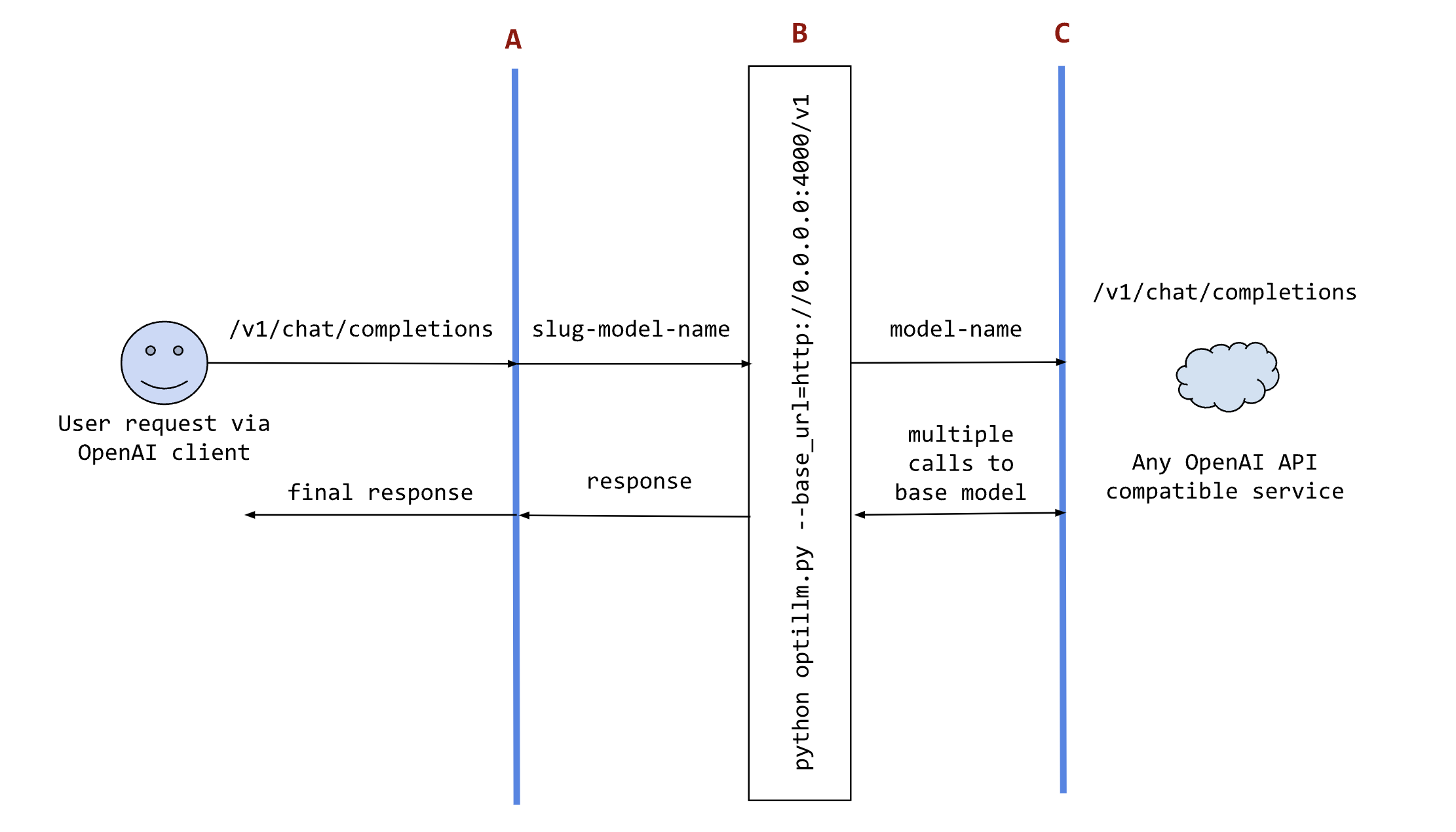
Ais an existing tool, framework, or your own code using any OpenAI client SDK.Bis the optillm service, which sends requests to the configuredbase_url.Cis any service providing an OpenAI-compatible chat completions endpoint.
For an LLM without an OpenAI-compatible endpoint, you can use the LiteLLM proxy server.
Local inference
Set OPTILLM_API_KEY to any value to use the built-in inference server, and use the same value in your client. Any HuggingFace model can be passed as the model name; set HF_TOKEN for private models. Add LoRA adapters with the + separator and choose one with active_adapter (the last one is used by default).
client = OpenAI(api_key="optillm", base_url="http://localhost:8000/v1")

response = client.chat.completions.create(
    model="meta-llama/Llama-3.2-1B-Instruct+patched-codes/Llama-3.2-1B-FastApply+patched-codes/Llama-3.2-1B-FixVulns",
    messages=messages,
    temperature=0.2,
    logprobs=True,
    top_logprobs=3,
    extra_body={"active_adapter": "patched-codes/Llama-3.2-1B-FastApply"},
)
Alternate decoding techniques are available on the local server:
response = client.chat.completions.create(
    model="meta-llama/Llama-3.2-1B-Instruct",
    messages=messages,
    temperature=0.2,
    extra_body={
        "decoding": "cot_decoding",  # or "entropy_decoding"
        # CoT specific params
        "k": 10,
        "aggregate_paths": True,
        # OR entropy specific params
        "top_k": 27,
        "min_p": 0.03,
    },
)
The server also exposes the legacy POST /v1/completions endpoint. Streaming is not supported on it yet; use /v1/chat/completions for streaming.
curl http://localhost:8000/v1/completions \
  -H "Content-Type: application/json" \
  -H "Authorization: Bearer $OPTILLM_API_KEY" \
  -d '{"model": "meta-llama/Llama-3.2-1B-Instruct", "prompt": "Write a haiku about recursion.", "max_tokens": 64}'
External servers (llama.cpp, ollama)
export OPENAI_API_KEY="sk-no-key"  # placeholder
./llama-server -c 4096 -m path_to_model
python3 optillm.py --base-url http://localhost:8080/v1
[!WARNING] The Anthropic API, llama.cpp-server, and ollama do not support sampling multiple responses from a model, which limits the available approaches to
cot_reflection,leap,plansearch,rstar,rto,self_consistency,re2, andz3. For HuggingFace models, the built-in local inference server supports multiple responses.
Use as an LLM gateway
The proxy plugin turns OptiLLM into a self-hosted gateway with load balancing, failover, and health checks across any OpenAI-compatible providers, with no gateway fees. It can also apply any of the techniques below to the requests it routes, combining routing and optimization in one service. See Using OptiLLM as an LLM gateway for setup.
Techniques
| Approach | Slug | Description |
|---|---|---|
| MARS (Multi-Agent Reasoning System) | mars | Multi-agent reasoning with diverse temperature exploration, cross-verification, and iterative improvement |
| Cerebras Planning and Optimization | cepo | Combines Best of N, Chain-of-Thought, Self-Reflection, Self-Improvement, and various prompting techniques |
| CoT with Reflection | cot_reflection | Chain-of-thought reasoning with <thinking>, <reflection> and <output> sections |
| PlanSearch | plansearch | Search over candidate plans for solving a problem in natural language |
| ReRead | re2 | Improves reasoning by processing queries twice |
| Self-Consistency | self_consistency | An advanced self-consistency method |
| Z3 Solver | z3 | Uses the Z3 theorem prover for logical reasoning |
| R* Algorithm | rstar | The R* algorithm for problem solving |
| LEAP | leap | Learns task-specific principles from few-shot examples |
| Round Trip Optimization | rto | Optimizes responses through a round-trip process |
| Best of N Sampling | bon | Generates multiple responses and selects the best one |
| Mixture of Agents | moa | Combines responses from multiple critiques |
| Monte Carlo Tree Search | mcts | Uses MCTS for decision-making in chat responses |
| PV Game | pvg | Applies a prover-verifier game at inference time |
| Deep Confidence | Local only | Confidence-guided reasoning with multiple intensity levels |
| CoT Decoding | Local only | Chain-of-thought decoding to elicit reasoning without explicit prompting |
| Entropy Decoding | Local only | Adaptive sampling based on the uncertainty of tokens during generation |
| Thinkdeeper | Local only | The reasoning_effort parameter for reasoning models like DeepSeek R1 |
| AutoThink | Local only | Combines query complexity classification with steering vectors |
Plugins
| Plugin | Slug | Description |
|---|---|---|
| System Prompt Learning | spl | Implements what Andrej Karpathy called the third paradigm for LLM learning, letting the model acquire problem-solving knowledge and strategies |
| Deep Think | deepthink | A Gemini-like Deep Think approach using inference-time scaling for reasoning LLMs |
| Long-Context Cerebras Planning and Optimization | longcepo | Combines planning and divide-and-conquer processing of long documents |
| Majority Voting | majority_voting | Generates k candidate solutions and selects the most frequent answer (default k=6) |
| MCP Client | mcp | Model Context Protocol client for using any LLM with any MCP server |
| Router | router | Uses the optillm-modernbert-large model to route requests to approaches based on the prompt |
| Chain-of-Code | coc | Combines CoT with code execution and LLM-based code simulation |
| Memory | memory | Short-term memory layer for unbounded context length with any LLM. Set OPTILLM_MEMORY_FILE to persist memories across requests |
| Compact | compact | Compresses conversation context that exceeds a token budget into a structured summary, keeping recent turns verbatim |
| Privacy | privacy | Anonymizes PII in the request and restores it in the response |
| Read URLs | readurls | Fetches URLs found in the request and adds their content to the context |
| Execute Code | executecode | Runs Python code from requests and LLM responses. Disabled by default; see Security |
| JSON | json | Structured outputs using the outlines library; supports pydantic types and JSON schema |
| GenSelect | genselect | Generates multiple candidates and selects the best based on quality criteria |
| Web Search | web_search | Performs Google searches using Chrome automation (Selenium) |
| Deep Research | deep_research | Test-Time Diffusion Deep Researcher (TTD-DR) for research reports using iterative refinement |
| Proxy | proxy | Load balancing and failover across LLM providers with health monitoring and round-robin routing |
| Streaming Hints | streaming_hints | Watches reasoning as it is generated and injects relevant hints from a memory bank at moments of uncertainty |
MCP plugin
The Model Context Protocol plugin connects OptiLLM to MCP servers, making their tools, resources, and prompts available to the model. When the model calls a tool, the plugin executes it and returns the result to the model.
Configure servers in ~/.optillm/mcp_config.json:
{
  "mcpServers": {
    "filesystem": {
      "transport": "stdio",
      "command": "npx",
      "args": ["-y", "@modelcontextprotocol/server-filesystem", "/home/user/docs"],
      "description": "Local filesystem access"
    },
    "github": {
      "transport": "sse",
      "url": "https://api.githubcopilot.com/mcp",
      "headers": {
        "Authorization": "Bearer ${GITHUB_TOKEN}",
        "Accept": "text/event-stream"
      },
      "description": "GitHub MCP server"
    },
    "remote-http": {
      "transport": "streamable_http",
      "url": "https://api.example.com/mcp",
      "headers": {
        "Authorization": "Bearer ${API_TOKEN}"
      },
      "description": "Remote Streamable HTTP MCP server"
    }
  },
  "log_level": "INFO"
}
| Transport | Required | Optional |
|---|---|---|
stdio (default) | command | args, env |
sse | url | headers, sse_read_timeout (default 300.0) |
streamable_http | url | headers, sse_read_timeout (default 300.0) |
All transports accept description and timeout (connection timeout in seconds, default 5.0). The websocket transport was removed in MCP Python SDK 2.x; use streamable_http or sse instead. String values such as headers support ${VARIABLE_NAME} expansion, and those variables must be set before starting OptiLLM.
Any of the official MCP servers can be used. Logs are written to ~/.optillm/logs/mcp_plugin.log; check there for connection and tool errors.
Configuration
Parameters can be passed on the command line. Most can also be set as environment variables prefixed with OPTILLM_, for example OPTILLM_APPROACH=mcts. Run optillm --help for the full list.
| Parameter | Description | Default |
|---|---|---|
--approach | Inference approach to use | auto |
--model | OpenAI model to use | gpt-4o-mini |
--base-url | Base URL for an OpenAI-compatible endpoint | "" |
--host | Host address to bind the server | 127.0.0.1 |
--port | Port to run the proxy on | 8000 |
--optillm-api-key | Optional API key for client authentication to optillm | "" |
--n | Number of final responses to return | 1 |
--return-full-response | Return the full response including the CoT with <thinking> tags | False |
--mcts-simulations | Number of MCTS simulations | 2 |
--mcts-exploration | Exploration weight for MCTS | 0.2 |
--mcts-depth | Simulation depth for MCTS | 1 |
--best-of-n | Number of samples for the best_of_n approach | 3 |
--rstar-max-depth | Maximum depth for the R* algorithm | 3 |
--rstar-num-rollouts | Number of rollouts for the R* algorithm | 5 |
--rstar-c | Exploration constant for the R* algorithm | 1.4 |
--cepo_* | See CePO parameters below | Various |
| Parameter | Description | Default |
|---|---|---|
--cepo_bestofn_n | Number of responses to be generated in best of n stage | 3 |
--cepo_bestofn_temperature | Temperature for verifier in best of n stage | 0.1 |
--cepo_bestofn_max_tokens | Maximum number of tokens for verifier in best of n stage | 4096 |
--cepo_bestofn_rating_type | Type of rating in best of n stage ("absolute" or "pairwise") | "absolute" |
--cepo_planning_n | Number of plans generated in planning stage | 3 |
--cepo_planning_m | Number of attempts to generate n plans in planning stage | 6 |
--cepo_planning_temperature_step1 | Temperature for generator in step 1 of planning stage | 0.55 |
--cepo_planning_temperature_step2 | Temperature for generator in step 2 of planning stage | 0.25 |
--cepo_planning_temperature_direct_resp | Temperature for generator after step 2 if planning fails and answer directly | 0.1 |
--cepo_planning_temperature_step3 | Temperature for generator in step 3 of planning stage | 0.1 |
--cepo_planning_temperature_step4 | Temperature for generator in step 4 of planning stage | 0 |
--cepo_planning_max_tokens_step1 | Maximum number of tokens in step 1 of planning stage | 4096 |
--cepo_planning_max_tokens_step2 | Maximum number of tokens in step 2 of planning stage | 4096 |
--cepo_planning_max_tokens_direct_resp | Maximum number of tokens after step 2 if planning fails and answer directly | 4096 |
--cepo_planning_max_tokens_step3 | Maximum number of tokens in step 3 of planning stage | 4096 |
--cepo_planning_max_tokens_step4 | Maximum number of tokens in step 4 of planning stage | 4096 |
--cepo_use_reasoning_fallback | Whether to fallback to lower levels of reasoning when higher level fails | False |
--cepo_num_of_retries | Number of retries if llm call fails, 0 for no retries | 0 |
--cepo_print_output | Whether to print the output of each stage | False |
--cepo_config_file | Path to CePO configuration file | None |
--cepo_use_plan_diversity | Use additional plan diversity step | False |
--cepo_rating_model | Specify a model for rating step if different than for completion | None |
Security
Network binding and authentication. The server binds to 127.0.0.1 by default. Use --host 0.0.0.0 to allow external connections, and only on trusted networks or with authentication enabled. Set --optillm-api-key (or OPTILLM_API_KEY) to require clients to send Authorization: Bearer <key>.
Code execution. The executecode plugin runs Python from requests and LLM responses in a live Jupyter kernel with no sandboxing, so it is disabled unless you opt in. Only enable it in single-user, air-gapped environments where whoever submits requests is trusted with full access to the host.
optillm --enable-unsafe-plugins=executecode
# or: export OPTILLM_ENABLE_UNSAFE_PLUGINS=executecode
URL fetching. The readurls plugin blocks requests to non-public destinations (private, loopback, link-local, and reserved addresses such as the cloud metadata IP 169.254.169.254) to prevent SSRF. Every redirect hop is re-validated and unresolvable hosts are rejected. Only opt out on trusted networks that need internal URL fetching:
optillm --readurls-allow-internal
# or: export OPTILLM_READURLS_ALLOW_INTERNAL=true
The guard validates DNS resolution before each request, but the HTTP client resolves the host again when it connects, so a domain under attacker control could rebind to an internal address between the two lookups. For high-security deployments, also restrict the network egress of the optillm process with a firewall or service-mesh policy.
SSL verification. Use a custom CA bundle for self-signed certificates or corporate proxies. Disabling verification is insecure and intended for development only. See SSL_CONFIGURATION.md for details.
optillm --ssl-cert-path /path/to/ca-bundle.crt  # or: export OPTILLM_SSL_CERT_PATH=...
optillm --no-ssl-verify                         # or: export OPTILLM_SSL_VERIFY=false
Benchmark results
MARS on AIME 2025, IMO 2025, and LiveCodeBench (Oct 2025)
| Benchmark | Approach | Problems | Correct | Accuracy | Improvement |
|---|---|---|---|---|---|
| AIME 2025 | Baseline | 30 | 13 | 43.3% | - |
| AIME 2025 | MARS | 30 | 22 | 73.3% | +30.0pp (+69.2%) |
| IMO 2025 | Baseline | 6 | 1 | 16.7% | - |
| IMO 2025 | MARS | 6 | 2 | 33.3% | +16.7pp (+100%) |
| LiveCodeBench v5/v6 | Baseline | 105 | 41 | 39.05% | - |
| LiveCodeBench v5/v6 | MARS | 105 | 53 | 50.48% | +11.43pp (+29.3%) |
Model: google/gemini-2.5-flash-lite-preview-09-2025 via OpenRouter. Configuration: 3 agents, 2-pass verification, thinking tags disabled for proofs.
CePO on math and code benchmarks (Sep 2025)
| Method | AIME 2024 | AIME 2025 | GPQA | LiveCodeBench |
|---|---|---|---|---|
| Qwen3 8B | 74.0 | 68.3 | 59.3 | 55.7 |
| CePO (using Qwen3 8B) | 86.7 | 80.0 | 62.5 | 60.5 |
| Qwen3 32B | 81.4 | 72.9 | 66.8 | 65.7 |
| CePO (using Qwen3 32B) | 90.7 | 83.3 | 70.0 | 71.9 |
| Qwen3 235B | 85.7 | 81.5 | 71.1 | 70.7 |
| DeepSeek R1 | 79.8 | 70.0 | 71.5 | 64.3 |
| OpenAI o3-mini | 79.6 | 74.8 | 76.8 | 66.3 |
| Grok3 Think | 83.9 | 77.3 | 80.2 | 70.6 |
AutoThink on GPQA-Diamond and MMLU-Pro (May 2025)
| Model | GPQA-Diamond | MMLU-Pro | ||
|---|---|---|---|---|
| Accuracy (%) | Avg. Tokens | Accuracy (%) | Avg. Tokens | |
| DeepSeek-R1-Distill-Qwen-1.5B | 21.72 | 7868.26 | 25.58 | 2842.75 |
| with Fixed Budget | 28.47 | 3570.00 | 26.18 | 1815.67 |
| with AutoThink | 31.06 | 3520.52 | 26.38 | 1792.50 |
LongCePO on LongBench v2 (Apr 2025)
| Model¹ | Context window | Short samples (up to 32K words) | Medium samples (32–128K words) |
|---|---|---|---|
| Llama 3.3 70B Instruct | 128K | 36.7 (45.0) | 27.0 (33.0) |
| LongCePO + Llama 3.3 70B Instruct | 8K | 36.8 ± 1.38 | 38.7 ± 2.574 (39.735)² |
| Mistral-Large-Instruct-2411 | 128K | 41.7 (46.1) | 30.7 (34.9) |
| o1-mini-2024-09-12 | 128K | 48.6 (48.9) | 33.3 (32.9) |
| Claude-3.5-Sonnet-20241022 | 200K | 46.1 (53.9) | 38.6 (41.9) |
| Llama-4-Maverick-17B-128E-Instruct | 524K | 32.22 (50.56) | 28.84 (41.86) |
¹ Performance numbers reported by LongBench v2 authors, except for LongCePO and Llama-4-Maverick results.
² Numbers in parentheses for LongCePO indicate accuracy of majority voting from 5 runs.
LongCePO on HELMET - InfiniteBench En.MC, 128K length (Apr 2025)
| Model | Accuracy (%) |
|---|---|
| Llama 3.3 70B Instruct (full context) | 58.0 |
| LongCePO + Llama 3.3 70B Instruct (8K context) | 71.6 ± 1.855 (73.0)¹ |
| o1-mini-2024-09-12 (full context) | 58.0 |
| gpt-4o-2024-08-06 (full context) | 74.0 |
¹ Numbers in parentheses for LongCePO indicate accuracy of majority voting from 5 runs.
CePO on math and code benchmarks (Mar 2025)
| Method | Math-L5 | MMLU-Pro (Math) | CRUX | LiveCodeBench (pass@1) | Simple QA |
|---|---|---|---|---|---|
| Llama 3.3 70B | 51.0 | 78.6 | 72.6 | 27.1 | 20.9 |
| Llama 3.1 405B | 49.8 | 79.2 | 73.0 | 31.8 | 13.5 |
| CePO (using Llama 3.3 70B) | 69.6 | 84.8 | 80.1 | 31.9 | 22.6 |
| QwQ 32B | 61.4 | 90.8 | 82.5 | 44.3 | 7.8 |
| CePO (using QwQ 32B) | 88.1 | 92.0 | 86.3 | 51.5 | 8.2 |
| DeepSeek R1 Llama | 83.1 | 82.0 | 84.0 | 47.3 | 14.6 |
| CePO (using DeepSeek R1 Llama) | 90.2 | 84.0 | 89.4 | 47.2 | 15.5 |
coc-claude-3-5-sonnet-20241022 on AIME 2024 pass@1 (Nov 2024)
| Model | Score |
|---|---|
| o1-mini | 56.67 |
| coc-claude-3-5-sonnet-20241022 | 46.67 |
| coc-gemini/gemini-exp-1121 | 46.67 |
| o1-preview | 40.00 |
| gemini-exp-1114 | 36.67 |
| claude-3-5-sonnet-20241022 | 20.00 |
| gemini-1.5-pro-002 | 20.00 |
| gemini-1.5-flash-002 | 16.67 |
readurls&memory-gpt-4o-mini on Google FRAMES Benchmark (Oct 2024)
| Model | Accuracy |
|---|---|
| readurls&memory-gpt-4o-mini | 61.29 |
| gpt-4o-mini | 50.61 |
| readurls&memory-Gemma2-9b | 30.1 |
| Gemma2-9b | 5.1 |
| Gemma2-27b | 30.8 |
| Gemini Flash 1.5 | 66.5 |
| Gemini Pro 1.5 | 72.9 |
plansearch-gpt-4o-mini on LiveCodeBench (Sep 2024)
| Model | pass@1 | pass@5 | pass@10 |
|---|---|---|---|
| plansearch-gpt-4o-mini | 44.03 | 59.31 | 63.5 |
| gpt-4o-mini | 43.9 | 50.61 | 53.25 |
| claude-3.5-sonnet | 51.3 | ||
| gpt-4o-2024-05-13 | 45.2 | ||
| gpt-4-turbo-2024-04-09 | 44.2 |
moa-gpt-4o-mini on Arena-Hard-Auto (Aug 2024)

optillm with Patchwork (July 2024)
We used optillm with patchwork, an open-source framework that automates development work such as PR reviews, bug fixing, and security patching through workflows called patchflows. The mixture of agents approach (moa) improved performance across all supported patchflows.

Testing
pip install -r tests/requirements.txt

# Approach tests
python tests/test.py
python tests/test.py --approaches moa bon mcts
python tests/test.py --single-test "Simple Math Problem"

# Unit and integration tests
./tests/run_tests.sh
pytest tests/test_plugins.py -v
Tests run on pull requests through GitHub Actions. See tests/README.md for the test structure and how to write new tests.
Contributing
- Report bugs by opening an issue.
- Share ideas by starting a discussion.
- Look for a place to start in the good first issues.
References
- Eliciting Fine-Tuned Transformer Capabilities via Inference-Time Techniques
- AutoThink: efficient inference for reasoning LLMs - Implementation
- Deep Think with Confidence: Confidence-guided reasoning and inference-time scaling - Implementation
- Self-Discover: Large Language Models Self-Compose Reasoning Structures - Implementation
- CePO: Empowering Llama with Reasoning using Test-Time Compute - Implementation
- LongCePO: Empowering LLMs to efficiently leverage infinite context - Implementation
- Chain of Code: Reasoning with a Language Model-Augmented Code Emulator - Inspired the implementation of coc plugin
- Entropy Based Sampling and Parallel CoT Decoding - Implementation
- Fact, Fetch, and Reason: A Unified Evaluation of Retrieval-Augmented Generation - Evaluation script
- Writing in the Margins: Better Inference Pattern for Long Context Retrieval - Inspired the implementation of the memory plugin
- Chain-of-Thought Reasoning Without Prompting - Implementation
- Re-Reading Improves Reasoning in Large Language Models - Implementation
- In-Context Principle Learning from Mistakes - Implementation
- Planning In Natural Language Improves LLM Search For Code Generation - Implementation
- Self-Consistency Improves Chain of Thought Reasoning in Language Models - Implementation
- Mutual Reasoning Makes Smaller LLMs Stronger Problem-Solvers - Implementation
- Mixture-of-Agents Enhances Large Language Model Capabilities - Inspired the implementation of moa
- Prover-Verifier Games improve legibility of LLM outputs - Implementation
- Monte Carlo Tree Search Boosts Reasoning via Iterative Preference Learning - Inspired the implementation of mcts
- Unsupervised Evaluation of Code LLMs with Round-Trip Correctness - Inspired the implementation of rto
- Patched MOA: optimizing inference for diverse software development tasks - Implementation
- Patched RTC: evaluating LLMs for diverse software development tasks - Implementation
- AIMO-2 Winning Solution: Building State-of-the-Art Mathematical Reasoning Models with OpenMathReasoning dataset - Implementation
- Test-Time Diffusion Deep Researcher (TTD-DR): Think More, Research More, Answer Better! - Implementation
Citation
If you use this library in your research, please cite:
@software{optillm,
  title = {OptiLLM: Optimizing inference proxy for LLMs},
  author = {Asankhaya Sharma},
  year = {2024},
  publisher = {GitHub},
  url = {https://github.com/algorithmicsuperintelligence/optillm}
}