课程仍在开发中,Part II、III、IV 部分章节尚未完成;依赖需按各章节要求分别安装,README 未给出统一依赖清单;完整性能验证与 Part III 深入内容建议在 GPU 上进行,纯 CPU 只能调试部分代码。
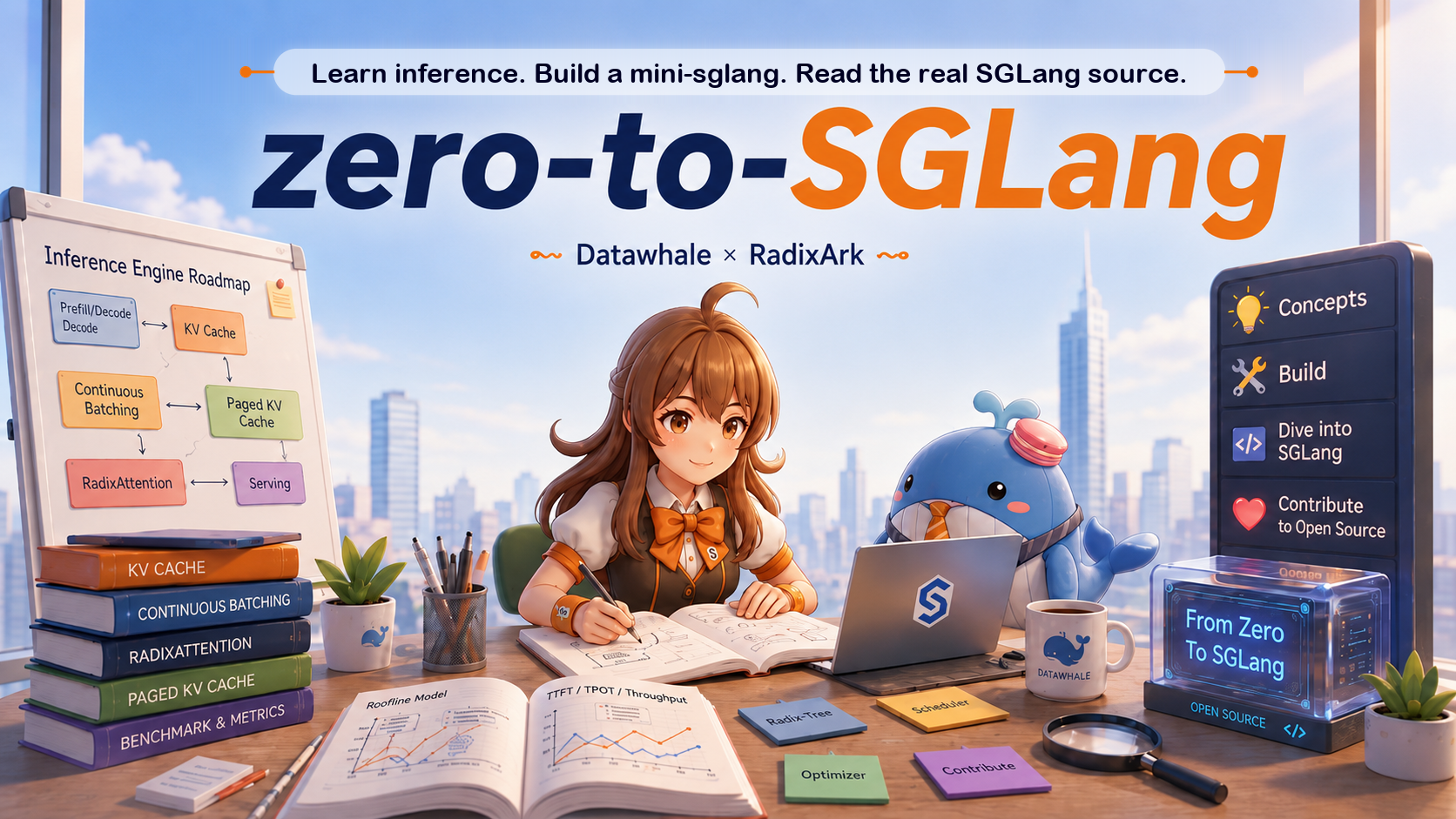
zero-to-sglang
datawhalechina活跃维护Datawhale 与 SGLang 官方合作的 LLM 推理课程,从零手写 mini-sglang 理解推理原理,再读真实源码并完成第一个 PR。
Official SGLang x Datawhale course on LLM inference: understand inference, build a mini-sglang from scratch, then read the real SGLang source and land your first PR. Available in English and Chinese.
暂无版本1,957star +222 / 7 天158fork同步于 2026-11-10 23:47 UTC
git clone https://github.com/datawhalechina/zero-to-sglang.git
# Install dependencies as each chapter requires 硬件要求按 README 说明
Part I 完全不需要 GPU;Part II 大部分代码可在 CPU 上调试,但完整实现与性能测试建议用 GPU(云端亦可)。README 未说明具体显存要求与 GPU 型号。
纯 CPU 可运行需要 CUDA多卡 / 张量并行
从零手写 mini-sglang 并读懂真实 SGLang 源码的 LLM 推理引擎教程
Datawhale 与 SGLang 官方合作的 LLM 推理课程,从零手写 mini-sglang 理解推理原理,再读真实源码并完成第一个 PR。
核心能力
- 从 KV Cache、prefill/decode 讲清推理核心概念
- 逐步手写 mini-sglang:前向、生成、KV Cache、HTTP 服务
- 实现 Continuous Batching、Paged KV Cache 与 RadixAttention
- 对照真实 SGLang 源码讲解量化、分层缓存、PD 分离等优化
- 走通 profiling、trace 分析与首个 SGLang PR 流程
容易踩的坑
内容由模型根据 README 生成,可能不完整或不准确,以官方文档为准。看原文 README
暂无 release 数据(可能没有发版,或尚未同步)。
用户点评
登录用户的真实使用记录,可按版本和硬件筛选共 0 条
还没有人点评。第一个说出真实体验的人最有价值。
Course status: Part 0, Part I, Chapters 1–5 and 8 of Part II, and Chapters 1 and 3 of Part III (Attention Backends and Hierarchical Caching) are complete in both English and Chinese. The course is still under development. You can switch to 简体中文 at any time. Want to help? See Contributing.
🎯 About
Large models have moved on from the training race to the inference race. Once applications took off, inference cost and latency became the real bottleneck: on the same GPU, a good inference engine can serve several times more requests. Yet there are few tutorials on inference engines. They either stay at the concept level without touching code, or drop you straight into the SGLang source with no idea where to start.
This course fills that gap. The first half starts from the core questions of inference: why KV Cache exists, how prefill differs from decode, what compute-bound and memory-bound actually mean. The middle part walks you through building a mini-sglang from scratch: forward pass, generation, KV Cache, HTTP serving, Continuous Batching, Paged KV Cache, RadixAttention, added one at a time. The last part returns to the real SGLang, explains how its cutting-edge optimizations are actually implemented, and finally shows you how to land your first solid PR in SGLang.
The project is jointly launched by Datawhale and RadixArk (the company founded by the SGLang team). SGLang is technically solid and actively iterated in the inference framework space. If you like this project, please give the official SGLang repository a ⭐.
✨ What you will learn
- 📖 Understand inference: KV Cache, prefill/decode, compute-bound vs. memory-bound, and what these concepts actually mean
- 🏗️ Build the engine: write a mini-sglang from 0 to 1, with every step landing in code
- 🛠️ Read the real engine: how RadixAttention, Paged KV Cache and Continuous Batching are implemented inside SGLang
- ⚙️ Touch the frontier: quantization, hierarchical caching, DP Attention / EP / PP, Prefill-Decode disaggregation
- 🚀 Join open source: learn profiling and trace analysis, and walk through the full SGLang PR workflow
📋 Prerequisites
- Python: fluent in Python, with basic software engineering habits
- Deep learning basics: familiar with PyTorch and the fundamentals of neural networks
- Math: linear algebra and probability; knowing roughly how matrix multiplication and attention are computed is enough
- GPU programming (optional): knowing CUDA basics helps, but is not required. Part I fills in the gaps from scratch
- Hardware (optional): Part I needs no GPU; most of Part II can be debugged on CPU, but the full implementation and performance tests are best done on a GPU (cloud is fine)
🔗 Links
- Repository: https://github.com/datawhalechina/zero-to-sglang
- SGLang: https://github.com/sgl-project/sglang
- mini-sglang reference implementation: https://github.com/sgl-project/mini-sglang
📖 Syllabus
Status legend: ✅ Done 🔄 In progress 📝 Needs polish 🚧 Planned ⏸️ Paused
Chapters in bold are written by SGLang core members.
| Chapter | Key content | Status |
|---|---|---|
| Part 0 — Before you learn | ||
| 0.1 Coding Ethics and Open-Source Spirit | Own your code, communicate like a human, profile first, the open-source spirit | ✅ |
| 0.2 Deploy Your First SGLang Server | Environment setup; run Qwen3-0.6B with SGLang on your own GPU | ✅ |
| Part I — Foundations (concepts only, no code, no GPU) | ||
| 1. Introduction to LLM | What an LLM is and how it evolved, the Transformer architecture, autoregressive generation, key concepts | ✅ |
| 2. Introduction to Inference | Training vs. inference, prefill/decode, compute-bound vs. memory-bound, the Roofline model | ✅ |
| 3. Introduction to GPU | GPU architecture basics, how LLM inference executes on a GPU, understanding inference bottlenecks from the hardware | ✅ |
| 4. KV Cache: The Core Data Structure of Inference | Deriving KV Cache from attention, cache lifecycle, quantitative memory analysis | ✅ |
| 5. Introduction to Benchmark | Core metrics such as TTFT / TPOT / ITL / Goodput, percentiles and tail latency, how to design, run and read a benchmark | ✅ |
| Part II — Build Your Own Mini SGL | ||
| 1. mini-sglang: What an Inference Engine Looks Like | Overall architecture of an inference engine, module breakdown, roadmap for this part | ✅ |
| 2. Inside SGLang: The Path of a Request (Concepts) · Code Walkthrough | The full lifecycle of a request from arrival to response | ✅ |
| 3. Your First 200 Lines: Forward Pass and Generation (Concepts) · Code Walkthrough | A source walkthrough of embeddings, attention, the LM head, and generation | ✅ |
| 4. KV Cache: From O(n²) to O(n) (Concepts) · Code Walkthrough | Implementing the cache and optimizing attention computation | ✅ |
| 5. HTTP and Concurrent Requests (Concepts) · Code Walkthrough | HTTP basics and request flow; implementing isolation, streaming, and cancellation | ✅ |
| 6. Continuous Batching and the Scheduler (Concepts) · Code Walkthrough | Continuous batching, scheduler state, resource limits, and latency/throughput tradeoffs | ✅ |
| 7. Paged KV Cache and Memory Management (Concepts) | Paged KV Cache and GPU memory management | ✅ |
| 8. RadixAttention and Prefix Caching (Concepts) · Code Walkthrough | RadixAttention and prefix caching | ✅ |
| 9. Multi-process & Tensor Parallelism(Concepts) · Code Walkthrough | Multi-process execution and tensor parallelism | ✅ |
| 10. Speculative Decoding (Concepts) · Code Walkthrough | Drafting and verification, greedy and sampling-based acceptance, rejection correction, and performance tradeoffs | ✅ |
| Part III — Advanced Inference Technique (deep into the real SGLang) | ||
| 1. Attention Backends (FlashInfer / Triton / FA3 / FlashMLA) | Backend responsibilities, tiled Attention, implementation tradeoffs, and selection | ✅ |
| 2. Quantization and Low-Precision Inference | Numeric formats and scales, Decode speedup and KV Cache capacity, accuracy tradeoffs, quantization labels and loading | ✅ |
| 3. Hierarchical Caching | L1/L2/L3 cache tiers, prefix matching, backup and restoration, prefetching and performance tradeoffs | ✅ |
| 4. Scaling Out: DP Attention, EP, PP | Scaling out: DP Attention / EP / PP | 🚧 |
| 5. Prefill-Decode Disaggregation | Prefill-Decode disaggregation | 🚧 |
| Part IV — How to Make Contribution to SGLang (optional) | ||
| 1. Deploying SGLang with the Cookbook | Deploying SGLang with the Cookbook | 🚧 |
| 2. Measuring It All: Profiling and Trace Analysis | Profiling and trace analysis | 🚧 |
| 3. SGLang PR Workflow | The full SGLang PR workflow | 🚧 |
🗓️ Writing schedule
Start date: Monday, August 24, 2026. About one week per chapter; chapters in bold are written by SGLang core members.
| Part | Schedule | Status |
|---|---|---|
| Part 0 — Before you learn | Done | ✅ |
| Part I — Foundations | Writing 8.24 ~ 9.06, review 9.07 ~ 9.13 | ✅ |
| Part II — Build Your Own Mini SGL | Writing 9.14 ~ 10.04, review 10.05 ~ 10.10 | 🔄 |
| Part III — Advanced Inference Technique | 10.10 ~ 11.15 | 🔄 |
| Part IV — How to Make Contribution to SGLang | 11.16 ~ 12.6 | 🚧 |
🚀 Quick start
# Clone the repository
git clone https://github.com/datawhalechina/zero-to-sglang.git
cd zero-to-sglang
# Install dependencies as each chapter requires
Learning path
1️⃣ Read Part I to build an overall picture of inference (no GPU needed)
2️⃣ Follow Part II to build a mini-sglang from 0 to 1
3️⃣ Move to Part III and understand the frontier optimizations against the real SGLang source
4️⃣ Finish Part IV: profiling, trace analysis, and the full PR workflow
Project structure
zero-to-sglang/
├── course-material/         # Course text
│   ├── ch/                  # Chinese edition (read online at /ch/)
│   │   ├── part0/           # Part 0: Before you learn
│   │   ├── part1/           # Part I: Foundations (complete)
│   │   ├── part2/           # Part II: Build Your Own Mini SGL (in progress)
│   │   ├── part3/           # Part III: Advanced Inference Technique (planned)
│   │   ├── part4/           # Part IV: How to Make Contribution to SGLang (planned)
│   │   └── WRITING_TEMPLATE.md
│   └── eng/                 # English edition (read online at /eng/, in progress)
│       ├── part0/
│       └── WRITING_TEMPLATE.md
├── community/               # Community corner: build logs, pitfalls, study notes
│   ├── ch/
│   └── eng/
├── docs/.vitepress/         # VitePress site config
├── README.md                # Project overview (English, default)
├── README_zh.md             # Project overview (Chinese)
├── README_en.md             # Legacy English entry (links to README.md)
└── .gitignore               # Git ignore rules
🤝 Contributing
We are an open community and welcome contributions of every kind. Before you start, please read Part 0 to understand the coding ethics and open-source spirit we expect.
1. Improve the course text
- 🐛 Found an error in the content, a formula, or code: open an issue, or fix it and open a PR
- 📝 Add to a chapter or improve the wording: open a PR. Chapter division and numbering follow the outline in the writing template; do not add, remove, or merge chapters on your own
- 🌐 Translate: help translate chapters into English following the English writing template, and put them under
course-material/eng/ - 💡 Have ideas about the course: open an issue to discuss
2. Share your practice
- 🔧 Built mini-sglang yourself following Part II? Write down the bugs you hit and how you fixed them
- ⚠️ Pitfalls from deploying SGLang or setting up the environment, or places where the docs were unclear and others deserve a warning
- 📒 Study notes written in your own words after finishing a chapter, or extra derivations and experiments
Community content goes under the matching directory in community/eng/ (English) or community/ch/ (Chinese).
How to open a PR
- Fork the repository and create a branch from
main - PR requirements are in community/eng/PR_requirement.md; check every item before submitting
❓ FAQ
Yes. Part I involves no GPU at all. Most of the code in Part II can be debugged on CPU, but full performance verification and the deeper content of Part III are best done on a GPU (cloud is fine).
No. The course starts from inference concepts. Low-level topics such as attention backends only come in Part III, and you can catch up on CUDA as needed at that point.
💬 Reader Community
Join the zero-to-sglang reader community to learn together, ask questions, and share ideas: Join our Discord community
👥 Contributors
We thank every developer who has contributed to this project!
Special thanks
- Thanks to Datawhale and the SGLang team for supporting the project
- Datawhale: @1iyouzhen, @xuhu0115, @kangkang-Adam
- SGLang: @Ccyest, @fcranzhou
- Thanks to @Sm1les for the help and support
- Thanks to every developer who has contributed to this project ❤️
🎓 Citation
If zero-to-sglang helps your research or work, please cite it:
@misc{zero_to_sglang2026,
  title  = {zero-to-sglang: Building an LLM Inference Engine from Scratch},
  author = {TODO},
  year   = {2026},
  url    = {https://github.com/datawhalechina/zero-to-sglang},
  note   = {GitHub repository}
}
⭐ Star History
If this project helps you, please give it a Star ⭐️!
📄 License
This work is licensed under a Creative Commons Attribution-NonCommercial-ShareAlike 4.0 International License.
flash-attention
Dao-AILab·Python
快速且省显存的精确注意力实现,支持训练和推理,能显著加速 Transformer 长序列计算。
注意力机制+4推理加速进阶
25267+113.2kv2.8.3.post22026-11-10 21:03 UTC
ipex-llm
intel·Python
Accelerate local LLM inference and finetuning (LLaMA, Mistral, ChatGLM, Qwen, DeepSeek, Mixtral, Gemma, Phi, MiniCPM, Qwen-VL, MiniCPM-V, etc.) on Intel XPU (e.g., local PC with iGPU and NPU, discrete GPU such as Arc, Flex and Max); seamlessly integrate with llama.cpp, Ollama, HuggingFace, LangChain, LlamaIndex, vLLM, DeepSpeed, Axolotl, etc.
推理加速
88441.4k2026-01-28 17:32 UTC
ai-infra-book
bojieli·Python
一本从硬件约束和模型架构出发、用定量推导讲透 LLM 推理与训练系统设计的开源书稿,附全书正文、PDF 和配套计算工具,适合想搞懂 AI Infra 底层账怎么算的工程师。
AI Infra+4推理加速
7454+83592build-20261001-1619202026-10-01 08:19 UTC
Chinese-LLaMA-Alpaca-2
ymcui·Python
中文 LLaMA-2 与 Alpaca-2 大模型二期项目,提供支持 64K 超长上下文的中文预训练和指令微调模型,可直接用于长文本理解与对话。
中文大模型+4推理加速
7099+1557v4.12026-04-19 00:58 UTC