需要自备 TypeSafe API key 并写入 .env,否则无法调用模型;仪表盘固定监听 127.0.0.1:4317;审查结果只是提示,不构成缺陷证明,且未接入编译器诊断或静态分析器
jev-review
devagrawal09MIT活跃维护基于 TypeSafe Jev 搭建的分阶段代码审查工作流与本地看板,把 AI 代码审查拆成多个可编排阶段,方便在本地跟踪和查看结果。
A staged code-review workflow and local dashboard built with TypeSafe Jev.
暂无版本698star46fork同步于 2026-11-07 07:32 UTC
npm install
cp .env.example .env
# 在 .env 中填入 TYPESAFE_API_KEY
npm run review:changes:save -- /path/to/git/repository
npm run dashboard 硬件要求按 README 说明
README 未说明;只要求 Node.js 24+ 和 Git,模型调用走 TypeSafe API,不需要本地 GPU
用 TypeSafe Jev 做分阶段代码审查,支持 Git diff 和全库扫描,并带本地仪表盘
基于 TypeSafe Jev 搭建的分阶段代码审查工作流与本地看板,把 AI 代码审查拆成多个可编排阶段,方便在本地跟踪和查看结果。
核心能力
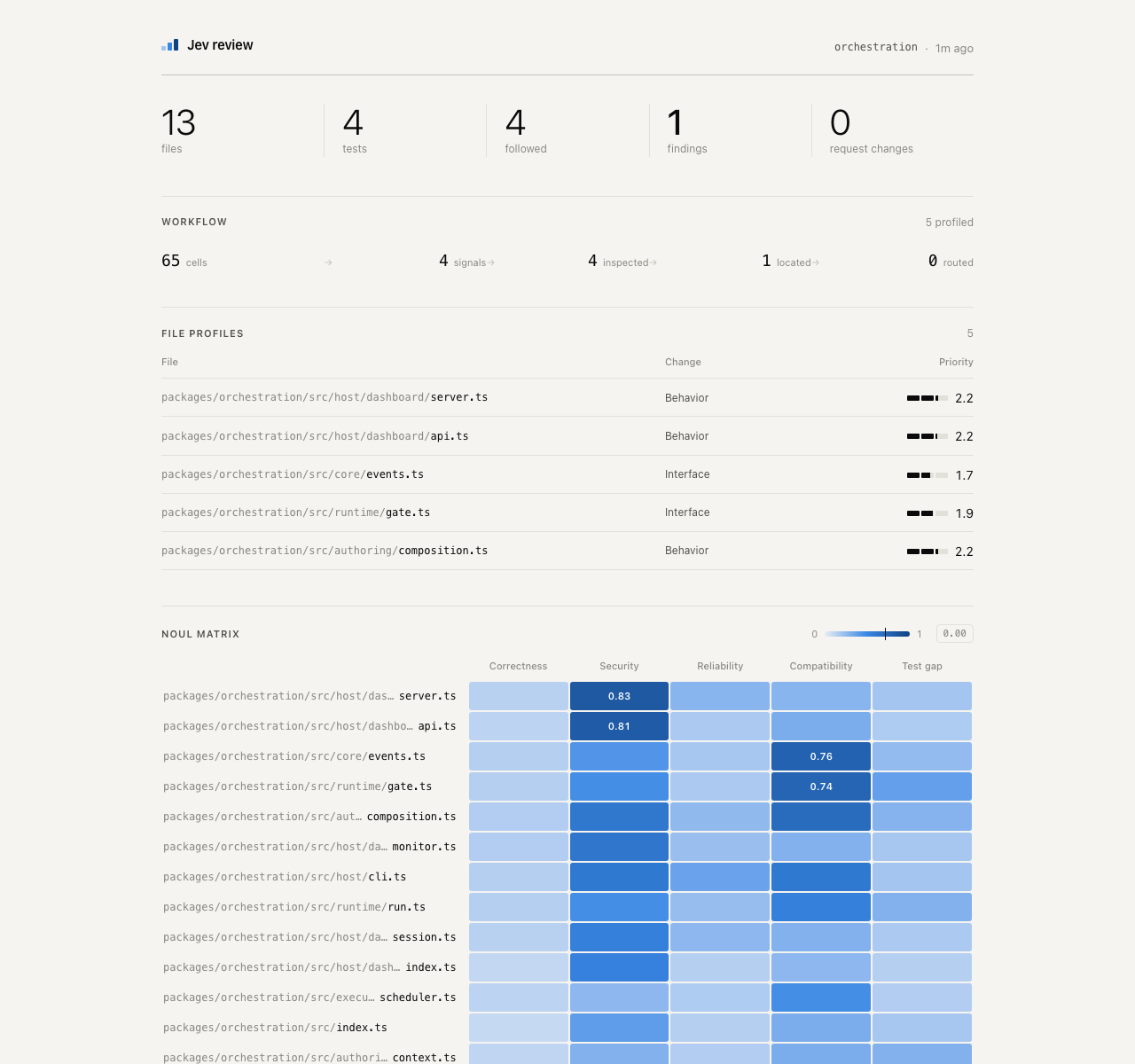
- 分阶段编排:风险矩阵、证据选择、机制分类、严重度评分、条件路由
- 审查正确性、安全、可靠性、兼容性和测试覆盖五类问题
- 判断测试缺口时把改动或相关测试作为上下文
- 先挑出具体 diff hunk 或源码区域再评影响
- 仪表盘只绑定 127.0.0.1,不提供环境文件
容易踩的坑
内容由模型根据 README 生成,可能不完整或不准确,以官方文档为准。看原文 README
暂无 release 数据(可能没有发版,或尚未同步)。
用户点评
登录用户的真实使用记录,可按版本和硬件筛选共 0 条
还没有人点评。第一个说出真实体验的人最有价值。
Jev Review
A small code-review workflow built with TypeSafe Jev. It can review a Git diff or scan a complete codebase, follows the strongest structured signals through focused model calls, and presents the result in a quiet local dashboard.

How It Works
The reviewer keeps orchestration in code and uses Jev for bounded judgments:
Noul risk matrix
  -> Choice + Score file profiles
  -> Choice evidence selection
  -> Choice mechanism classification
  -> Score severity
  -> conditional Choice reviewer routing
- Exposes separate change-review and complete-codebase entry points.
- Uses changed or related tests as context when judging test gaps.
- Screens correctness, security, reliability, compatibility, and test coverage.
- Selects concrete diff hunks or source regions before scoring impact.
- Uses structured hints, counterexamples, and explicit decision boundaries.
- Applies thresholds and workflow policy in code.
- Shows large reports in collapsible dashboard sections.
- Binds the dashboard to
127.0.0.1and never serves environment files.
Quick Start
Requires Node.js 24+, Git, and a TypeSafe API key.
npm install
cp .env.example .env
# Add TYPESAFE_API_KEY to .env

# Review the current Git diff
npm run review:changes:save -- /path/to/git/repository

# Or scan every non-ignored source file under a scope
npm run review:codebase:save -- /path/to/git/repository-or-package
npm run dashboard
Open http://127.0.0.1:4317.
Commands
| Command | Purpose |
|---|---|
npm run review:changes -- <path> | Print a current-diff review as JSON |
npm run review:changes:save -- <path> | Save a current-diff review for the dashboard |
npm run review:codebase -- <path> | Print a complete codebase scan as JSON |
npm run review:codebase:save -- <path> | Save a complete codebase scan for the dashboard |
npm run dashboard | Start the local dashboard |
npm run check | Typecheck, verify dependency flow, and syntax-check the dashboard client |
Architecture
Everything lives under src/, arranged in layers that only depend downward:
src/
  domain/      config.ts, types.ts, patch.ts   shared policy, report shapes, diff parsing
  adapters/    git.ts, repository-files.ts     change and complete-source discovery
               report-store.ts                 atomic report save/load
  review/      changes.ts, codebase.ts          mode-specific workflows
               *-judgments.ts, workflow.ts     Jev calls and shared staged orchestration
  cli/         review-*.ts, save-*.ts           explicit mode entry points
  dashboard/   server.ts, public/              local-only HTTP server and the plain client
Imports point toward lower layers only:
{ cli, dashboard } -> review -> adapters -> domain
scripts/check-dependencies.ts fails npm run check on any upward import, any
import between cli and dashboard, or any cycle.
Current Scope
This is an experiment in composing fast typed judgments into a review workflow. It does not yet integrate compiler diagnostics, static analyzers, repository indexing, or generated explanations. Findings are review prompts, not proof of a defect.
License
ruff
astral-sh·Rust
用 Rust 写成的超快 Python 代码检查与格式化工具,能替代 Flake8、Black 等,大幅缩短 lint 和格式化耗时。
Python 代码检查+4代码质量
51157+3952.6k0.17.42026-11-10 17:02 UTC

open-code-review
alibaba·Go
阿里开源的大规模代码审查工具,用确定性流水线加 LLM Agent 混合架构,精准定位行级问题,内置 NPE、线程安全、XSS、SQL 注入等多语言规则集。
代码审查+4代码质量
49782+1953.7kv1.13.62026-11-10 11:15 UTC
SwiftLint
realm·Swift
Swift 代码风格检查工具,按预设规则自动扫描并报告不符合规范的写法,帮团队统一 Swift 代码风格。
Swift+4代码质量
19786+72.3k0.65.12026-11-05 17:57 UTC

diff-so-fancy
so-fancy·Perl
把 Git diff 输出重新排版成更易读的格式,突出改动位置和代码块,方便快速定位缺陷、提升代码审查效率。
代码审查+3代码质量
18114+6350v1.4.142026-10-18 18:29 UTC