- 多节点跑 ZeRO-3/FSDP 分片训练:它把节点分配、代码部署、任务排队都包了,不用自己写 rsync 加 pdsh 那套胶水
- 团队共享一批机器、多个实验抢卡:队列机制让实验排队而不是互相 OOM 或抢显存
- 节点会掉、任务要能续:容错编排是它的核心卖点,长跑训练不用人盯着重启
- 用 @experiment 装饰器把实验定义和监控收进代码里,省掉一层外部 tracking 配置
higgsfield
higgsfield-aiApache-2.0活跃维护 有专家点评在自有 GPU 节点上编排多机训练任务并做容错调度,替代手工 SSH 加脚本拼集群
暂无版本6,295star1,171fork同步于 2026-11-07 07:31 UTC
专家点评
上手难度:硬核更新于 2026-11-11在自有 GPU 节点上编排多机训练任务并做容错调度,替代手工 SSH 加脚本拼集群
适用场景
踩坑
- 节点初始化门槛卡在权限模型上:必须是非 root 用户加免密 sudo,云镜像默认给的 root 或受限用户会直接失败,得先改镜像或建用户
- pip 装完只是开始,还要按 setup.md 在每台节点装 Docker、配部署密钥和二进制,节点多了这一步是逐台手工的
- 示例代码依赖外部数据模块(如 alpaca 加载),clone 下来直接跑示例会缺依赖,得自己补
同类对比
如果只是单机多卡或少量节点,torchrun 加 accelerate 更轻;要托管式集群调度就看 Ray 或 SkyPilot,它们不绑定这套部署密钥和 Docker 前置
pip install higgsfield==0.0.3 硬件要求按 README 说明
README 未给出具体显存或 GPU 型号要求;节点需为 Ubuntu、可 SSH 登录、具备免密 sudo 的非 root 用户,已在 Azure、LambdaLabs、FluidStack 上测试
项目说明
由 README 自动翻译提炼面向千亿到万亿参数大模型的多节点训练框架,自带容错 GPU 编排,省去环境与配置折腾
核心能力
- 分配节点独占或共享算力给训练任务
- 支持 ZeRO-3 DeepSpeed 与 PyTorch FSDP 分片
- 用队列管理资源争抢并排队跑实验
- 通过 GitHub Actions 自动部署代码到节点
- 用 @experiment 装饰器定义并监控训练实验
容易踩的坑
安装后还需按 setup.md 在节点上装 Docker、配置部署密钥和 higgsfield 二进制;节点必须提供免密 sudo 的非 root 用户,否则初始化会失败;示例依赖 alpaca 数据加载等外部模块,需自行准备
内容由模型根据 README 生成,可能不完整或不准确,以官方文档为准。看原文 README
暂无 release 数据(可能没有发版,或尚未同步)。
用户点评
登录用户的真实使用记录,可按版本和硬件筛选共 0 条
还没有人点评。第一个说出真实体验的人最有价值。
higgsfield - multi node training without crying
Higgsfield is an open-source, fault-tolerant, highly scalable GPU orchestration, and a machine learning framework designed for training models with billions to trillions of parameters, such as Large Language Models (LLMs).

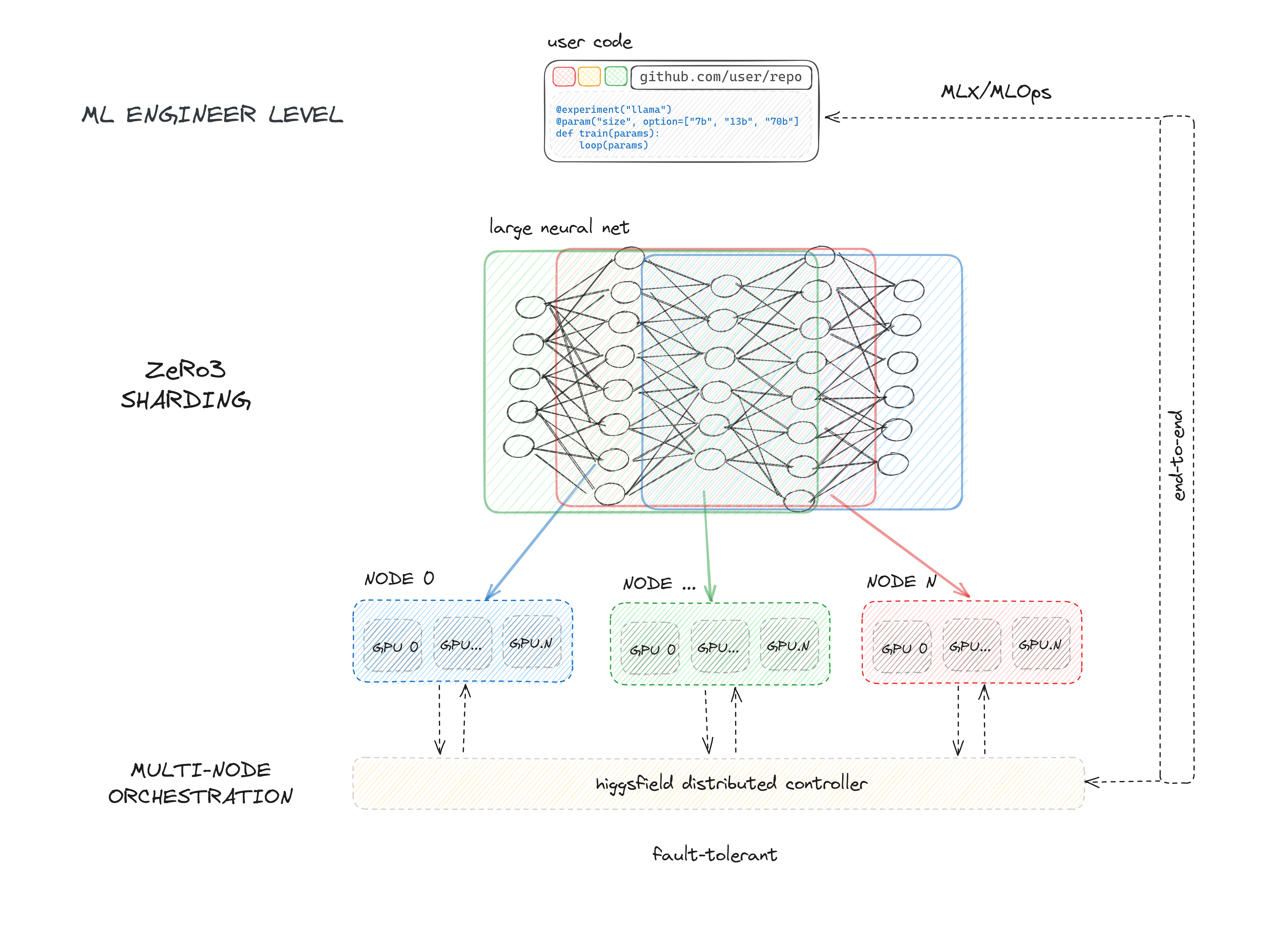
Higgsfield serves as a GPU workload manager and machine learning framework with five primary functions:
- Allocating exclusive and non-exclusive access to compute resources (nodes) to users for their training tasks.
- Supporting ZeRO-3 deepspeed API and fully sharded data parallel API of PyTorch, enabling efficient sharding for trillion-parameter models.
- Offering a framework for initiating, executing, and monitoring the training of large neural networks on allocated nodes.
- Managing resource contention by maintaining a queue for running experiments.
- Facilitating continuous integration of machine learning development through seamless integration with GitHub and GitHub Actions. Higgsfield streamlines the process of training massive models and empowers developers with a versatile and robust toolset.
Install
$ pip install higgsfield==0.0.3
Train example
That's all you have to do in order to train LLaMa in a distributed setting:
from higgsfield.llama import Llama70b
from higgsfield.loaders import LlamaLoader
from higgsfield.experiment import experiment

import torch.optim as optim
from alpaca import get_alpaca_data

@experiment("alpaca")
def train(params):
    model = Llama70b(zero_stage=3, fast_attn=False, precision="bf16")

    optimizer = optim.AdamW(model.parameters(), lr=1e-5, weight_decay=0.0)

    dataset = get_alpaca_data(split="train")
    train_loader = LlamaLoader(dataset, max_words=2048)

    for batch in train_loader:
        optimizer.zero_grad()
        loss = model(batch)
        loss.backward()
        optimizer.step()

    model.push_to_hub('alpaca-70b')
How it's all done?
- We install all the required tools in your server (Docker, your project's deploy keys, higgsfield binary).
- Then we generate deploy & run workflows for your experiments.
- As soon as it gets into Github, it will automatically deploy your code on your nodes.
- Then you access your experiments' run UI through Github, which will launch experiments and save the checkpoints.
Design
We follow the standard pytorch workflow. Thus you can incorporate anything besides what we provide, deepspeed, accelerate, or just implement your custom pytorch sharding from scratch.
Enviroment hell
No more different versions of pytorch, nvidia drivers, data processing libraries. You can easily orchestrate experiments and their environments, document and track the specific versions and configurations of all dependencies to ensure reproducibility.
Config hell
No need to define 600 arguments for your experiment. No more yaml witchcraft. You can use whatever you want, whenever you want. We just introduce a simple interface to define your experiments. We have even taken it further, now you only need to design the way to interact.
Compatibility
We need you to have nodes with:
- Ubuntu
- SSH access
- Non-root user with sudo privileges (no-password is required)
Clouds we have tested on:
- Azure
- LambdaLabs
- FluidStack
Feel free to open an issue if you have any problems with other clouds.
Getting started
Setup
Here you can find the quick start guide on how to setup your nodes and start training.
- Initialize the project
- Setup the environment
- Setup git
- Time to setup your nodes!
- Run your very first experiment
- Fasten your seatbelt, it's time to deploy!
Tutorial
API for common tasks in Large Language Models training.
- Working with distributed model
- Preparing Data
- Optimizing the Model Parameters
- Saving Model
- Training stabilization techniques
- Monitoring
| Platform | Purpose | Estimated Response Time | Support Level |
|---|---|---|---|
| Github Issues | Bug reports, feature requests, install issues, usage issues, etc. | < 1 day | Higgsfield Team |
| For staying up-to-date on new features. | Daily | Higgsfield Team | |
| Website | Discussion, news. | < 2 days | Higgsfield Team |

LocalAI
mudler·Go
开源本地 AI 推理引擎,无需 GPU 即可在任意硬件上跑 LLM、视觉、语音和图像生成模型,提供兼容 OpenAI 的 API。
推理引擎+4分布式训练进阶
50302+664.6kv4.12.12026-11-11 00:59 UTC
DeepSpeed
deepspeedai·Python
基于 PyTorch 的深度学习优化库,通过 ZeRO、模型并行和混合专家等技术,让千亿到万亿参数模型的分布式训练与推理更省显存、更高效。
分布式训练+4分布式训练进阶
43319+125.1kv0.19.92026-11-11 03:53 UTC
ColossalAI
hpcaitech·Python
一套面向大模型训练的分布式并行框架,把数据、模型、流水线并行和异构训练整合成统一接口,让训练和推理更省显存、更快。
分布式训练+4分布式训练硬核
41433+54.5kv0.5.02026-11-11 05:14 UTC
dgraph
dgraph-io·Go
高性能分布式图数据库,专为实时查询场景设计,支持知识图谱等大规模关联数据的存储与毫秒级检索。
图数据库+4分布式训练进阶
21824+41.6kv25.5.12026-11-05 23:30 UTC