v0.2.4 (2026-11-10)
Added
- code-review: strengthen behavior-review evidence for v0.2.4
Auditable code review skill for Claude Code and Codex: four independent probes, evidence-backed findings, and a JSON-derived merge gate.
npx -y skills add kyy-logs/code-review-gate-skill --agent codex --skill code-review-gate --yes
npx -y skills add kyy-logs/code-review-gate-skill --agent codex --skill code-review-gate-zh --yesREADME 没有说明硬件要求。
这个项目的说明还在生成中,先参考下面「最近发版」和 README。
还没有人点评。第一个说出真实体验的人最有价值。
English | 简体中文
Evidence-backed code review. Static-first, probe-driven, and gated.
The skill sources live in skills/code-review-gate/ (English) and skills/code-review-gate-zh/ (Chinese), independently of any host's installation directory. The current stable release is v0.2.4; see VERSION.




Most AI reviews stop at “this looks risky.” This skill produces a review you can audit: every finding points to a location, a contract or code path, and a severity; every gate decision is rendered from machine-readable JSON. It reads the diff, surrounding source, tests, and project rules — no build, test run, or coverage report required.
It never modifies the code under review.
v0.2.4 is a stable release within the scope described below.
Pre-1.0 contract or format changes will be documented in NEWS.
high, medium, low. Records written by the
earlier four-level version, including any critical value, are not
compatible; collect-metrics rejects them. Re-run the review or migrate the
records before using them with this release.For the next stable release, update VERSION (for example, to 0.1.1) and push it to main. After Validate skills succeeds, the release workflow generates NEWS from commits, updates the README release information, and publishes the version tag and GitHub Release. Existing releases are preserved; failed CI does not publish.
No self-grading.
The implementation context does not sign off on its own work. Four probes run in fresh contexts, each files its own evidence, and the gate is derived from those records.
This is separation of duties, not independent human adjudication; all probes still use the same model.
| Static-first | Works on a fresh clone or a partial checkout. Coverage is optional, not a prerequisite. |
| Evidence contract | A finding without a location, summary, and checkable evidence is not a finding. |
| Four probes | Behavior, tests, rules, and impact are separate questions with separate reports. |
| Machine-checkable gate | Counts and blockers come from JSON, not from prose the model retyped. |
| Auditable output | The human report and the JSON records are rendered from the same source and verified against each other. |
Run this command inside your project:
# English (default)
npx -y skills add kyy-logs/code-review-gate-skill --agent codex --skill code-review-gate --yes

# Chinese
npx -y skills add kyy-logs/code-review-gate-skill --agent codex --skill code-review-gate-zh --yes
Use --agent claude-code for Claude Code. Codex installs to .agents/skills/<skill>/; Claude Code installs to .claude/skills/<skill>/. Node.js 22.20+ is required. Install one language per project. The Python installers also accept --lang en|zh-CN and default to English.
Ask in Claude Code:
Review these changes with code-review-gate.
Or invoke the skill directly:
/code-review-gate
For a fixed range:
Use code-review-gate on commits abc123..def456
The skill supports two review modes:
worktree — staged, unstaged, and untracked changes against the current HEAD.commits — a fixed base..head range.docs/work/active/{slug}/
├── code-review.md # human report
├── review-snapshot.json
└── probes/
├── behavior-review.json
├── test-coverage.json
├── repo-guard.json
└── impact-analysis.json
The four probes use the same model in fresh contexts. This is separation of duties, not independent human review. A passing gate is not human approval, CI, or proof that no issues remain. The current skill has no separate reviewer or finding-verification stage; raw findings feed the report and gate.
worktree or commits; record base and head as commit IDs, then init the run with --mode to pin review-snapshot.json.collect-metrics.| Probe | Required | Question it answers |
|---|---|---|
behavior-review | yes | Does the changed behavior match its actual contract and implementation path? |
test-coverage | yes | Are the tests meaningful, and is incremental coverage measured when data exists? |
repo-guard | yes | Does the change violate repository or project rules? |
impact-analysis | no | Who calls this, what contracts change, and what is the performance/architecture blast radius? |
Probes are intentionally narrow. behavior-review is not a linter, and repo-guard is not a general bug scanner.
The default repo-guard workflow selects .java, .ts, .tsx, and .vue files for pattern scanning. The built-in rule pack includes Java- and Spring-specific guidance; selecting an extension does not establish complete framework or language coverage.
AI semantic checks can inspect relevant code beyond those extensions, but their results depend on the model and available contracts, source, and tests. The historical cases below exercise particular stacks and skill snapshots; they do not establish equally validated support across all stacks. Use applicable project rules and record unverified dependencies or language-specific behavior.
Every finding records:
| Field | Meaning |
|---|---|
location | path:line, or file level with a reason |
summary | What is wrong — not “consider improving” |
evidence | Contract, code path, test output, or rule ID |
severity | high / medium / low |
status | open / reconciled / wontfix / false-positive |
High-severity findings must cite the actual method signature and the contract they violate, or a concrete code path. A hunch is capped at medium until the evidence is checked.
references/probes.yaml controls the probe registry:
Project-specific rules can live in .code-review/rules/, or be pointed to with CODE_REVIEW_RULES_DIR:
export CODE_REVIEW_RULES_DIR=/path/to/rules
A project rule package replaces the built-in package; it is not merged with it.
Offline tests check JSON validation, derived counts, report consistency, installation, and gate behavior. Passing them does not establish defect-detection recall, false-positive rates, or the correctness of an AI finding.
A controlled comparison against a single-agent review, measuring missed defects, false positives, wall-clock time, and token usage on the same cases and model configuration, has not yet been established. The historical runs below are snapshot-specific observations and do not demonstrate an improvement over that baseline.
494a39bb, before behavior-review was extracted into a standalone probe. The snapshot validates the shared finding and gate contract, not the four-probe split itself.Risk areas exercised by these cases:
| Risk area | Cases | Observed result |
|---|---|---|
| Resource lifecycle | DBeaver | Found an input stream left open after copying; confirmed target. |
| Execution logic | Kestra, Keycloak guides | Found duplicate interpreter/command assembly in Kestra; confirmed target. Also reported switch fall-through in Keycloak, with downstream impact only partly supported. |
| Input boundaries and value handling | Lang-1, Spring AI Alibaba | Found hexadecimal overflow handling and blank-string sentinel problems; confirmed targets. The leading-zero return-type finding remained a contract dispute and was rated too high. |
| Permissions and data scope | Keycloak groups (m01), Elasticsearch | Found authorization resource IDs used as group IDs; confirmed target. The non-default filesystem permission-bypass candidate still needs threat-model and exploitability evidence. |
| API compatibility | Kestra | Identified public SPI return-type changes and new abstract methods; compatibility break supported, affected external plugins not measured. |
| Cache and state consistency | Keycloak login cache (m02) | Reported an invalidation risk involving organization-wrapped models; runtime consequences remain unverified. |
| Performance and repeated work | Elasticsearch, Kestra, Keycloak login cache | Reported logging overhead, repeated rendering/downloads, and extra lookups; performance impact was not benchmarked. |
| Test quality and regression protection | DBeaver, Keycloak, Kestra | Identified missing branch tests, tests bypassing the changed production entry point, and incorrect cleanup or cache-invalidation coverage. |
The two confirmed misses were Keycloak's valid tileVisible = "false"
syntax bypassing validation, and Kestra's JSON render/parse round-trip
corrupting command values containing quotes, backslashes, or newlines.
The four controls checked false alarms: the Lang-1 fix, normal pagination, normal tag normalization, and a valid login-cache delegation path that should not be reported as recursion. Passing a control does not establish that its entire change is defect-free.
The evaluation harness and raw reports are kept out of the published repository. This snapshot is a regression result, not a claim of general recall.
2026-10-30-review9-1a4adc1 on an older main (1a4adc1); it did not re-run the 11 historical cases. Do not combine the two batches into a 20/20 claim.d flag and x04's cancellation/loading lifecycle./bin/bash; Linux/Windows Git Bash: bash).npx skills install entry.code-review-gate-skill/
├── README.md
├── README.zh-CN.md
├── NEWS.md
├── LICENSE
├── VERSION
├── assets/
│ ├── code-review-architecture.svg
│ └── code-review-architecture.zh-CN.svg
├── .github/workflows/
│ ├── news-update.yml
│ ├── skill-validation.yml
│ ├── star-history.yml
│ └── sync-news.yml
├── scripts/
│ ├── check-skill-locales.py
│ ├── install
│ ├── install.py
│ ├── install-remote.py
│ ├── news-update.py
│ ├── sync-skill-scripts.py
│ └── sync-news.py
├── shared/scripts/
│ ├── collect-metrics
│ ├── lib-metrics
│ ├── rule-grep
│ └── sync-results.py
├── skills/
│ ├── code-review-gate/
│ │ ├── SKILL.md
│ │ ├── assets/
│ │ ├── references/
│ │ └── scripts/
│ └── code-review-gate-zh/
│ ├── SKILL.md
│ ├── assets/
│ ├── references/
│ └── scripts/
└── tests/
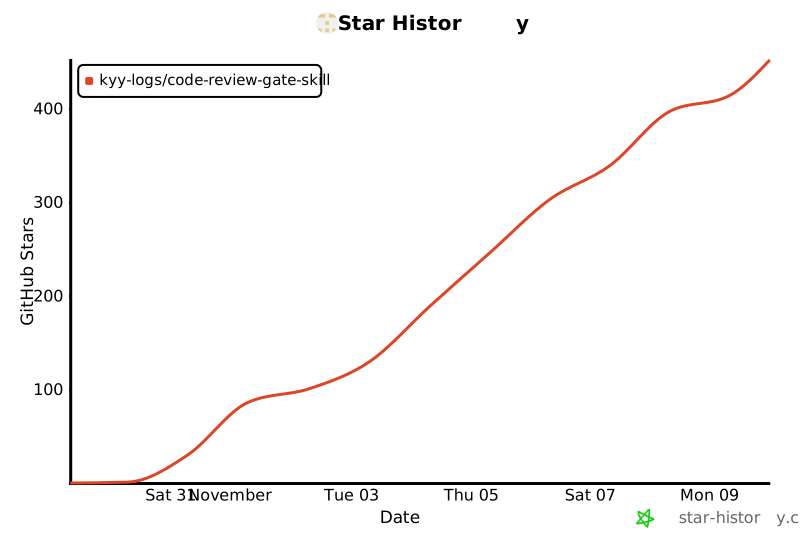
Updated daily by star-history.yml.
Issues and pull requests are welcome. For a behavior change, include the review target (repo and base/head), expected and observed result or gate decision, and evidence that distinguishes them.
For a probe or schema change, update the probe document, output contract, and affected scripts together.
Run tests with python -m unittest discover -s tests -v; set CODE_REVIEW_TEST_BASH to include shell and installation checks. These tests do not call models or establish defect recall.
For user-facing changes, add an entry to NEWS.md. Pushes to main update the README news preview; locally, run python scripts/news-update.py and python scripts/sync-news.py (use --check to verify only). Keep the Chinese README aligned.
This repository is distributed under the MIT License.
Optional .code-review/config.json (paths relative to the reviewed project):
{
  "output_dir": "docs/work",
  "line_target": 85,
  "branch_target": 80
}
85% / 80% are configurable defaults. Line coverage blocks below target; branch coverage is advisory.
Probes, gates, and reports use the same effective targets. CODE_REVIEW_OUTPUT_DIR overrides the output root;
pass identical settings to every shell invocation. Source inspection is read-only, but the workflow writes
active/<slug>/code-review.md, probes/*.json, review-snapshot.json, root-level workflow-events.log,
and scorecards / quality-trend.csv on archive.
Start a new review with bash "$CODE_REVIEW_SKILL_DIR/scripts/collect-metrics" init <unique-slug> --mode worktree
(or --mode commits --base <base> [--head <head>]). With --mode, init writes review-snapshot.json; new runs
should always pass it. Omitting --mode keeps the legacy behavior and skips freshness checking.
Existing active, archived, or event-history slugs are rejected. Re-rendering the same run updates only automatic report regions;
do not run concurrent writers for the same run. The effective thresholds are returned by init and recorded in the generated report; keep configuration stable when
resuming, and re-check findings and re-render after policy changes. gate-pass code-review recomputes review-snapshot.json
and returns stale-review when the reviewed source changed; run snapshot <slug> after a fix and re-review.
The minimum shell is Bash 3.2. macOS can use /bin/bash; Linux / Windows Git Bash use bash.
A macOS CI job is configured; a passing macOS result has not been established locally.
用 Rust 写成的超快 Python 代码检查与格式化工具,能替代 Flake8、Black 等,大幅缩短 lint 和格式化耗时。

阿里开源的大规模代码审查工具,用确定性流水线加 LLM Agent 混合架构,精准定位行级问题,内置 NPE、线程安全、XSS、SQL 注入等多语言规则集。
Swift 代码风格检查工具,按预设规则自动扫描并报告不符合规范的写法,帮团队统一 Swift 代码风格。

把 Git diff 输出重新排版成更易读的格式,突出改动位置和代码块,方便快速定位缺陷、提升代码审查效率。
