输入文本、图像、视频及生成结果需另行从 Google Drive 或百度网盘下载,pip 包只负责按 ID 取 prompt;调用 load_prompt.get_prompts 时需传入 id 列表和模型名,视觉 prompt 返回的是图像或视频 URL 而非本地文件
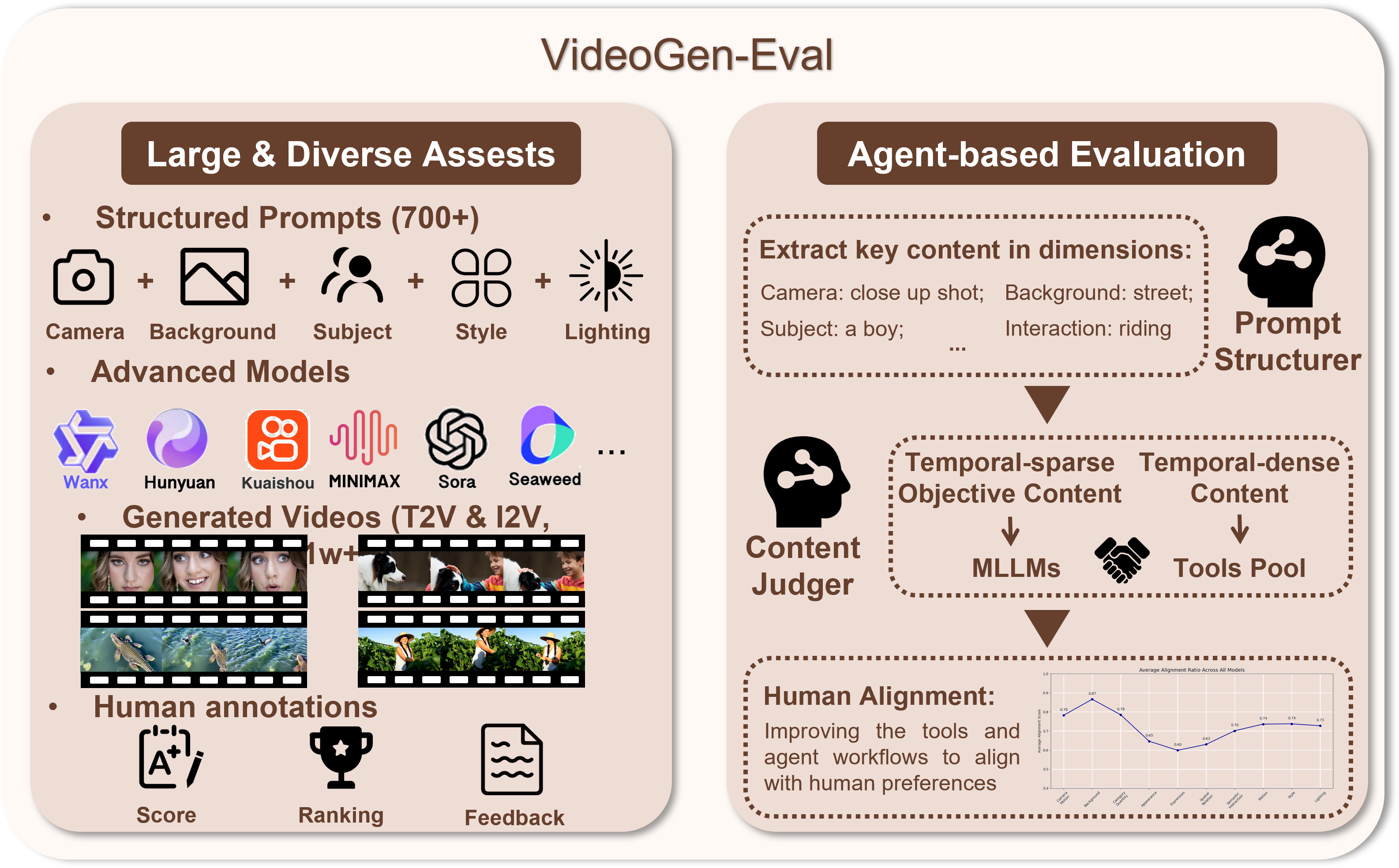
VideoGen-Eval
AILab-CVCMIT更新放缓基于智能体的视频生成评测系统,用自动化方式给文生视频、图生视频等模型的生成质量打分,省去人工逐条评估的麻烦。
VideoGen-Eval: Agent-based System for Video Generation Evaluation
暂无版本272star15fork同步于 2026-11-07 07:30 UTC
基于 Agent 的视频生成评测系统,用动态可扩展方式对比 T2V/I2V/V2V 模型表现
基于智能体的视频生成评测系统,用自动化方式给文生视频、图生视频等模型的生成质量打分,省去人工逐条评估的麻烦。
核心能力
- 用 Agent 驱动评测,强调动态、可扩展、可演进
- 覆盖 T2V、I2V、V2V 三类视频生成任务
- 用 700 条关键 prompt 对比十余个闭源与开源模型
- 为每个用例分配 ID,输入与生成结果按 model_name+id.mp4 命名
- 提供 VGenEval pip 包,一行代码按 ID 取回文本与视觉 prompt
容易踩的坑
内容由模型根据 README 生成,可能不完整或不准确,以官方文档为准。看原文 README
暂无 release 数据(可能没有发版,或尚未同步)。
用户点评
登录用户的真实使用记录,可按版本和硬件筛选共 0 条
还没有人点评。第一个说出真实体验的人最有价值。


Project Page 🚀 | Agent Evaluation Report 📝 | Survey Report 📝 | Prompt 🎬 | Video Download 🤩 | Join WeChat 💬
🔥 Project Updates
- News:
2025/3/31: We propose an agent-based video generation evaluation, which is dynamic, flexible, and evolutionary. - News:
2024/12/21: We update results of PramidalFlow, please check our website. - News:
2024/12/10: We update results of Sora and the comparison results of the latest 6 Sota models. - News:
2024/12/04: We update results of Hunyuan, please check our website. - News:
2024/11/21: We update results of Seaweed2.0 Pro, PixelDance2.0 Pro, Pika1.5 and Vidu1.5, please check our website. - News:
2024/11/12: We update results of Seaweed and PixVerse-V3, please check our website. - News:
2024/11/01: We update text-to-video results of Mochi1, we usecfg=6.0, which is the same as their website. - News:
2024/10/19: We update 1k text-to-video results of Meta-MovieGen (prompts are from MovieGenVideoBench); please check here. Plus, we make the pypi packageVGenEvalavailable, you can easily obtain all input prompts (text, image, video) corresponding to any ID through jsut one line of code. - News:
2024/10/14: We update results of Minimax image-to-video generation, please check here. - News:
2024/10/08: VideoGen-Eval-1.0 is available, please check the Project Page and Technical Report for more details.
💡 About The Project
High-quality video generation, such as text-to-video (T2V), image-to-video (I2V), and video-to-video (V2V) generation, holds considerable significance in content creation and world simulation. Models like SORA have advanced generating videos with higher resolution, more natural motion, better vision-language alignment, and increased controllability, particularly for long video sequences. These improvements have been driven by the evolution of model architectures, shifting from UNet to more scalable and parameter-rich DiT models, along with large-scale data expansion and refined training strategies. However, despite the emergence of several DiT-based closed-source and open-source models, a comprehensive investigation into their capabilities and limitations still needs to be completed. Additionally, existing evaluation metrics often fail to align with human preferences.
This survey report studies a series of SORA-like T2V, I2V, and V2V models via to bridge the gap between academic research and industry practice and provide a more profound analysis of recent video generation advancements. This is achieved by demonstrating and comparing over 8,000 generated video cases from ten closed-source and several open-source models (Kling 1.0, Kling 1.5, Gen-3, Luma 1.0, Luma 1.6, Vidu, Qingying, MiniMax Hailuo, Tongyi Wanxiang, Pika1.5) via our 700 critical prompts. Seeing is believing. We encourage readers to visit our Website to browse these results online. Our study systematically examines four core aspects:
Our agent-based evaluation emphasizes a flexible, scalable, and evolving system to keep up with the rapid development of video generation
We assign an ID to each case. The input text, the names of input images and videos correspond to the ID. The results generated by different models are named as model_name+id.mp4. Please refer to the prompt. All the results are publicly accessible, and we will continuously update the results as new models are released and existing ones undergo version updates.
🎞️ Assets
The inputs we introduced, including the input text, images, videos, and the generated results of all models, are available for download at Google Drive and Baidu. You can also visit our Website to browse these results online.
Get VideoGen-Eval prompts:
pip install VGenEval

# example
#id_list of the id e.g. [0,1,2,3]
#test_model_name of the model name e.g. 'SORA'
from VGenEval import load_prompt
results = load_prompt.get_prompts([id_list], 'test_model_name')

# result is a dict, {
#   'text prompt': [],
#   'visual prompt': [], return the url of the input image or video
#   'save name': [], We have standardized the save name
# }

# note: for the sample which takes the first-last frame for generation, visual prompt return urls of the two frames.
🦉 Job List
- VideoGen-Eval-1.0 released
- Add results of multiple models.
💗 Contributing
Welcome all contributions! If you have a suggestion to improve this project, please fork the repo and create a pull request. You can also open an issue with the tag "enhancement." Don't forget to give the project a star! Thanks again!
- Fork the Project
- Create your Feature Branch (
git checkout -b feature/AmazingFeature) - Commit your Changes (
git commit -m 'Add some change') - Push to the Branch (
git push origin feature/AmazingFeature) - Open a Pull Request
🏄 Top contributors:
✏️ License
Distributed under the MIT License. See LICENSE.txt for more information.
📢 Contact
Ailing Zeng - [email protected]
Yuhang Yang - [email protected]
💌 Citation
@article{zeng2024dawn,
  title={The Dawn of Video Generation: Preliminary Explorations with SORA-like Models},
  author={Zeng, Ailing and Yang, Yuhang and Chen, Weidong and Liu, Wei},
  journal={arXiv preprint arXiv:2410.05227},
  year={2024}
}
@article{yang2025videogen,
  title={VideoGen-Eval: Agent-based System for Video Generation Evaluation},
  author={Yang, Yuhang and Fan, Ke and Sun, Shangkun and Li, Hongxiang and Zeng, Ailing and Han, FeiLin and Zhai, Wei and Liu, Wei and Cao, Yang and Zha, Zheng-Jun},
  journal={arXiv preprint arXiv:2503.23452},
  year={2025}
}