PyPI 版本可能不是最新,需最新功能应从仓库 pip install -e . 安装;首次运行需从 Hugging Face 下载模型权重;量化缓存(quantize_cache)在基准中反而明显降低吞吐。
phi
JosefAlbersMIT活跃维护在 Apple Silicon Mac 上本地运行 Phi-3、Phi-3.5 和 Phi-4 视觉与语言模型,基于 MLX 和 Metal 加速,支持微调、LoRA 与多智能体编排。
Phi-3, -3.5, and -4 for Mac: Locally-run Vision and Language Models for Apple Silicon
v0.1.7发布于 2026-07-31 08:44 UTC280star22fork同步于 2026-11-07 07:29 UTC
pip install phi-3-vision-mlx
phi3v 硬件要求按 README 说明
需 Apple Silicon Mac(M1、M2 或更新),8GB 内存配合 quantize_model=True 量化可运行,推荐 16GB 以上;README 未提及非 Apple 平台或 NVIDIA GPU 支持。
支持 Apple Silicon
在 Apple Silicon Mac 上本地运行 Phi-3/3.5/4 视觉与语言模型的 MLX 框架
在 Apple Silicon Mac 上本地运行 Phi-3、Phi-3.5 和 Phi-4 视觉与语言模型,基于 MLX 和 Metal 加速,支持微调、LoRA 与多智能体编排。
核心能力
- 用 MLX 框架针对 Apple Silicon 优化推理
- 支持 Phi-3.5-vision 多模态与 Phi-3.5-mini 语言模型
- 提供模型与 KV 缓存量化以降低内存占用
- 内置 Agent 多轮对话、代码执行与外部 API 工具调用
- 支持 LoRA 微调与批量生成
容易踩的坑
内容由模型根据 README 生成,可能不完整或不准确,以官方文档为准。看原文 README
- v0.1.7Phi-4-MLX最新正式版2026-07-31 · 2026-07-31 08:44 UTC
Updates
Nov 9 2025: You can pass
repo_id="microsoft/MediPhi-Instruct"(or any other compatible HF repo) to load and run alternative models directly.generate("A 20-year-old woman presents with menorrhagia for the past several years. She says that her menses “have always been heavy”, and she has experienced easy bruising for as long as she can remember. Family history is significant for her mother, who had similar problems with bruising easily. The patient's vital signs include: heart rate 98/min, respiratory rate 14/min, temperature 36.1°C (96.9°F), and blood pressure 110/87 mm Hg. Physical examination is unremarkable. Laboratory tests show the following: platelet count 200,000/mm3, PT 12 seconds, and PTT 43 seconds. Which of the following is the most likely cause of this patient’s symptoms? A: Factor V Leiden B: Hemophilia A C: Lupus anticoagulant D: Protein C deficiency E: Von Willebrand disease", repo_id="microsoft/MediPhi-Instruct") ... 'E: Von Willebrand disease<|end|>'Nov 10 2025:
repo_id="microsoft/Phi-4-mini-instruct"Jul 31 2026:
deepseek_apifor DeepSeek R1 throughrouter.huggingface.cofree tier access - v0.1.5Phi-3.5-MLX2024-08-21 · 2024-08-21 01:21 UTC
查看更新说明
Phi-3-MLX is a versatile AI framework that leverages both the Phi-3-Vision multimodal model and the Phi-3-Mini-128K language model, optimized for Apple Silicon using the MLX framework. This project provides an easy-to-use interface for a wide range of AI tasks, from advanced text generation to visual question answering and code execution.
Features
- Integration with Phi-3-Vision (multimodal) model
- Support for the Phi-3-Mini-128K (language-only) model
- Optimized performance on Apple Silicon using MLX
- Batched generation for processing multiple prompts
- Flexible agent system for various AI tasks
- Custom toolchains for specialized workflows
- Model quantization for improved efficiency
- LoRA fine-tuning capabilities
- API integration for extended functionality (e.g., image generation, text-to-speech)
Minimum Requirements
Phi-3-MLX is designed to run on Apple Silicon Macs. The minimum requirements are:
- Apple Silicon Mac (M1, M2, or later)
- 8GB RAM (with quantization using
quantize_model=Trueoption)
For optimal performance, especially when working with larger models or datasets, we recommend using a Mac with 16GB RAM or more.
Quick Start
Install and launch Phi-3-MLX from command line:
pip install phi-3-vision-mlx phi3vTo instead use the library in a Python script:
from phi_3_vision_mlx import generate1. Core Functionalities
Visual Question Answering
generate('What is shown in this image?', 'https://collectionapi.metmuseum.org/api/collection/v1/iiif/344291/725918/main-image')Model and Cache Quantization
# Model quantization generate("Describe the water cycle.", quantize_model=True) # Cache quantization generate("Explain quantum computing.", quantize_cache=True)Batch Text Generation
# A list of prompts for batch generation prompts = [ "Write a haiku about spring.", "Explain the theory of relativity.", "Describe a futuristic city." ] # Generate responses using Phi-3-Vision (multimodal model) generate(prompts, max_tokens=100) # Generate responses using Phi-3-Mini-128K (language-only model) generate(prompts, max_tokens=100, blind_model=True)Constrained Beam Decoding
from phi_3_vision_mlx import constrain # Use constrain for structured generation (e.g., code, function calls, multiple-choice) prompts = [ "A 20-year-old woman presents with menorrhagia for the past several years. She says that her menses “have always been heavy”, and she has experienced easy bruising for as long as she can remember. Family history is significant for her mother, who had similar problems with bruising easily. The patient's vital signs include: heart rate 98/min, respiratory rate 14/min, temperature 36.1°C (96.9°F), and blood pressure 110/87 mm Hg. Physical examination is unremarkable. Laboratory tests show the following: platelet count 200,000/mm3, PT 12 seconds, and PTT 43 seconds. Which of the following is the most likely cause of this patient’s symptoms? A: Factor V Leiden B: Hemophilia A C: Lupus anticoagulant D: Protein C deficiency E: Von Willebrand disease", "A 25-year-old primigravida presents to her physician for a routine prenatal visit. She is at 34 weeks gestation, as confirmed by an ultrasound examination. She has no complaints, but notes that the new shoes she bought 2 weeks ago do not fit anymore. The course of her pregnancy has been uneventful and she has been compliant with the recommended prenatal care. Her medical history is unremarkable. She has a 15-pound weight gain since the last visit 3 weeks ago. Her vital signs are as follows: blood pressure, 148/90 mm Hg; heart rate, 88/min; respiratory rate, 16/min; and temperature, 36.6℃ (97.9℉). The blood pressure on repeat assessment 4 hours later is 151/90 mm Hg. The fetal heart rate is 151/min. The physical examination is significant for 2+ pitting ede - v0.1.4Phi-3-MLX: Language and Vision Models for Apple Silicon2024-07-23 · 2024-07-23 10:26 UTC
查看更新说明
Phi-3-MLX is a versatile AI framework that leverages both the Phi-3-Vision multimodal model and the Phi-3-Mini-128K language model, optimized for Apple Silicon using the MLX framework. This project provides an easy-to-use interface for a wide range of AI tasks, from advanced text generation to visual question answering and code execution.
Features
- Integration with Phi-3-Vision (multimodal) model
- Support for the Phi-3-Mini-128K (language-only) model
- Optimized performance on Apple Silicon using MLX
- Batched generation for processing multiple prompts
- Flexible agent system for various AI tasks
- Custom toolchains for specialized workflows
- Model quantization for improved efficiency
- LoRA fine-tuning capabilities
- API integration for extended functionality (e.g., image generation, text-to-speech)
Quick Start
Install and launch Phi-3-MLX from command line:
pip install phi-3-vision-mlx phi3vTo instead use the library in a Python script:
from phi_3_vision_mlx import generate1. Core Functionalities
Visual Question Answering
generate('What is shown in this image?', 'https://collectionapi.metmuseum.org/api/collection/v1/iiif/344291/725918/main-image')Batch Text Generation
# A list of prompts for batch generation prompts = [ "Explain the key concepts of quantum computing and provide a Rust code example demonstrating quantum superposition.", "Write a poem about the first snowfall of the year.", "Summarize the major events of the French Revolution.", "Describe a bustling alien marketplace on a distant planet with unique goods and creatures." "Implement a basic encryption algorithm in Python.", ] # Generate responses using Phi-3-Vision (multimodal model) generate(prompts, max_tokens=100) # Generate responses using Phi-3-Mini-128K (language-only model) generate(prompts, max_tokens=100, blind_model=True)Constrained (Beam Search) Decoding
The
constrainfunction allows for structured generation, which can be useful for tasks like code generation, function calling, chain-of-thought prompting, or multiple-choice question answering.from phi_3_vision_mlx import constrain # Define the prompt prompt = "Write a Python function to calculate the Fibonacci sequence up to a given number n." # Define constraints constraints = [ (100, "\n```python\n"), # Start of code block (100, " return "), # Ensure a return statement (200, "\n```"), # End of code block ] # Apply constrained decoding using the 'constrain' function from phi_3_vision_mlx. constrain(prompt, constraints)The
constrainfunction can also guide the model to provide reasoning before concluding with an answer. This approach can be especially helpful for multiple-choice questions, such as those in the Massive Multitask Language Understanding (MMLU) benchmark, where the model's thought process is as crucial as its final selection.prompts = [ "A 20-year-old woman presents with menorrhagia for the past several years. She says that her menses “have always been heavy”, and she has experienced easy bruising for as long as she can remember. Family history is significant for her mother, who had similar problems with bruising easily. The patient's vital signs include: heart rate 98/min, respiratory rate 14/min, temperature 36.1°C (96.9°F), and blood pressure 110/87 mm Hg. Physical examination is unremarkable. Laboratory tests show the following: platelet count 200,000/mm3, PT 12 seconds, and PTT 43 seconds. Which of the following is the most likely cause of this patient’s symptoms? A: Factor V Leiden B: Hemophilia A C: Lupus anticoagulant D: Protein C deficiency E: Von Willebrand disease", "A 25-year-old primigravida presents to her physician for a routine prenatal visit. She is at 34 weeks gestation, as confirmed by an ultrasound examin - v0.1.0Phi-3-MLX: Language and Vision Models for Apple Silicon2024-07-20 · 2024-07-20 05:34 UTC
查看更新说明
Phi-3-MLX is a versatile AI framework that leverages both the Phi-3-Vision multimodal model and the recently updated (July 2, 2024) Phi-3-Mini-128K language model, optimized for Apple Silicon using the MLX framework. This project provides an easy-to-use interface for a wide range of AI tasks, from advanced text generation to visual question answering and code execution.
Features
- Support for the newly updated Phi-3-Mini-128K (language-only) model
- Integration with Phi-3-Vision (multimodal) model
- Optimized performance on Apple Silicon using MLX
- Batched generation for processing multiple prompts
- Flexible agent system for various AI tasks
- Custom toolchains for specialized workflows
- Model quantization for improved efficiency
- LoRA fine-tuning capabilities
- API integration for extended functionality (e.g., image generation, text-to-speech)
Quick Start
Install and launch Phi-3-MLX from command line:
pip install phi-3-vision-mlx phi3vTo instead use the library in a Python script:
from phi_3_vision_mlx import generate1. Core Functionalities
Visual Question Answering
generate('What is shown in this image?', 'https://collectionapi.metmuseum.org/api/collection/v1/iiif/344291/725918/main-image')Batch Text Generation
# A list of prompts for batch generation prompts = [ "Explain the key concepts of quantum computing and provide a Rust code example demonstrating quantum superposition.", "Write a poem about the first snowfall of the year.", "Summarize the major events of the French Revolution.", "Describe a bustling alien marketplace on a distant planet with unique goods and creatures." "Implement a basic encryption algorithm in Python.", ] # Generate responses using Phi-3-Vision (multimodal model) generate(prompts, max_tokens=100) # Generate responses using Phi-3-Mini-128K (language-only model) generate(prompts, max_tokens=100, blind_model=True)Constrained (Beam Search) Decoding
The
constrainfunction allows for structured generation, which can be useful for tasks like code generation, function calling, chain-of-thought prompting, or multiple-choice question answering.from phi_3_vision_mlx import constrain # Define the prompt prompt = "Write a Python function to calculate the Fibonacci sequence up to a given number n." # Define constraints constraints = [ (100, "\n```python\n"), # Start of code block (100, " return "), # Ensure a return statement (200, "\n```")], # End of code block # Apply constrained decoding using the 'constrain' function from phi_3_vision_mlx. constrain(prompt, constraints)The
constrainfunction can also guide the model to provide reasoning before concluding with an answer. This approach can be especially helpful for multiple-choice questions, such as those in the Massive Multitask Language Understanding (MMLU) benchmark, where the model's thought process is as crucial as its final selection.prompts = [ "A 20-year-old woman presents with menorrhagia for the past several years. She says that her menses “have always been heavy”, and she has experienced easy bruising for as long as she can remember. Family history is significant for her mother, who had similar problems with bruising easily. The patient's vital signs include: heart rate 98/min, respiratory rate 14/min, temperature 36.1°C (96.9°F), and blood pressure 110/87 mm Hg. Physical examination is unremarkable. Laboratory tests show the following: platelet count 200,000/mm3, PT 12 seconds, and PTT 43 seconds. Which of the following is the most likely cause of this patient’s symptoms? A: Factor V Leiden B: Hemophilia A C: Lupus anticoagulant D: Protein C deficiency E: Von Willebrand disease", "A 25-year-old primigravida presents to her physicia - 0.0.9-alphaPhi-3-MLX: Language and Vision Models for Apple Siliconpre-release2024-07-14 · 2024-07-14 14:26 UTC
查看更新说明
Phi-3-MLX is a versatile AI framework that leverages both the Phi-3-Vision multimodal model and the recently updated (July 2, 2024) Phi-3-Mini-128K language model, optimized for Apple Silicon using the MLX framework. This project provides an easy-to-use interface for a wide range of AI tasks, from advanced text generation to visual question answering and code execution.
Features
- Support for the newly updated Phi-3-Mini-128K (language-only) model
- Integration with Phi-3-Vision (multimodal) model
- Optimized performance on Apple Silicon using MLX
- Batched generation for processing multiple prompts
- Flexible agent system for various AI tasks
- Custom toolchains for specialized workflows
- Model quantization for improved efficiency
- LoRA fine-tuning capabilities
- API integration for extended functionality (e.g., image generation, text-to-speech)
Quick Start
Install and launch Phi-3-MLX from command line:
pip install phi-3-vision-mlx phi3vTo instead use the library in a Python script:
from phi_3_vision_mlx import generate1. Core Functionalities
Visual Question Answering
generate('What is shown in this image?', 'https://collectionapi.metmuseum.org/api/collection/v1/iiif/344291/725918/main-image')Batch Text Generation
# A list of prompts for batch generation prompts = [ "Explain the key concepts of quantum computing and provide a Rust code example demonstrating quantum superposition.", "Write a poem about the first snowfall of the year.", "Summarize the major events of the French Revolution.", "Describe a bustling alien marketplace on a distant planet with unique goods and creatures." "Implement a basic encryption algorithm in Python.", ] # Generate responses using Phi-3-Vision (multimodal model) generate(prompts, max_tokens=100) # Generate responses using Phi-3-Mini-128K (language-only model) generate(prompts, max_tokens=100, blind_model=True)Constrained (Beam Search) Decoding
The
constrainfunction allows for structured generation, which can be useful for tasks like code generation, function calling, chain-of-thought prompting, or multiple-choice question answering.from phi_3_vision_mlx import constrain # Define the prompt prompt = "Write a Python function to calculate the Fibonacci sequence up to a given number n." # Define constraints constraints = [ (100, "\n```python\n"), # Start of code block (100, " return "), # Ensure a return statement (200, "\n```")], # End of code block # Apply constrained decoding using the 'constrain' function from phi_3_vision_mlx. constrain(prompt, constraints)The
constrainfunction can also guide the model to provide reasoning before concluding with an answer. This approach can be especially helpful for multiple-choice questions, such as those in the Massive Multitask Language Understanding (MMLU) benchmark, where the model's thought process is as crucial as its final selection.prompts = [ "A 20-year-old woman presents with menorrhagia for the past several years. She says that her menses “have always been heavy”, and she has experienced easy bruising for as long as she can remember. Family history is significant for her mother, who had similar problems with bruising easily. The patient's vital signs include: heart rate 98/min, respiratory rate 14/min, temperature 36.1°C (96.9°F), and blood pressure 110/87 mm Hg. Physical examination is unremarkable. Laboratory tests show the following: platelet count 200,000/mm3, PT 12 seconds, and PTT 43 seconds. Which of the following is the most likely cause of this patient’s symptoms? A: Factor V Leiden B: Hemophilia A C: Lupus anticoagulant D: Protein C deficiency E: Von Willebrand disease", "A 25-year-old primigravida presents to her physicia
用户点评
登录用户的真实使用记录,可按版本和硬件筛选共 0 条
还没有人点评。第一个说出真实体验的人最有价值。
Phi Language and Vision Models for Apple Silicon
Phi-3-MLX is a versatile AI framework that leverages both the Phi-3-Vision multimodal model and the Phi-3-Mini-128K language model, optimized for Apple Silicon using the MLX framework. This project provides an easy-to-use interface for a wide range of AI tasks, from advanced text generation to visual question answering and code execution.
Features
- Integration with Phi-3.5-vision model
- Support for the Phi-3.5-mini model
- Optimized performance on Apple Silicon using MLX
- Batched generation for processing multiple prompts
- Flexible agent system for various AI tasks
- Custom toolchains for specialized workflows
- Model quantization for improved efficiency
- LoRA fine-tuning capabilities
- API integration for extended functionality (e.g., image generation, text-to-speech)
Minimum Requirements
Phi-3-MLX is designed to run on Apple Silicon Macs. The minimum requirements are:
- Apple Silicon Mac (M1, M2, or later)
- 8GB RAM (with quantization using
quantize_model=Trueoption)
For optimal performance, especially when working with larger models or datasets, we recommend using a Mac with 16GB RAM or more.
Quick Start
Install and launch Phi-3-MLX from command line:
# Quick install (note: PyPI version may not always be up to date)
pip install phi-3-vision-mlx
phi3v
# For the latest version, you can install directly from the repository:
# git clone https://github.com/JosefAlbers/Phi-3-Vision-MLX.git
# cd Phi-3-Vision-MLX
# pip install -e .
To use the library in a Python script:
from phi_3_vision_mlx import generate
1. Core Functionalities
Visual Question Answering
generate('What is shown in this image?', 'https://collectionapi.metmuseum.org/api/collection/v1/iiif/344291/725918/main-image')
Model and Cache Quantization
# Model quantization
generate("Describe the water cycle.", quantize_model=True)
# Cache quantization
generate("Explain quantum computing.", quantize_cache=True)
Batch Text Generation
# A list of prompts for batch generation
prompts = [
"Write a haiku about spring.",
"Explain the theory of relativity.",
"Describe a futuristic city."
]
# Generate responses using Phi-3-Vision (multimodal model)
generate(prompts, max_tokens=100)
# Generate responses using Phi-3-Mini-128K (language-only model)
generate(prompts, max_tokens=100, blind_model=True)
Constrained Beam Decoding
from phi_3_vision_mlx import constrain
# Use constrain for structured generation (e.g., code, function calls, multiple-choice)
prompts = [
"A 20-year-old woman presents with menorrhagia for the past several years. She says that her menses “have always been heavy”, and she has experienced easy bruising for as long as she can remember. Family history is significant for her mother, who had similar problems with bruising easily. The patient's vital signs include: heart rate 98/min, respiratory rate 14/min, temperature 36.1°C (96.9°F), and blood pressure 110/87 mm Hg. Physical examination is unremarkable. Laboratory tests show the following: platelet count 200,000/mm3, PT 12 seconds, and PTT 43 seconds. Which of the following is the most likely cause of this patient’s symptoms? A: Factor V Leiden B: Hemophilia A C: Lupus anticoagulant D: Protein C deficiency E: Von Willebrand disease",
"A 25-year-old primigravida presents to her physician for a routine prenatal visit. She is at 34 weeks gestation, as confirmed by an ultrasound examination. She has no complaints, but notes that the new shoes she bought 2 weeks ago do not fit anymore. The course of her pregnancy has been uneventful and she has been compliant with the recommended prenatal care. Her medical history is unremarkable. She has a 15-pound weight gain since the last visit 3 weeks ago. Her vital signs are as follows: blood pressure, 148/90 mm Hg; heart rate, 88/min; respiratory rate, 16/min; and temperature, 36.6℃ (97.9℉). The blood pressure on repeat assessment 4 hours later is 151/90 mm Hg. The fetal heart rate is 151/min. The physical examination is significant for 2+ pitting edema of the lower extremity. Which of the following tests o should confirm the probable condition of this patient? A: Bilirubin assessment B: Coagulation studies C: Hematocrit assessment D: Leukocyte count with differential E: 24-hour urine protein"
]
# Define constraints for the generated text
constraints = [(0, '\nThe'), (100, ' The correct answer is'), (1, 'X.')]
# Apply constrained beam decoding
results = constrain(prompts, constraints, blind_model=True, quantize_model=True, use_beam=True)
Choosing From Options
from phi_3_vision_mlx import choose
# Select best option from choices for given prompts
prompts = [
"What is the largest planet in our solar system? A: Earth B: Mars C: Jupiter D: Saturn",
"Which element has the chemical symbol 'O'? A: Osmium B: Oxygen C: Gold D: Silver"
]
# For multiple-choice or decision-making tasks
choose(prompts, choices='ABCDE')
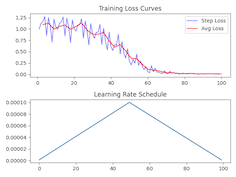
LoRA Fine-tuning
from phi_3_vision_mlx import train_lora, test_lora
# Train a LoRA adapter
train_lora(
lora_layers=5, # Number of layers to apply LoRA
lora_rank=16, # Rank of the LoRA adaptation
epochs=10, # Number of training epochs
lr=1e-4, # Learning rate
warmup=0.5, # Fraction of steps for learning rate warmup
dataset_path="JosefAlbers/akemiH_MedQA_Reason"
)
# Generate text using the trained LoRA adapter
generate("Describe the potential applications of CRISPR gene editing in medicine.",
blind_model=True,
quantize_model=True,
use_adapter=True)
# Test the performance of the trained LoRA adapter
test_lora()
2. Agent Interactions
Multi-turn Conversation
from phi_3_vision_mlx import Agent
# Create an instance of the Agent
agent = Agent()
# First interaction: Analyze an image
agent('Analyze this image and describe the architectural style:', 'https://images.metmuseum.org/CRDImages/rl/original/DP-19531-075.jpg')
# Second interaction: Follow-up question
agent('What historical period does this architecture likely belong to?')
# End conversation, clear memory for new interaction
agent.end()

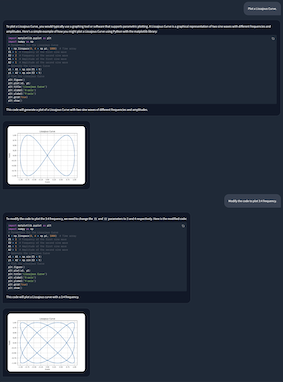
Generative Feedback Loop
# Ask the agent to generate and execute code to create a plot
agent('Plot a Lissajous Curve.')
# Ask the agent to modify the generated code and create a new plot
agent('Modify the code to plot 3:4 frequency')
agent.end()
External API Tool Use
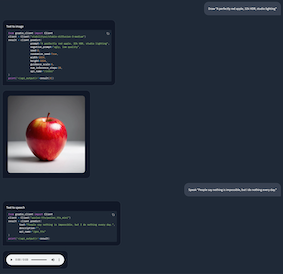
# Request the agent to generate an image
agent('Draw "A perfectly red apple, 32k HDR, studio lighting"')
agent.end()
# Request the agent to convert text to speech
agent('Speak "People say nothing is impossible, but I do nothing every day."')
agent.end()
3. Custom Toolchains
In-Context Learning Agent
from phi_3_vision_mlx import add_text
# Define the toolchain as a string
toolchain = """
prompt = add_text(prompt)
responses = generate(prompt, images)
"""
# Create an Agent instance with the custom toolchain
agent = Agent(toolchain, early_stop=100)
# Run the agent
agent('How to inspect API endpoints? @https://raw.githubusercontent.com/gradio-app/gradio/main/guides/08_gradio-clients-and-lite/01_getting-started-with-the-python-client.md')
Retrieval Augmented Coding Agent
from phi_3_vision_mlx import VDB
import datasets
# Simulate user input
user_input = 'Comparison of Sortino Ratio for Bitcoin and Ethereum.'
# Create a custom RAG tool
def rag(prompt, repo_id="JosefAlbers/sharegpt_python_mlx", n_topk=1):
ds = datasets.load_dataset(repo_id, split='train')
vdb = VDB(ds)
context = vdb(prompt, n_topk)[0][0]
return f'{context}\n<|end|>\n<|user|>\nPlot: {prompt}'
# Define the toolchain
toolchain_plot = """
prompt = rag(prompt)
responses = generate(prompt, images)
files = execute(responses, step)
"""
# Create an Agent instance with the RAG toolchain
agent = Agent(toolchain_plot, False)
# Run the agent with the user input
_, images = agent(user_input)
Multi-Agent Interaction
# Continued from Example 2 above
agent_writer = Agent(early_stop=100)
agent_writer(f'Write a stock analysis report on: {user_input}', images)
External LLM Integration
# Create Agent with Mistral-7B-Instruct-v0.3 instead
agent = Agent(toolchain = "responses, history = mistral_api(prompt, history)")
# Generate a neurology ICU admission note
agent('Write a neurology ICU admission note.')
# Follow-up questions (multi-turn conversation)
agent('Give me the inpatient BP goal for this patient.')
agent('DVT ppx for this patient?')
agent("Patient's prognosis?")
# End
agent.end()
Benchmarks
from phi_3_vision_mlx import benchmark
benchmark()
| Task | Vanilla Model | Quantized Model | Quantized Cache | LoRA Adapter |
|---|---|---|---|---|
| Text Generation | 25.02 tps | 61.01 tps | 18.68 tps | 24.72 tps |
| Image Captioning | 21.29 tps | 44.26 tps | 5.56 tps | 20.48 tps |
| Batched Generation | 236.60 tps | 149.23 tps | 121.92 tps | 232.78 tps |
(On M1 Max 64GB)
Updates
Nov 9 2025: You can pass repo_id="microsoft/MediPhi-Instruct" (or any other compatible HF repo) to load and run alternative models directly.
generate("A 20-year-old woman presents with menorrhagia for the past several years. She says that her menses “have always been heavy”, and she has experienced easy bruising for as long as she can remember. Family history is significant for her mother, who had similar problems with bruising easily. The patient's vital signs include: heart rate 98/min, respiratory rate 14/min, temperature 36.1°C (96.9°F), and blood pressure 110/87 mm Hg. Physical examination is unremarkable. Laboratory tests show the following: platelet count 200,000/mm3, PT 12 seconds, and PTT 43 seconds. Which of the following is the most likely cause of this patient’s symptoms? A: Factor V Leiden B: Hemophilia A C: Lupus anticoagulant D: Protein C deficiency E: Von Willebrand disease", repo_id="microsoft/MediPhi-Instruct")

...

'E: Von Willebrand disease<|end|>'
Nov 10 2025: repo_id="microsoft/Phi-4-mini-instruct"
Documentation
API references and additional information are available at:
https://josefalbers.github.io/Phi-3-Vision-MLX/
Also check out our tutorial series available at:
License
This project is licensed under the MIT License.