默认开启匿名遥测,可用 TRTLLM_NO_USAGE_STATS=1 或 --no-telemetry 关闭;安装步骤需按官方 Installation Guide 操作,README 未直接给出命令;自 1.0 起废弃 API 仅有 3 个月迁移期,升级需留意 Release Notes
TensorRT-LLM
NVIDIA活跃维护用 Python API 定义大模型,并借助 TensorRT 在 NVIDIA GPU 上做极致优化推理,还提供 Python/C++ 运行时来编排高性能服务。
TensorRT LLM provides users with an easy-to-use Python API to define Large Language Models (LLMs) and supports state-of-the-art optimizations to perform inference efficiently on NVIDIA GPUs. TensorRT LLM also contains components to create Python and C++ runtimes that orchestrate the inference execution in a performant way.
README 未给出安装命令,仅指向 Installation Guide:https://nvidia.github.io/TensorRT-LLM/installation/index.html 硬件要求按 README 说明
README 未说明具体显存要求,仅说明面向 NVIDIA GPU 优化;支持的硬件型号需查阅官方 support-matrix 文档。
支持 Apple Silicon需要 CUDA多卡 / 张量并行
NVIDIA 官方 LLM 推理优化框架,用专用 kernel 和高效 runtime 在 NVIDIA GPU 上跑得更快
用 Python API 定义大模型,并借助 TensorRT 在 NVIDIA GPU 上做极致优化推理,还提供 Python/C++ 运行时来编排高性能服务。
核心能力
- 提供 Python API 定义和定制 LLM 推理流程
- 针对常见算子使用专用 kernel 加速
- 内置高效 runtime,支持 Python 与 C++ 调用
- 支持 KV Cache 压缩、稀疏注意力等优化
- 覆盖 LLM 与视觉生成模型的推理优化
容易踩的坑
内容由模型根据 README 生成,可能不完整或不准确,以官方文档为准。看原文 README
- v1.4.0rc3pre-release最新正式版2026-11-06 · 2026-11-06 21:38 UTC
Highlights
-
Known Issues
- DSA models, including GLM-5.2, may produce incorrect output when using an NVFP4 KV cache.
- Kimi K3 DSpark with MegaMoE CuTe DSL TEP and CUDA graphs may hang during GB300 warmup.
- DeepSeek-V4-Pro initialization may run out of GPU memory when MPI workers are reused after large MoE workloads.
- Tensor-parallel serving with RPC orchestration may hang during model initialization when reusing an MPI worker pool across threads.
-
Model Support
- Add Muse Spark Open model and configuration support #21042, #20643
- Add LTX-2.3 text-to-video and retake pipelines #18111
- Add GLM-5.2 NVFP4 Modeling V2 targets for GB300 and SM103 #20524, #20662
- Add MiniMax-M3 NVFP4 low-latency decode for Blackwell and MiniMax-M3.1-Flash DSpark serving #20306, #20922
- Consolidate Kimi K3 native modeling and support NVFP4 KV caching #20893, #20888
- Add MiniMax-H3 CPU offloading and tensor parallelism for its text encoder and DiT #21301, #19807, #20176
- Qualify the Qwen3.5 dense vision-language model for ModelExpress #20764
- Enable DeepSeek-V4.1-Flash on SM120 #20769
-
API
- Remove unused LlmRequest fields (BREAKING) #21036
- Remove obsolete TensorRT-backend compatibility surfaces (BREAKING) #21041
- Default to eight serving frontends with a single-frontend fallback (BREAKING) #19379
- Add image, video, and audio inputs to OpenEngine gRPC #20446, #20654, #20655
- Expose OpenEngine Prometheus metrics and standard gRPC health checks #21034, #20437
- Add keepalive events for Responses and Anthropic Messages streams #21061, #21030
- Accept Chat Completions service tier, client metadata, and store fields #21154, #20864
- Allow Responses web-search requests by default when the server cannot execute them #21065
-
Feature
- Add unified KV cache manager foundations, sparse attention arenas, and host-backed pools #20178, #21129
- Add aggregated Helix KV sizing, request preemption, and phase-dependent MLA heads #20759, #21122, #20833
- Support attention DP connectors, per-view KV-head transfers, and owner-only Helix MLA writes #19369, #20709, #21245
- Protect BF16 context-first KV transfers and attribute transfer timeouts to their owners #21272, #20708
- Add trusted KV hints, immutable request metadata, and OpenEngine image routing metadata #20269, #21125
- Add paged block-causal KV caching and cached attention for VisualGen #19938
- Add native sparse MLA attention for DeepSeek-V4 generation and DSA Vanilla sparse attention #20209, #16309
- Support native FP8 MoE LoRA weights and DynamicEPLB runtime integration #18555, #19646
- Add DSpark ragged graphs and FlashInfer ring-buffer replay for GDN MTP #20072, #20008
- Add layer and buffer reuse policies for attention and SSM #21088
- Add blob backend batch registration, bounded queueing, and a CPU example #20884
- Add TTFT-percentile admission and cancel paired generation when context processing fails #20736, #20491
- Optimize Helix prefill, Kimi K3 attention-DP execution, and KDA prefill #20939, #20597, #20941
- Optimize one-model speculative decoding, including vocabulary-parallel selection and DSpark verification #20940
- Accelerate Qwen3.5, Qwen3.8-Flash-Next, and GLM-5.3-Flash serving on Blackwell #20815, #20937, #20755
- Add opt-in tiled QKV preprocessing and FP8 block-scale low-M GEMM #21198, #20942
- Enable FlashInfer GDN chunked prefill on SM107 and fused AdaLN on SM103 #21210, #21396
- Improve GVR V2 sampling, SID-GR beam search, and GDN execution #21271, #20998, #21268, #21126, #20830, #21132
- Optimize OpenEngine image preparation, gRPC result delivery, and Qwen vision RoPE #21037, #19760, #20932
- Reduce sampler logprob memory and parallelize KV host-tier initialization #20803, #20790
- Add optional Morton token ordering for Wan and fuse MiniMax-H3 QK normalization and RoPE #20787, #19645
-
Fix
- Remove the direct Git dependency th
-
- v1.4.0rc2pre-release2026-10-28 · 2026-10-28 15:51 UTC
查看更新说明
Python package version
The Python wheels for this release are published as 1.4.0rc2.post1. Container images and documentation remain at 1.4.0rc2. Use
1.4.0rc2.post1when installing the Python package.The wheel-only patch removes a direct Git dependency that prevented PyPI publication (#21128) and updates the Boost download mirror used during builds (#21133). Patched wheel source: v1.4.0rc2.post1, commit
43f8f70da6415a3b06f91f9ebaa4fb7611ab62cc.Highlights
-
Known Issues
- Tensor-parallel serving with RPC orchestration may hang during model initialization when reusing an MPI worker pool across threads.
-
Model Support
- Add Cosmos3-Edge Reasoner support for visual generation workloads #20307
- Add GLM-5.2 NVFP4 low-latency decode on Rubin through Modeling V2 #20517
- Enable MiniMax-M3 on Rubin with NVFP4 KV exemptions and paged FMHA #20167
- Expand Qwen3.8-Flash-Next Modeling V2 support for MTP, video, and quantized KV caches #20276
- Add SM103 Modeling V2 defaults for GPT-OSS-120B and DeepSeek-R1-0528 NVFP4 #20267
- Qualify dense Phi3 models for ModelExpress integration #19997
- Support static FP8 Cosmos3 parallelism and four-step distilled checkpoints #20007
- Support FLUX.1-dev static NVFP4 with per-tensor FP8 attention on SM103 #18396
-
API
- Migrate LlmRequest fields from C++ to Python (BREAKING) #20388
- Drop KV cache manager V1 support from transceiver V2 (BREAKING) #20129
- Remove obsolete executor backend compatibility paths (BREAKING) #20043
- Enable zero-copy mode for Mooncake Store (BREAKING) #20108
- Deprecate n-gram and user-provided speculative decoding modes #20438
- Add configurable FP32 LM-head logits through lm_head_output_dtype #19850
- Consolidate prompt rendering into standalone serve/render support for Dynamo #19964
- Define backend contracts and share lifecycle enforcement for KV cache transfers #20117, #19822
- Add a blob-store driver boundary with an in-memory test implementation #20217
-
Feature
- Add native retention and cross-turn generation-block reuse to KV cache V2 #20086, #19710
- Commit sliding-window prefixes at fork points and account for connector-provided reuse blocks #19877, #20180
- Add first-N/last-N mixed-precision KV caching using native sliding-window attention #20452
- Support FP4 MLA in disaggregated serving deployments #20544
- Add MXFP8 refitting with piecewise CUDA graphs and Ray collectives #20075
- Optimize DeepSeek-V4 and DSpark on Rubin, including fused RMSNorm/RoPE kernels #19961, #20366
- Add Kimi K3 fabric gathering, TCPStore rendezvous, and managed KDA replay buffers #20576
- Integrate FlashInfer KDA prefill with fused convolution #20653
- Enable shared CUDA graph setup for Qwen3-family vision-language encoders #20213
- Schedule multimodal encoders by prefill chunk and reduce Gemma attention-mask memory #19884, #20405
- Improve Qwen-Image Ulysses performance and add MiniMax-H3 asynchronous Ulysses execution #17147, #20333
- Add PrimsTS SageAttention for VisualGen VSA and SOL workloads #20224
- Parallelize MiniMax-M3 indexer scoring and use BF16 tensor-core router GEMMs #19975, #20699
- Accelerate GLM-5.3-Flash sparse attention, verification offsets, mHC, quantization, and routing #20454, #20389, #20390
- Improve DSA paged-MQA logits kernels and default indexing to CuTe DSL #19976
- Optimize one-model speculative decoding host scheduling, target logits, and KDA draft records #19989
- Optimize GVR V2 for large batches and short sequences #20106
- Fuse SwiGLU into BF16 gate/up GEMM epilogues on SM100 #19773
- Compile Mamba replay-input preparation and vectorize SID-GR final beam assembly #20688, #20166
- Support required tool choice for Nemotron Super 3.5 VL #20422
-
Fix
- Prevent global stop-word buffer growth in the PyTorch sampler #20679
- Preserve o
-
- v1.4.0rc1pre-release2026-10-22 · 2026-10-22 01:38 UTC
查看更新说明
Highlights
-
Known Issues
- Disaggregated serving with the default Python KV cache transceiver may fail generation requests with a KV cache transfer error after streaming requests are cancelled (observed on A100).
- The OpenAI JSON-schema serving example (examples/serve/openai_completion_client_json_schema.py) may return an unbounded response with Qwen3 models.
-
Model Support
- Add DeepSeek-V4.1-Flash support #19727
- Support NVFP4 GLM-5.3-Flash checkpoints #20127
- Add Qwen3.8-Flash-Next NVFP4 as an experimental Modeling V2 target #20143
- Support LiLiCorr draft checkpoints in DFlash #19856
- Remove the automatic W4A16 fallback for Nemotron-H NVFP4 checkpoints on Hopper #15772
-
API
- Default to KV cache manager V2 and the Python KV cache transceiver (BREAKING) #17495
- Remove unused LlmRequest fields (BREAKING) #19967
- Replace the C++ ArrayView API with std::span #20205
- Select Modeling V2 through LLM configuration and arguments #20077
- Publish serving configuration schemas #19906
- Add a KV cache lending API for transfer backends #19722
- Expose native KV event streaming and routing load #19440
- Support runtime sleep and wakeup through LLM and trtllm-serve, including MiniMax-H3 #19016, #19604
- Unify compiled-artifact cache configuration through TRTLLM_CACHE_DIR #18897
- Make KV cache V2 pool rebalancing parameters configurable #19077
- Reorganize VisualGen attention modules, keeping deprecated import paths and lazy exports #20214, #20215, #20218
-
Feature
- Integrate the Mooncake connector with KV cache manager V2 #19171
- Fill the KV cache V2 host tier progressively #19650
- Add RoPE precision options for NVFP4 cold-page compression #19391
- Honor per-request seeds in batched TorchSampler and one-model speculative acceptance #19719, #20147
- Add ragged DSpark verification with confidence-based policy and calibrated scoring #19707, #19818, #20071
- Add deterministic FP32 GVR V2 top-K decoding and reduce its overflow overhead #20100, #20290
- Add an opt-in setting to compile only piecewise CUDA graph forwards #18366
- Support Rubin locality-domain execution and extend SM107 and multi-node MegaMoE initialization #19272, #19183
- Optimize Kimi K3 on Rubin and avoid cuBLAS fallback in KDA prefill #19960, #20084
- Support packed query heads and compact inputs in Blackwell CuTe DSL MLA #19338
- Add PrimTS dense BF16, mixed BF16/FP8, and FP8 context attention paths #20006
- Use paged attention for MiniMax-M3 dense layers and cut NVFP4 KV host overhead #20159, #19974
- Limit GLM-5.3-Flash indexer scoring to visible pools with BF16 tensor cores #20251
- Add token-sharded tensor parallelism for Wan in VisualGen #19713
- Support MiniMax-H3 parallel tiled VAE decoding and Ulysses parallelism #19506
- Speed up MiniMax-H3 video-VAE decoding and fuse AdaLN RMSNorm modulation #19774, #19772
- Unify multimodal encoder caching and reduce encoder output copies #17876, #19799
- Optimize Qwen vision encoders and decode JPEGs through torchvision #19797, #19794
- Reduce per-response overhead in LLM API streaming #20244
- Enable SwiGLU clamping and update NVFP4 FC1 weight layout in Rubin CuTe DSL MoE #19488, #20181
- Overhaul the NVLink one-sided all-to-all #19610
-
Fix
- Align MiniMax-M3 and GLM reasoning and tool parsing between streaming and non-streaming #20442, #19935
- Flush the Hugging Face streaming detokenizer on the final response #20424
- Restore trtllm-serve streaming throughput by constraining uvloop below 0.23.0 #19992
- Constrain FastAPI to versions below 0.140.0 #20161
- Keep the overlap scheduler responsive while waiting for disaggregated KV receives #19857, #19940
- Reserve retiring-request slot headroom for overlap scheduling without attention data parallelism #20250
- Correct draft KV scheduling and prompt-tail recomputation on cache hits with overlap speculation #19745
-
- v1.4.0rc0pre-release2026-10-14 · 2026-10-14 16:35 UTC
查看更新说明
Highlights
-
Known Issues
- Multi-GPU (TP2) streaming or RPC executor workloads may hang during worker initialization when MPI worker pools are reused across LLM instances (observed on H100).
- DeepSeek MLA models on SM120/SM121 GPUs (for example RTX PRO 6000 Blackwell) may crash with an illegal memory access when CUDA graphs are captured with BF16 BMM.
- GPT-OSS models on SM120 GPUs may fail with attention data parallelism when automatic communication selects NCCL EP for unsupported hidden sizes.
- Qwen3 models with tied embeddings (for example Qwen3-0.6B) may fail at model construction when attention data parallelism is enabled with TP greater than 1.
- OpenTelemetry tracing may export additional FastAPI spans when FastAPI 0.142 or newer is installed.
-
Model Support
- Add GLM-5.3-Flash (glm5_next) support #19136
- Support K-EXAONE-2 in the PyTorch backend #17067
- Add Qwen-Image-Layered with FP8 and Cache-DiT support #16889
- Load static FP8 Cosmos3 Nano/Super checkpoints without re-quantization #17476
- Enable EVS for Nemotron Super 3.5 VL and EVS handoff for Nemotron-H in EPD #19648, #19702
- Load quantized Nemotron-H MTP heads #19558, #19597
- Add MiniMax-M3 NVFP4 KV cache support with query-length buffer reuse and a native draft KV view #19422, #19768, #19731
- Add MiniMax H3 ref2va mode and Turbo LoRA tensor-name mapping #19657, #19701
- Route Qwen3.6/3.8 vision-language checkpoints to the generic Qwen3.5 VLM wrapper #19892
-
API
- Remove the Python backend of KVCacheManagerV2 (BREAKING) #19154
- Migrate LlmRequest fields to Python (BREAKING) #19484
- Add command-line configuration overrides #19555
- Report per-request speculative-decoding acceptance in responses #19311
- Return OpenAI-style errors when a request exceeds the context length #19457
- Add a per-model serving-extension registry to the OpenAI server #19499
- Ship the OpenEngine gRPC bindings in the wheel, so no separate package install is needed #19371
-
Feature
- Add a Mooncake store pool, CLI, and V2 scheduler preemption (part 1) #19235
- Add sparse KV cache configuration, tier-aware locking, and offload with GPU metadata publication; prepare DeepSeek V4 attention for sparse KV offload #19580, #19821, #19502
- Add VisualGen VSA and SOL sparse attention on PrimTS block-sparse FMHA and integrate updated SM90 SageAttention kernels #18079, #18496
- Support beam search with the C++ KVCacheManagerV2 #17306
- Stream C++ KV events with multimodal payloads #19359
- Add model startup stage timing metrics, sampled iteration statistics, and partial telemetry context for startup failures #18060, #19717, #19598
- Support model_kwargs with encoder CUDA graphs #19439
- Speed up MoE routing for batches of up to eight tokens and cache MegaMoE kernel descriptors across forwards #19682, #19901
- Enable tiled FP8 context FMHA for head dimension 256 on SM120 #19825
- Add a static tile scheduler override for context FMHA #19873
- Include KV connector prefixes in V2 scheduler budgeting and add configurable sliding-window attention endpoint retention priority #17974, #19670
- Weight the speculative draft KV budget split by per-request spend #19744
- Support post-SiLU clamp in CUTLASS MoE and add an optional finalize-before-combine path to the MoE scheduler #19217, #19749
- Accept flat int32 arrays as GenerationRequest prompts without converting them to lists #19658
- Allow the prefix-tokenization cache for MiniMax-M3 text-only prompts #19613
- Reduce MTP draft-loop and multimodal fusion overhead #19785, #18636
-
Fix
- Fix host out-of-memory failures by releasing asynchronous IPC payloads when garbage collection is disabled #19869
- Fix dummy-slot handling for Kimi K2.5 disaggregated EAGLE3 inference with attention data parallelism #19891
- Harden disaggregated KV transfer: retire ownership after late completion, require verified write coverage bef
-
- v1.3.0rc29pre-release2026-09-29 · 2026-09-29 10:56 UTC
查看更新说明
Highlights
-
Model Support
- Support Qwen3.5 checkpoints with global FP8 scales across model loading paths #19519
- Optimize Gemma4 vision rotary embeddings without a GEMM operation #19571
- Enable the CuTeDSL MoE backend for Kimi K3 NVFP4 SiTU #19003
- Expose Nemotron-H vision-language LoRA configuration for supported inference paths #19151
- Extend MiniMax-M3 piecewise CUDA graphs through model and executor paths #19423
-
API
- Remove the AutoDeploy integration and its public entry points (BREAKING) #19028
- Remove the obsolete cpp_only build option from CMake (BREAKING) #19421
- Accept parallel_tool_calls and cap tool enum values in OpenAI requests #19459
- Treat explicit null optional fields as unset in the Responses API #19454
- Validate media data URIs and require opt-in for private URL fetches #19458
-
Feature
- Add an MLA-backed standalone DSpark drafter for Inferact and Kimi K3 #19040
- Enable Helix speculative verification for FP8, FP4 MLA, and DSpark groups #19273
- Add a non-MTP KDA decode kernel and dispatch path #18938
- Add an NVFP4 MLA residual switch for DeepSeek V4 #19305
- Support MNNVL all-reduce through the Ray orchestrator #18231
- Add opt-in cached KV token counts and per-rank routing logs #19375, #16323
- Add quiet PyExecutor hang diagnostics for stalled inference requests #19045
- Support backend-independent agent tools and a required-tool policy #19236
- Update scaffolding MCP transport and KV-cache truncation behavior #19055
- Support W4A16 NVFP4 group size 32 with explicit validation #19091
- Add Triton top-k combine for Marlin NVFP4 MoE #18999
- Fuse MLA context FP8 Q quantization into the absorb BMM epilogue #19082
- Enable PDL on additional decode edges and FlashInfer GDN prefill on SM120/121 #19446, #19376
- Defer fused-GELU MLP NVFP4 scale finalization until needed #18906
- Avoid KV-cache V2 prefix probes when context chunk budget is insufficient #19366
- Publish MoE all-to-all counters before dispatch and consolidate C++ MoE ops #19425, #19216
-
Fix
- Compute Cosmos3 rotary tables with broadcast multiplication to avoid K=1 matmul failures #19532
- Restore Qwen3.5 gather and scatter behavior after a performance regression #19578
- Preserve disaggregated KV transfer outcomes and synchronize receive destinations #19377, #19444
- Authenticate disaggregated subagent affinity and reject unbindable IPv6 listener addresses #19175, #19544
- Make disaggregated load-balancing routing global and repair cache-reuse adapter behavior #19399, #19480
- Extend startup and warmup timeouts for Blackwell pipeline-parallel tests #19402
- Keep one-sided MoE combine offsets and FP4 permute buffers correctly sized #19312, #19251
- Reject paged-context attention when no fused kernel exists #19353
- Share speculative CUDA-graph capture buffers and correct RNG corner cases #19350, #19505
- Correct DFlash buffer sizing, positions, and FlashInfer speculation gating #19466
- Guard PyExecutor model-engine access while handling responses #19559
- Route zero-token causal convolution through the channel-major kernel #18571
- Correct VBWS width tracking and terminal-step finalization #19407
- Drain guided-decoder host functions before forward calls that hold the GIL #19455
- Prevent out-of-bounds indices in vanilla top-p sampling #19496
- Reuse pending MNNVL split communicators across workspace construction retries #19101
-
Documentation
- Document GVR V2 self-sampling and multi-threshold exact top-k methods #19244
-
Test & Infra
- Upgrade public PyTorch to 2.14, Triton to 3.8, and C++ to 20 #19477, #19249
- Add Helix zero-KV, disaggregated closure, and speculative acceptance regression coverage #18995, #19478, #19176
- Expand Qwen3.8 coverage across GPU configurations #19530
- Disable context overlap for the DeepSeek V4 Pro disaggregated test configuration #19424
-
用户点评
登录用户的真实使用记录,可按版本和硬件筛选4.0
1 人评分
50
41
30
20
10
用户实测硬件
多卡 ×1
共 1 条
 erin2026-11-09多卡
编译时间长是最大的痛点,从源码编译一次要 40 分钟以上。但跑起来以后推理速度确实快,生产上我们用它在 A100 集群做 batch 推理。
TensorRT LLM




Architecture | Performance | Examples | Documentation | Roadmap
Tech Blogs
-
[10/14] KV Cache Compression in TensorRT LLM ✨ ➡️ link
-
[09/22] GVR V2: Self-Sampling and Multi-Thresholding for Faster Exact Top-K ✨ ➡️ link
-
[09/02] Accelerating Video Generation with GEMM Quantization, Attention Quantization and Skip Softmax Attention in TensorRT-LLM ✨ ➡️ link
-
[08/20] Evaluating Agentic Serving with Trace Replay and Job-Level Metrics ✨ ➡️ link
-
[07/17] DeepSeek-V4 on NVIDIA Blackwell: Model-Specific and Agentic-Workload Optimizations in TensorRT LLM ✨ ➡️ link
-
[07/01] Scaling Video Generation Across NVL72 Rack with TensorRT-LLM ✨ ➡️ link
-
[05/15] Joint Optimization of Agent Applications and TensorRT-LLM ✨ ➡️ link
-
[04/03] Tuning CUDA Graph Batch Sizes for Higher Output Throughput ✨ ➡️ link
-
[04/03] DWDP: Distributed Weight Data Parallelism for High-Performance LLM Inference on NVL72 ✨ ➡️ link
-
[03/16] Optimizing MoE Communication with One-Sided AlltoAll Over NVLink ✨ ➡️ link
-
[03/04] Sparse Attention in TensorRT LLM ✨ ➡️ link
-
[02/06] Accelerating Long-Context Inference with Skip Softmax Attention ✨ ➡️ link
-
[01/09] Optimizing DeepSeek-V3.2 on NVIDIA Blackwell GPUs ✨ ➡️ link
-
[09/26] Inference Time Compute Implementation in TensorRT LLM ✨ ➡️ link
-
[09/19] Combining Guided Decoding and Speculative Decoding: Making CPU and GPU Cooperate Seamlessly ✨ ➡️ link
-
[08/29] ADP Balance Strategy ✨ ➡️ link
-
[08/05] Running a High-Performance GPT-OSS-120B Inference Server with TensorRT LLM ✨ ➡️ link
-
[08/01] Scaling Expert Parallelism in TensorRT LLM (Part 2: Performance Status and Optimization) ✨ ➡️ link
-
[07/26] N-Gram Speculative Decoding in TensorRT LLM ✨ ➡️ link
-
[06/19] Disaggregated Serving in TensorRT LLM ✨ ➡️ link
-
[06/05] Scaling Expert Parallelism in TensorRT LLM (Part 1: Design and Implementation of Large-scale EP) ✨ ➡️ link
-
[05/30] Optimizing DeepSeek R1 Throughput on NVIDIA Blackwell GPUs: A Deep Dive for Developers ✨ ➡️ link
-
[05/23] DeepSeek R1 MTP Implementation and Optimization ✨ ➡️ link
-
[05/16] Pushing Latency Boundaries: Optimizing DeepSeek-R1 Performance on NVIDIA B200 GPUs ✨ ➡️ link
Latest News
- [04/03] 🎨 TensorRT LLM now supports diffusion models for visual generation ➡️ link
-
[08/05] 🌟 TensorRT LLM delivers Day-0 support for OpenAI's latest open-weights models: GPT-OSS-120B ➡️ link and GPT-OSS-20B ➡️ link
-
[07/15] 🌟 TensorRT LLM delivers Day-0 support for LG AI Research's latest model, EXAONE 4.0 ➡️ link
-
[05/22] Blackwell Breaks the 1,000 TPS/User Barrier With Meta’s Llama 4 Maverick ✨ ➡️ link
-
[04/10] TensorRT LLM DeepSeek R1 performance benchmarking best practices now published. ✨ ➡️ link
-
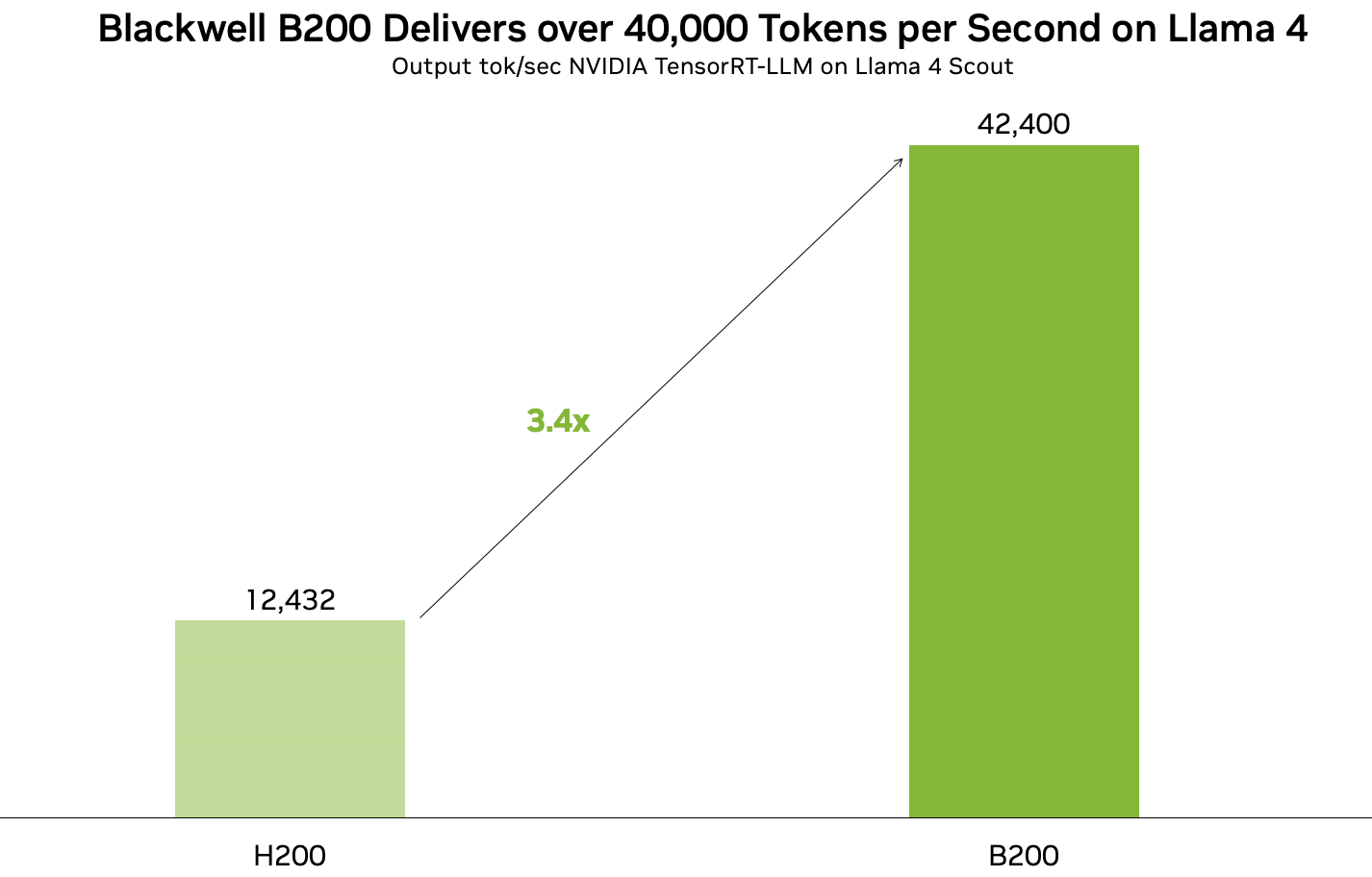
[04/05] TensorRT LLM can run Llama 4 at over 40,000 tokens per second on B200 GPUs!
-
[03/22] TensorRT LLM is now fully open-source, with developments moved to GitHub!
-
[03/18] 🚀🚀 NVIDIA Blackwell Delivers World-Record DeepSeek-R1 Inference Performance with TensorRT LLM ➡️ Link
-
[02/28] 🌟 NAVER Place Optimizes SLM-Based Vertical Services with TensorRT LLM ➡️ Link
-
[02/25] 🌟 DeepSeek-R1 performance now optimized for Blackwell ➡️ Link
-
[02/20] Explore the complete guide to achieve great accuracy, high throughput, and low latency at the lowest cost for your business here.
-
[02/18] Unlock #LLM inference with auto-scaling on @AWS EKS ✨ ➡️ link
-
[02/12] 🦸⚡ Automating GPU Kernel Generation with DeepSeek-R1 and Inference Time Scaling ➡️ link
-
[02/12] 🌟 How Scaling Laws Drive Smarter, More Powerful AI ➡️ link
-
[2025/01/25] Nvidia moves AI focus to inference cost, efficiency ➡️ link
-
[2025/01/24] 🏎️ Optimize AI Inference Performance with NVIDIA Full-Stack Solutions ➡️ link
-
[2025/01/23] 🚀 Fast, Low-Cost Inference Offers Key to Profitable AI ➡️ link
-
[2025/01/16] Introducing New KV Cache Reuse Optimizations in TensorRT LLM ➡️ link
-
[2025/01/14] 📣 Bing's Transition to LLM/SLM Models: Optimizing Search with TensorRT LLM ➡️ link
-
[2025/01/04] ⚡Boost Llama 3.3 70B Inference Throughput 3x with TensorRT LLM Speculative Decoding ➡️ link
-
[2024/12/10] ⚡ Llama 3.3 70B from AI at Meta is accelerated by TensorRT-LLM. 🌟 State-of-the-art model on par with Llama 3.1 405B for reasoning, math, instruction following and tool use. Explore the preview ➡️ link
-
[2024/12/03] 🌟 Boost your AI inference throughput by up to 3.6x. We now support speculative decoding and tripling token throughput with our NVIDIA TensorRT-LLM. Perfect for your generative AI apps. ⚡Learn how in this technical deep dive ➡️ link
-
[2024/12/02] Working on deploying ONNX models for performance-critical applications? Try our NVIDIA Nsight Deep Learning Designer ⚡ A user-friendly GUI and tight integration with NVIDIA TensorRT that offers: ✅ Intuitive visualization of ONNX model graphs ✅ Quick tweaking of model architecture and parameters ✅ Detailed performance profiling with either ORT or TensorRT ✅ Easy building of TensorRT engines ➡️ link
-
[2024/11/26] 📣 Introducing TensorRT LLM for Jetson AGX Orin, making it even easier to deploy on Jetson AGX Orin with initial support in JetPack 6.1 via the v0.12.0-jetson branch of the TensorRT LLM repo. ✅ Pre-compiled TensorRT LLM wheels & containers for easy integration ✅ Comprehensive guides & docs to get you started ➡️ link
-
[2024/11/21] NVIDIA TensorRT LLM Multiblock Attention Boosts Throughput by More Than 3x for Long Sequence Lengths on NVIDIA HGX H200 ➡️ link
-
[2024/11/19] Llama 3.2 Full-Stack Optimizations Unlock High Performance on NVIDIA GPUs ➡️ link
-
[2024/11/09] 🚀🚀🚀 3x Faster AllReduce with NVSwitch and TensorRT LLM MultiShot ➡️ link
-
[2024/11/09] ✨ NVIDIA advances the AI ecosystem with the AI model of LG AI Research 🙌 ➡️ link
-
[2024/11/02] 🌟🌟🌟 NVIDIA and LlamaIndex Developer Contest 🙌 Enter for a chance to win prizes including an NVIDIA® GeForce RTX™ 4080 SUPER GPU, DLI credits, and more🙌 ➡️ link
-
[2024/10/28] 🏎️🏎️🏎️ NVIDIA GH200 Superchip Accelerates Inference by 2x in Multiturn Interactions with Llama Models ➡️ link
-
[2024/10/22] New 📝 Step-by-step instructions on how to ✅ Optimize LLMs with NVIDIA TensorRT-LLM, ✅ Deploy the optimized models with Triton Inference Server, ✅ Autoscale LLMs deployment in a Kubernetes environment. 🙌 Technical Deep Dive: ➡️ link
-
[2024/10/07] 🚀🚀🚀Optimizing Microsoft Bing Visual Search with NVIDIA Accelerated Libraries ➡️ link
-
[2024/09/29] 🌟 AI at Meta PyTorch + TensorRT v2.4 🌟 ⚡TensorRT 10.1 ⚡PyTorch 2.4 ⚡CUDA 12.4 ⚡Python 3.12 ➡️ link
-
[2024/09/17] ✨ NVIDIA TensorRT LLM Meetup ➡️ link
-
[2024/09/17] ✨ Accelerating LLM Inference at Databricks with TensorRT-LLM ➡️ link
-
[2024/09/17] ✨ TensorRT LLM @ Baseten ➡️ link
-
[2024/09/04] 🏎️🏎️🏎️ Best Practices for Tuning TensorRT LLM for Optimal Serving with BentoML ➡️ link
-
[2024/08/20] 🏎️SDXL with #Model Optimizer ⏱️⚡ 🏁 cache diffusion 🏁 quantization aware training 🏁 QLoRA 🏁 #Python 3.12 ➡️ link
-
[2024/08/13] 🐍 DIY Code Completion with #Mamba ⚡ #TensorRT #LLM for speed 🤖 NIM for ease ☁️ deploy anywhere ➡️ link
-
[2024/08/06] 🗫 Multilingual Challenge Accepted 🗫 🤖 #TensorRT #LLM boosts low-resource languages like Hebrew, Indonesian and Vietnamese ⚡➡️ link
-
[2024/07/30] Introducing🍊 @SliceXAI ELM Turbo 🤖 train ELM once ⚡ #TensorRT #LLM optimize ☁️ deploy anywhere ➡️ link
-
[2024/07/23] 👀 @AIatMeta Llama 3.1 405B trained on 16K NVIDIA H100s - inference is #TensorRT #LLM optimized ⚡ 🦙 400 tok/s - per node 🦙 37 tok/s - per user 🦙 1 node inference ➡️ link
-
[2024/07/09] Checklist to maximize multi-language performance of @meta #Llama3 with #TensorRT #LLM inference: ✅ MultiLingual ✅ NIM ✅ LoRA tuned adaptors➡️ Tech blog
-
[2024/07/02] Let the @MistralAI MoE tokens fly 📈 🚀 #Mixtral 8x7B with NVIDIA #TensorRT #LLM on #H100. ➡️ Tech blog
-
[2024/06/24] Enhanced with NVIDIA #TensorRT #LLM, @upstage.ai’s solar-10.7B-instruct is ready to power your developer projects through our API catalog 🏎️. ✨➡️ link
-
[2024/06/18] CYMI: 🤩 Stable Diffusion 3 dropped last week 🎊 🏎️ Speed up your SD3 with #TensorRT INT8 Quantization➡️ link
-
[2024/06/18] 🧰Deploying ComfyUI with TensorRT? Here’s your setup guide ➡️ link
-
[2024/06/11] ✨#TensorRT Weight-Stripped Engines ✨ Technical Deep Dive for serious coders ✅+99% compression ✅1 set of weights → ** GPUs ✅0 performance loss ✅** models…LLM, CNN, etc.➡️ link
-
[2024/06/04] ✨ #TensorRT and GeForce #RTX unlock ComfyUI SD superhero powers 🦸⚡ 🎥 Demo: ➡️ link 📗 DIY notebook: ➡️ link
-
[2024/05/28] ✨#TensorRT weight stripping for ResNet-50 ✨ ✅+99% compression ✅1 set of weights → ** GPUs\ ✅0 performance loss ✅** models…LLM, CNN, etc 👀 📚 DIY ➡️ link
-
[2024/05/21] ✨@modal_labs has the codes for serverless @AIatMeta Llama 3 on #TensorRT #LLM ✨👀 📚 Marvelous Modal Manual: Serverless TensorRT LLM (LLaMA 3 8B) | Modal Docs ➡️ link
-
[2024/05/08] NVIDIA Model Optimizer -- the newest member of the #TensorRT ecosystem is a library of post-training and training-in-the-loop model optimization techniques ✅quantization ✅sparsity ✅QAT ➡️ blog
-
[2024/05/07] 🦙🦙🦙 24,000 tokens per second 🛫Meta Llama 3 takes off with #TensorRT #LLM 📚➡️ link
-
[2024/02/06] 🚀 Speed up inference with SOTA quantization techniques in TRT-LLM
-
[2024/01/30] New XQA-kernel provides 2.4x more Llama-70B throughput within the same latency budget
-
[2023/12/04] Falcon-180B on a single H200 GPU with INT4 AWQ, and 6.7x faster Llama-70B over A100
-
[2023/11/27] SageMaker LMI now supports TensorRT LLM - improves throughput by 60%, compared to previous version
-
[2023/11/13] H200 achieves nearly 12,000 tok/sec on Llama2-13B
-
[2023/10/22] 🚀 RAG on Windows using TensorRT LLM and LlamaIndex 🦙
-
[2023/10/19] Getting Started Guide - Optimizing Inference on Large Language Models with NVIDIA TensorRT-LLM, Now Publicly Available
-
[2023/10/17] Large Language Models up to 4x Faster on RTX With TensorRT LLM for Windows
TensorRT LLM Overview
TensorRT LLM is an open-sourced library for optimizing LLM and Visual Gen inference. It provides state-of-the-art optimizations, including custom kernels for common inference operations (attention, GEMMs, MoE, ...), algorithmic runtime optimizations (Prefill-Decode disaggregation, Wide Expert Parallelism, Speculative Decoding, etc), and much more, to perform inference efficiently on NVIDIA GPUs.
Architected on PyTorch, TensorRT LLM provides a high-level Python LLM API that supports a wide range of inference setups - from single-GPU to multi-GPU or multi-node deployments. It includes built-in support for various parallelism strategies and advanced features. The LLM API integrates seamlessly with the broader inference ecosystem, including NVIDIA Dynamo and the Triton Inference Server.
TensorRT LLM is designed to be modular and easy to modify. Its PyTorch-native architecture allows developers to experiment with the runtime or extend functionality. Several popular models are also pre-defined and can be customized using native PyTorch code, making it easy to adapt the system to specific needs.
Getting Started
To get started with TensorRT-LLM, visit our documentation:
- Quick Start Guide
- Installation Guide
- Supported Hardware, Models, and other Software
- Benchmarking Performance
- Release Notes
Deprecation Policy
Deprecation is used to inform developers that some APIs and tools are no longer recommended for use. Beginning with version 1.0, TensorRT LLM has the following deprecation policy:
- Communication of Deprecation
- Deprecation notices are documented in the Release Notes.
- Deprecated APIs, methods, classes, or parameters include a statement in the source code indicating when they were deprecated.
- If used, deprecated methods, classes, or parameters issue runtime deprecation warnings.
- Migration Period
- TensorRT LLM provides a 3-month migration period after deprecation.
- During this period, deprecated APIs, tools, or parameters continue to work but trigger warnings.
- Scope of Deprecation
- Full API/Method/Class Deprecation: The entire API/method/class is marked for removal.
- Partial Deprecation: If only specific parameters of an API/method are deprecated (e.g., param1 in LLM.generate(param1, param2)), the method itself remains functional, but the deprecated parameters will be removed in a future release.
- Removal After Migration Period
- After the 3-month migration period ends, deprecated APIs, tools, or parameters are removed in a manner consistent with semantic versioning (major version changes may include breaking removals).
Telemetry Data Collection
TensorRT-LLM collects anonymous telemetry data by default. This data is used in aggregate to understand usage patterns and prioritize engineering efforts. This data cannot be traced back to any individual user. No prompts, outputs, model weights, model paths, tokenizer paths, user-identifying information, raw free-form configuration strings, or persistent identifiers are collected. Any deployment identifiers are ephemeral, randomly generated per deployment, and not linked to users. The data we collect includes:
- Ingress point (e.g., LLM API, CLI, serve command)
- Deployment duration (via periodic heartbeats)
- GPU SKUs, count, memory, and CUDA version
- Public model architecture identifier (e.g.,
LlamaForCausalLMorQwen3ForTextEmbedding). This may be an upstream checkpoint architecture or a publicly documented TensorRT-LLM runtime architecture. Identifiers outside the checked-in public allowlist are sent only as a deterministic SHA-256 hash, never as the original free-form name - Parallelism configuration (TP/PP/CP/MoE-EP/MoE-TP sizes), quantization algorithm, dtype, KV cache dtype
- System information (OS platform, Python version, CPU architecture, CPU count)
- TRT-LLM version and backend
- Feature summary flags (LoRA, speculative decoding, prefix caching, CUDA graphs, chunked context, data parallelism)
- Disaggregated serving metadata (role and deployment ID)
- Process-local LLM lifecycle counts (initialization attempts, successful and active instances, peak concurrency, and initialization failures)
- Bounded terminal status for instrumented processes (known exit code or signal, termination category, lifecycle phase, component, and reporting source)
- Selected LLM API configuration values: parallelism, dtype, KV cache, scheduler, CUDA graph, and compile settings
- Capture diagnostics for that payload: a schema checksum (for provenance), the count of captured fields, and whether any free-form value was skipped
Telemetry is automatically disabled in CI and test environments.
If LLM startup fails, an initial report can still include the available environment and sanitized configuration information, marked as partial context.
Opting Out of Telemetry Data Collection
To disable telemetry data collection, use any of the following methods:
- Environment variable: Set
TRTLLM_NO_USAGE_STATS=1,DO_NOT_TRACK=1, orTELEMETRY_DISABLED=true - File-based: Create the file
~/.config/trtllm/do_not_track - Python API: Pass
TelemetryConfig(disabled=True)toLLM() - CLI flag: Use
--no-telemetryontrtllm-serve,trtllm-bench, ortrtllm-eval
CLI terminal telemetry may report that an argument or YAML configuration was invalid. The terminal event records only categorical termination and lifecycle metadata, never the raw argument or YAML text. Other telemetry events collect the selected, sanitized configuration fields listed above. The environment-variable, file-based, and CLI-flag opt-outs are all applied before CLI and YAML validation.
The telemetry collection code is fully open source and auditable at
tensorrt_llm/usage/. For a detailed field-by-field
reference of exactly what is collected, see the
schema documentation.
Useful Links
- Quantized models on Hugging Face: A growing collection of quantized (e.g., FP8, FP4) and optimized LLMs, including DeepSeek FP4, ready for fast inference with TensorRT LLM.
- NVIDIA Dynamo: A datacenter scale distributed inference serving framework that works seamlessly with TensorRT LLM.
- WeChat Discussion Group: A real-time channel for TensorRT LLM Q&A and news.