README 未列出具体依赖版本,需按官方安装文档配置环境;部署到设备还需配合 SSCMA-Micro 固件及 Arduino/Python 库;预训练模型需从 SSCMA Model Zoo 单独获取
ModelAssistant
Seeed-Studio活跃维护面向嵌入式设备的开源 AI 模型训练与部署工具,支持在 ESP32、Jetson、树莓派等硬件上完成图像分类、目标检测等任务的训练与推理。
Seeed SenseCraft Model Assistant is an open-source project focused on embedded AI. 🔥🔥🔥
2.0.0rc3发布于 2023-08-21 10:51 UTC448star65fork同步于 2026-11-07 07:30 UTC
README 未给出可直接执行的安装命令,安装步骤见 https://sensecraftma.seeed.cc/introduction/installation 硬件要求按 README 说明
README 未说明训练所需显存或 GPU 型号;部署目标为 ESP32、部分 Arduino 开发板、树莓派等 MCU 与嵌入式 SBC,示例称可在低于 0.3 瓦功耗的 MCU 上运行。
Seeed 开源的嵌入式 AI 工具链,把视觉模型训练、导出并部署到 MCU 和 SBC 上
面向嵌入式设备的开源 AI 模型训练与部署工具,支持在 ESP32、Jetson、树莓派等硬件上完成图像分类、目标检测等任务的训练与推理。
核心能力
- 基于 OpenMMLab 算法优化,面向低算力端侧
- 支持目标检测、分类、分割、姿态估计与异常检测
- 导出 TFLite、ONNX、TensorRT、UF2 等部署格式
- 提供 QAT 量化感知训练与 Swift YOLO 轻量检测
- 配套 Model Zoo、Web Toolkit、SSCMA-Micro 与 Arduino/Python 库
容易踩的坑
内容由模型根据 README 生成,可能不完整或不准确,以官方文档为准。看原文 README
- 2.0.0rc3SenseCraft Model Assistant releases v2.0.0rc3最新正式版2023-08-21 · 2023-08-21 10:51 UTC

EdgeLab got a optimized visualization tool for inference, model training and export command-line interface has refactored, also GitHub Actions CI integration is supported now. Please stay turned for upcoming Web tools and C++ SDK for model deployment on edge computing devices.
Highlights
- EdgeLab Model Zoo, which provides some pre-trained models for different kinds of tasks with detailed benchmark information.
- Optimized inference and visualization tool for easy testing and evaluation your trained models on PCs.
- Anomaly detection for gyroscope sensors (Experimental).
New features
- Optimized and refactored the command-line interfaces for model training, export and inference.
- Added CI (GitHub Actions), it is welcome to submit PRs to us.
- Cleaned up redundant code, lots of issues got fixed.
Coming soon
- EdgeLab Web Tools will provide a quick and interactive interface for deploying models to MCUs using browser.
- EdgeLab C++ SDK will deliver a unified and easy-to-use API for rapid deployment of models to edge computing devices (MCUs, SBCs).
- EdgeLab Model Zoo will add more pre-trained models continuously and EdgeLab documentation will be revised accordingly.
Changelog
- Changes between previous release and this release: v2.0.0rc2 - v2.0.0rc3.
- Changes since this release: v2.0.0rc3 - dev.
- 2.0.0rc2EdgeLab releases v2.0.0rc22023-07-14 · 2023-07-14 14:28 UTC
查看更新说明
EdgeLab got a optimized visualization tool for inference, model training and export command-line interface has refactored, also GitHub Actions CI integration is supported now. Please stay turned for upcoming Web tools and C++ SDK for model deployment on edge computing devices.
Highlights
- EdgeLab Model Zoo, which provides some pre-trained models for different kinds of tasks with detailed benchmark information.
- Optimized inference and visualization tool for easy testing and evaluation your trained models on PCs.
- Anomaly detection for gyroscope sensors (Experimental).
New features
- Optimized and refactored the command-line interfaces for model training, export and inference.
- Added CI (GitHub Actions), it is welcome to submit PRs to us.
- Cleaned up redundant code, lots of issues got fixed.
Coming soon
- EdgeLab Web Tools will provide a quick and interactive interface for deploying models to MCUs using browser.
- EdgeLab C++ SDK will deliver a unified and easy-to-use API for rapid deployment of models to edge computing devices (MCUs, SBCs).
- EdgeLab Model Zoo will add more pre-trained models continuously and EdgeLab documentation will be revised accordingly.
Changelog
- Changes between previous release and this release: v2.0.0rc1 - v2.0.0rc2.
- Changes since this release: v2.0.0rc2 - dev.
- 2.0.0rc1EdgeLab releases v2.0.0rc12023-05-10 · 2023-05-10 02:12 UTC
查看更新说明
We upgraded the framework to openMMlab 2.0, and updated the content of the documentation and the framework
Highlights
- Support openMMLab2.0
- Documentation significantly optimized
New Features
- model_zoomodel zoo2022-11-28 · 2022-11-28 09:40 UTC
查看更新说明
Model weights in different formats,Including pt, onnx, tflite, ncnn。
用户点评
登录用户的真实使用记录,可按版本和硬件筛选共 0 条
还没有人点评。第一个说出真实体验的人最有价值。




Introduction
Seeed SenseCraft Model Assistant is an open-source project focused on providing state-of-the-art AI algorithms for embedded devices. It is designed to help developers and makers to easily deploy various AI models on low-cost hardwares, such as microcontrollers and single-board computers (SBCs).
*Real-world deploy examples on MCUs with less than 0.3 Watts power consumption.
🤝 User-friendly
SSCMA provides a user-friendly platform that allows users to easily perform training on collected data, and to better understand the performance of algorithms through visualizations generated during the training process.
🔋 Models with low computing power and high performance
SSCMA focuses on end-side AI algorithm research, and the algorithm models can be deployed on microprocessors, similar to ESP32, some Arduino development boards, and even in embedded SBCs such as Raspberry Pi.
🗂️ Supports multiple formats for model export
TensorFlow Lite is mainly used in microcontrollers, while ONNX is mainly used in devices with Embedded Linux. There are some special formats such as TensorRT, OpenVINO which are already well supported by OpenMMLab. SSCMA has added TFLite model export for microcontrollers, which can be directly converted to TensorRT, UF2 format and drag-and-drop into the device for deployment.
Features
We have optimized excellent algorithms from OpenMMLab for real-world scenarios and made implementation more user-friendly, achieving faster and more accurate inference. Currently we support the following directions of algorithms:
🔍 Anomaly Detection
In the real world, anomalous data is often difficult to identify, and even if it can be identified, it requires a very high cost. The anomaly detection algorithm collects normal data in a low-cost way, and anything outside normal data is considered anomalous.
👁️ Computer Vision
Here we provide a number of computer vision algorithms such as object detection, image classification, image segmentation and pose estimation. However, these algorithms cannot run on low-cost hardwares. SSCMA optimizes these computer vision algorithms to achieve good running speed and accuracy in low-end devices.
⏱️ Scenario Specific
SSCMA provides customized scenarios for specific production environments, such as identification of analog instruments, traditional digital meters, and audio classification. We will continue to add more algorithms for specified scenarios in the future.
What's New
SSCMA is always committed to providing the cutting-edge AI algorithms for best performance and accuracy, along with the community feedbacks, we keeps updating and optimizing the algorithms to meet the actual needs of users, here are some of the latest updates:
🔥 RTMDet, VAE, QAT
We have added the RTMDet algorithm for real-time multi-object detection, VAE for anomaly detection, and QAT for quantization-aware training. These algorithms are optimized for low-cost hardwares and can be deployed on microcontrollers.

We also optimized the training process for these algorithms, now the training process is much more faster than before.
YOLOv8, YOLOv8 Pose, Nvidia Tao Models and ByteTrack
With SSCMA-Micro, now you can deploy the latest YOLOv8, YOLOv8 Pose, Nvidia TAO Models on microcontrollers. we also added the ByteTrack algorithm to enable real-time object tracking on low-cost hardwares.
Swift YOLO
We implemented a lightweight object detection algorithm called Swift YOLO, which is designed to run on low-cost hardware with limited computing power. The visualization tool, model training and export command-line interface has refactored now.
Meter Recognition
Meter is a common instrument in our daily life and industrial production, such as analog meters, digital meters, etc. SSCMA provides meter recognition algorithms that can be used to identify the readings of various meters.
The SSCMA Toolchains
SSCMA provides a complete toolchain for users to easily deploy AI models on low-cost hardwares, including:
- SSCMA-Model-Zoo SSCMA Model Zoo provides a series of pre-trained models for different application scenarios for you to use. The source code for this web is hosted here.
- SSCMA-Web-Toolkit, which is now renamed to SenseCraft AI A web-based tool that makes trainning and deploying machine learning models (with a focus on vision models by now) fast, easy, and accessible to everyone.
- SSCMA-Micro A cross-platform framework that deploys and applies SSCMA models to microcontrol devices.
- Seeed-Arduino-SSCMA Arduino library for devices supporting the SSCMA-Micro firmware.
- Python-SSCMA A Python library for interacting with microcontrollers using SSCMA-Micro, and for higher-level deep learning applications.
Acknowledgement
SSCMA is a united effort of many developers and contributors, we would like to thank the following projects and organizations for their contributions which SSCMA referenced to implement:
License
This project is released under the Apache 2.0 license.
raylib
raysan5·C
用 C 写的轻量级游戏编程库,封装 OpenGL 等底层图形接口,让开发者不用折腾窗口、输入和渲染细节,专注写游戏逻辑,支持桌面、移动端和嵌入式平台。
游戏编程库+4IoT / 固件
35619+373.4k6.22026-11-09 07:43 UTC
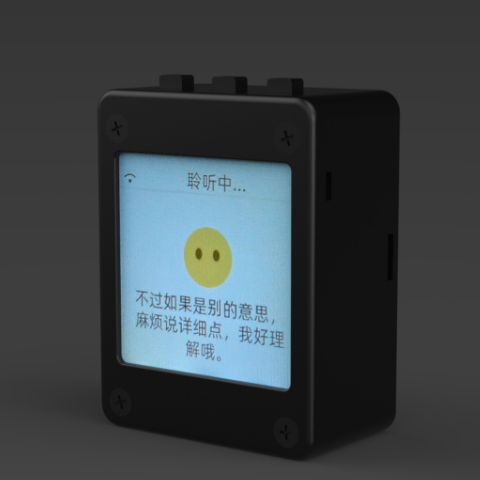
xiaozhi-esp32
78·C++
基于 MCP 协议、跑在 ESP32 上的聊天机器人固件,让单片机也能接入大模型对话与工具调用。
聊天机器人+4IoT / 固件
32966+1247.8kv2.5.22026-11-07 04:14 UTC
DeepSpeech
mozilla·C++
DeepSpeech is an open source embedded (offline, on-device) speech-to-text engine which can run in real time on devices ranging from a Raspberry Pi 4 to high power GPU servers.
IoT / 固件
267724.1k2025-06-19 12:52 UTC
Tasmota
arendst·C
给 ESP8266/ESP32 设备刷的替代固件,通过网页配置、OTA 升级和定时/规则自动化,用 MQTT、HTTP、串口或 KNX 实现完全本地控制。
ESP32+4IoT / 固件
24974+45.2kv16.0.02026-11-09 13:09 UTC