Windows 构建尚未代码签名,首次运行可能触发 SmartScreen 警告;Windows 和 Linux 的备份恢复需自行安装 PostgreSQL 客户端工具;Windows 构建未捆绑 SQL 语言服务器,需用 TUSK_PGLS 和 TUSK_SQLS 指向对应可执行文件

tusk
alpcanaydinMIT活跃维护面向 macOS 的原生数据库客户端,支持 20 种数据库,键盘驱动操作流畅,内置会展示推理过程的 AI 助手,免费开源。
A fast, native, keyboard-driven database client for macOS. 20 databases, an AI assistant that shows its work, free and open source.
v0.2.1发布于 2026-09-30 16:24 UTC434star +13 / 7 天25fork同步于 2026-11-10 23:58 UTC
brew install alpcanaydin/tusk/tusk 硬件要求按 README 说明
macOS 需 14 及以上且为 Apple Silicon;Windows 需 10/11 的 x64 或 ARM64;Linux 需 x86_64 并运行 Wayland 桌面(Xwayland 可作后备)。README 未提及显存要求。
支持 Apple Silicon有 Docker 镜像
基于 GPUI 的原生跨平台数据库客户端,支持 20 种数据库,用键盘操作,AI 只写 SQL 不执行
面向 macOS 的原生数据库客户端,支持 20 种数据库,键盘驱动操作流畅,内置会展示推理过程的 AI 助手,免费开源。
核心能力
- 用虚拟化 GPU 渲染网格流畅滚动百万行
- 统一连接 PostgreSQL、MySQL、SQLite 等 20 种引擎
- AI 代理读取表结构后把 SQL 写入新标签页,不自动执行
- 单元格编辑与删除合并为单个事务提交并支持撤销
- 内置 postgres-language-server 与 sqls 提供补全诊断
容易踩的坑
内容由模型根据 README 生成,可能不完整或不准确,以官方文档为准。看原文 README
- v0.2.1Tusk 0.2.1最新正式版2026-09-30 · 2026-09-30 16:24 UTC
A small follow-up to 0.2.0.
Fixes
- Fold the connected connection in the sidebar. In the connections tree (Settings ▸ Interface ▸ Sidebar Layout ▸ "Connections tree"), clicking the connection you're connected to now folds and unfolds its tables, just like a folder. Clicking any other connection still switches to it.
- A roomier connection search at the top of the connections tree.
- The app icon is back. The first 0.2.0 downloads showed a blank placeholder icon on macOS and a generic program icon on Windows. If you got one of those, this update puts the Tusk elephant back.
Install
macOS (14 Sonoma or later, Apple Silicon): Tusk updates itself. Or download
Tusk-0.2.1-arm64.dmgbelow, or runbrew upgrade tusk.Windows (x64 or ARM64): download the zip for your machine, unzip it, and run
Tusk.exe. SmartScreen may warn the first time because the build isn't code-signed yet: click More info ▸ Run anyway.Linux (x86_64):
.debfor Ubuntu,.rpmfor Fedora,.pkg.tar.zstfor Arch, all below.See 0.2.0 for everything that came with Windows and Linux support.
- v0.2.0Tusk 0.2.02026-09-30 · 2026-09-30 13:39 UTC
查看更新说明
Tusk now runs on Windows and Linux, not just macOS. This release also brings a connections sidebar, Omarchy theme support, and a long list of fixes from the first round of your feedback. Thank you to everyone who tried 0.1 and reported what broke.
New platforms
- Linux. Native Wayland, with an Xwayland fallback. Packages for Ubuntu (
.deb), Fedora (.rpm) and Arch (.pkg.tar.zst). Passwords go to your Secret Service keyring (GNOME Keyring, KWallet…). Huge thanks to Tajeddine Bourhim (@scorpionTaj), who built the whole Linux port and its packaging in #9. - Windows. A portable build for x64 and ARM64. Passwords go to Windows Credential Manager, shortcuts use Ctrl, and the window buttons are native, Snap Layouts included.
- Omarchy. Tusk now follows your Omarchy theme and recolors itself as soon as you switch themes. No restart needed.
What's new
- Connections sidebar. Turn it on in Settings ▸ Interface ▸ Sidebar Layout ▸ "Connections tree". All your connections sit in a sidebar, grouped in folders, and you switch between them with one click. The classic sidebar stays the default.
- Select a range of cells. Shift + arrows, Shift + click or drag selects a block of cells. ⌘A selects everything. ⌘C copies the block as tab-separated text, and ⌘V pastes a block back.
- Undo in the data grid. ⌘Z and ⇧⌘Z undo and redo cell edits and new rows before you save.
- Reorder columns. Drag a column header to move it. Only the view changes, never the table.
- Safe mode for writes. With Settings ▸ Safe Mode ▸ "Confirm Before Saving" on, Tusk asks before saving grid edits and before any query that writes, such as
INSERT,UPDATE,DELETEorCREATE. It's off by default. - What's new after an update. A small card links to these notes the first time you open a new version. You can also open them any time from Tusk ▸ Release Notes.
- Right-click on Structure rows. Copy a column name, add a column, or delete one.
- Window and Help menus. Minimize (⌘M), Zoom, Full Screen (⌃⌘F), Bring All to Front, plus links to GitHub and the issue tracker.
- Friendlier details:
- Timestamps read as
2026-09-11 21:56:05+00. - File databases show their file name instead of
127.0.0.1:0. - Row counts use proper plurals.
- A connection imported from a URL gets a name suggested automatically.
- Timestamps read as
Fixes
- Connections you connect to are saved now. Before, pressing Connect on a new connection never saved it, so it disappeared after a restart. Saving is also crash-safe now: an unreadable
connections.jsonis backed up instead of being overwritten. - Autocomplete no longer wipes the line. Accepting a suggestion with Enter or Tab replaces only the word you're typing. Suggestions with placeholders insert clean text.
- macOS 14 crash fixed. Tusk could quit unexpectedly on Sonoma when a window closed, for example right after connecting to a SQLite file.
- Switching connections is safe. The old workspace stays until the new connection succeeds. If a password is missing, Tusk asks for it. If unsaved queries or changes would be lost, Tusk asks before switching or disconnecting.
- Backup and Restore:
- They use the password you connected with, or ask for one.
- They list only Postgres connections.
- Return in the confirmation dialog really starts the restore.
- You can name the new database the backup restores into.
- Export:
- JSON writes
nullfor NULL values. - Several tables can be picked at once again.
- Rows come out in primary-key order.
- JSON writes
- Readability. Clearer text contrast, larger small text, and
--no longer turns into a dash—. Primary buttons stand out, destructive menu items are red, and Esc, ⌘W and Return work in every dialog. - Safer prompts. Return no longer triggers destructive actions such as Discard, Drop or Delete: Esc cancels, and you confirm them on pu
- Linux. Native Wayland, with an Xwayland fallback. Packages for Ubuntu (
- v0.1.1Tusk 0.1.12026-09-29 · 2026-09-29 10:13 UTC
查看更新说明
What's new
- Tusk updates itself. Tusk checks for new versions and downloads them in the background. When one is ready, a Restart to Update button appears at the top right of the window. If you don't click it, the update installs the next time you quit. You can also check right away with Tusk ▸ Check for Updates….
- About Tusk. A new item under Tusk ▸ About Tusk (also in the command palette) shows which version you're running.
Install
- Download
Tusk-0.1.1-arm64.dmgbelow, open it, and drag Tusk into Applications. It's signed and notarized by Apple. - Or with Homebrew:
brew install alpcanaydin/tusk/tusk(update withbrew upgrade tusk)
macOS 14 (Sonoma) or later, Apple Silicon.
Full Changelog: https://github.com/alpcanaydin/tusk/compare/v0.1.0...v0.1.1
- v0.1.0Tusk 0.1.02026-09-28 · 2026-09-28 22:38 UTC
查看更新说明
The first public release of Tusk: a fast, native, keyboard-driven database client for macOS. Free and open source (MIT).
Install
- Download
Tusk-0.1.0-arm64.dmgbelow, open it, and drag Tusk into Applications. It's signed and notarized by Apple. - Or with Homebrew:
brew install alpcanaydin/tusk/tusk
It needs macOS 14 (Sonoma) or later on Apple Silicon. From this version on, Tusk updates itself: new versions download in the background, and a Restart to Update button appears in the top bar.
What's in it
- 20 databases. PostgreSQL, MySQL, MariaDB, SQLite, SQL Server, Oracle, ClickHouse, DuckDB, Snowflake, BigQuery, Redis, MongoDB, Cassandra, DynamoDB, CockroachDB, Redshift and more, with SSH tunnels and SSL.
- A GPU-rendered data grid. Millions of rows scroll smoothly. You can edit cells in place, and pending edits are saved in one transaction with ⌘S. Undo and redo work.
- Structure and indexes. Edit them in place. Tusk writes each engine's own DDL and tells you up front when an engine can't make a change.
- SQL editor. Completions come from a real language server. ⌘↵ runs the statement under the cursor, and each SELECT gets its own result tab.
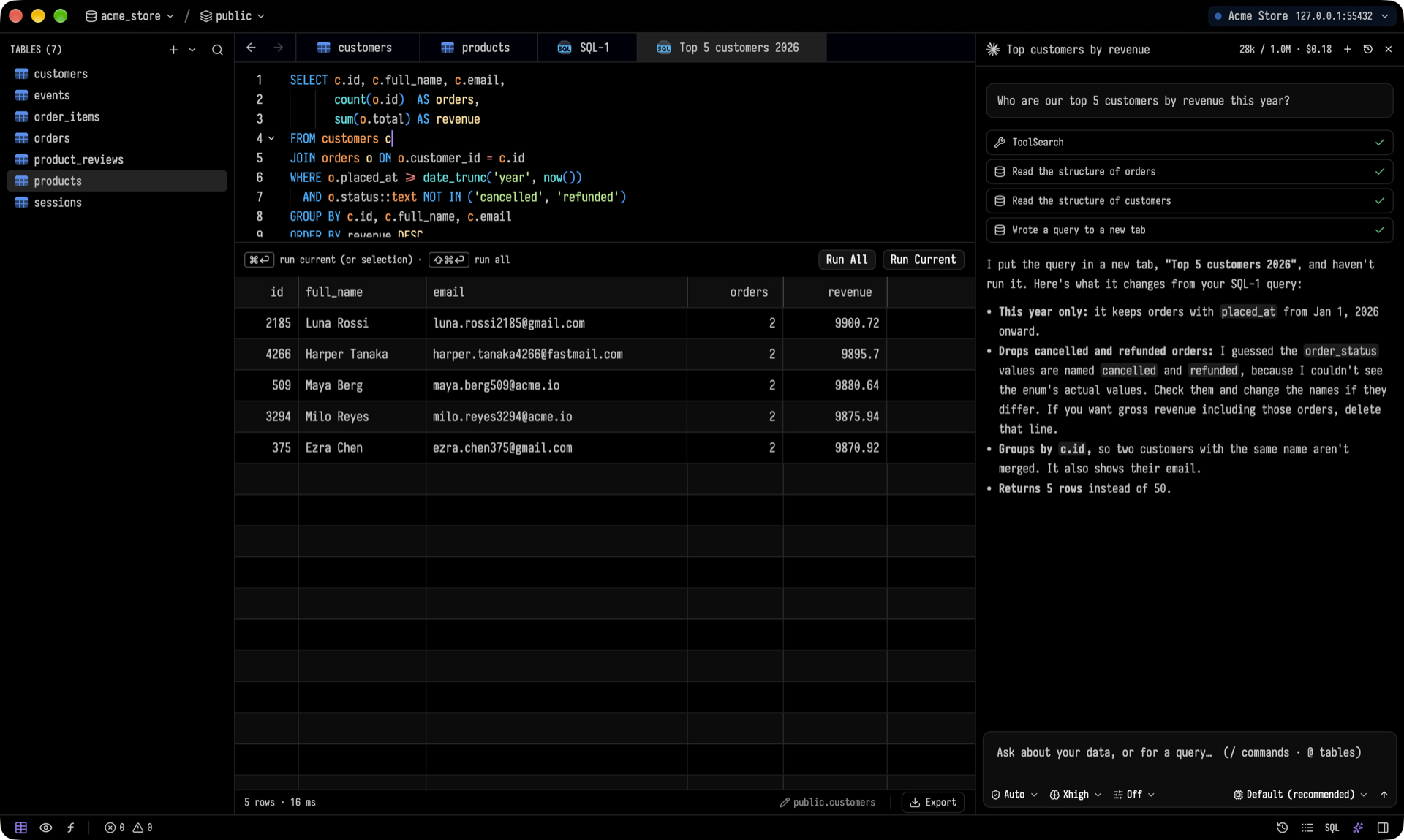
- AI assistant (⌘L). Ask in plain English. The agent reads your schema and writes a query into a new tab, and you decide when it runs. It works with Claude, Codex or Gemini CLI.
- Keyboard first. Every action is in the command palette (⌘⇧P). There are 30+ themes.
- Also: backup and restore with bundled
pg_dump,pg_restoreandpsql, CSV / JSON / SQL export and import, and a process list.
Your passwords stay in the macOS Keychain. There's no account and no telemetry.
Found a bug? Open an issue. Questions and ideas go in Discussions.
- Download
用户点评
登录用户的真实使用记录,可按版本和硬件筛选共 0 条
还没有人点评。第一个说出真实体验的人最有价值。
Tusk
The gentle giant for your databases.
A fast, native, keyboard-driven database client for macOS, Windows and Linux. It's written in Rust on GPUI, the GPU-accelerated UI framework behind the Zed editor.





Why Tusk
- Native and fast. No Electron and no web view. Tables with millions of rows scroll smoothly because the grid is virtualized and GPU-rendered.
- One app for 20 databases. PostgreSQL, MySQL, SQLite, SQL Server, Oracle, ClickHouse, Snowflake, BigQuery, Redis, MongoDB and more.
- Keyboard first. Everything is in the command palette (⌘⇧P), and the common actions have shortcuts.
- AI that doesn't take the wheel. Ask about your data in plain English. The agent reads your schema and writes a query into a new tab. It never runs SQL on its own.
- Your credentials stay yours. Passwords are stored in the macOS Keychain, Windows Credential Manager or Linux Secret Service. There's no account and no telemetry.
Features
Connect to anything
Supported engines: PostgreSQL, Amazon Redshift, CockroachDB, Greenplum, Vertica, MySQL, MariaDB, SQLite, DuckDB, LibSQL, Cloudflare D1, Microsoft SQL Server, Oracle, ClickHouse, Snowflake, BigQuery, Redis, MongoDB, Cassandra and DynamoDB.
- Organize connections with groups, tags and status colors (for example, red for production).
- Connect through an SSH tunnel with a password or a key, and choose any SSL mode.
- Import existing connections from TablePlus, a Docker Compose file, or a connection URL.
A data grid you can actually edit
- Virtualized scrolling. Column widths fit the content, and your resized widths are remembered per table.
- Double-click a cell to edit it with a typed editor (dates, enums, numbers). Pending edits and deletes are highlighted and saved together in one transaction with ⌘S.
- Full undo and redo.
- Right-click a row to copy it as TSV, CSV, JSON,
INSERT,UPDATEor Markdown, filter by its value, sort, or set a cell toNULLor empty.
Filters support a per-column operator, raw SQL conditions, and one-click export of the filtered rows.
Structure, indexes and DDL
Edit columns, types, defaults, nullability, comments and indexes right in the grid. Tusk generates each engine's own DDL. If an engine can't make a change in place (for example, changing a column type in SQLite), Tusk tells you before you save, not after. You can also design new tables and views from the sidebar's + menu.
SQL editor
- Completions and diagnostics come from a bundled language server: postgres-language-server for Postgres, and sqls for most other SQL engines. For the rest, completions come from the live catalog.
- Run Current (⌘↵) runs the statement under the cursor. Run All (⌘⇧↵) runs everything, and each
SELECTgets its own result tab. - When a query fails, Ask AI to Fix sends the error and your query to the agent.
An AI assistant that shows its work
Open the AI panel with ⌘L and ask a question. The agent reads the structure of the tables it needs, writes a query into a new tab, and explains its assumptions. You review it and run it. Tusk doesn't let the agent execute SQL.
Tusk talks to agents over the Agent Client Protocol, so you can use Claude, Codex or Gemini CLI, or add your own. The agents reach your open connection through Tusk's built-in MCP server.
[!NOTE] The agent runs on your machine through the CLI you choose, under that CLI's own account and settings. Tusk doesn't send your data anywhere itself.
Everything is one keystroke away
The command palette (⌘⇧P) lists every action along with its shortcut. It also switches connections, databases, schemas and themes. The console shows every statement Tusk sends. History keeps the queries you've run, and you can search it.
Make it yours
Tusk ships with more than 30 light and dark themes: Tusk, Kanagawa, Catppuccin, Tokyo Night, Gruvbox, One, Rosé Pine, Nord, Solarized and more. You can change the accent color, the UI and table fonts, the editor settings, the grid settings, and the Safe Mode confirmations for destructive statements.
Also included
- Backup and restore for PostgreSQL. The client tools are bundled on macOS; on Windows and Linux, Tusk uses the PostgreSQL client tools you install.
- Export tables and results as CSV, JSON or SQL, and import from CSV.
- Process list with cancel and kill, for every engine.
Keyboard shortcuts
On Windows and Linux, use Ctrl wherever the table shows ⌘.
| Action | Shortcut |
|---|---|
| Command palette | ⌘⇧P |
| Quick open table | ⌘P |
| New connection / Open connection | ⌘N / ⌘⇧O |
| New SQL tab | ⌘T |
| Run current / Run all | ⌘↵ / ⌘⇧↵ |
| Save pending changes | ⌘S |
| Undo / Redo | ⌘Z / ⌘⇧Z |
| AI panel | ⌘L |
| Settings | ⌘, |
Getting started
[!IMPORTANT]
- macOS: macOS 14 (Sonoma) or later, Apple Silicon.
- Windows: Windows 10 or 11, x64 or ARM64.
- Linux: x86_64, on a Wayland desktop (Xwayland works as a fallback).
Download
Get the latest release from the Releases page.
macOS: download Tusk-<version>-arm64.dmg, open it and drag Tusk into Applications. Or install it with Homebrew:
brew install alpcanaydin/tusk/tusk
macOS releases are signed with a Developer ID and notarized by Apple, so they open without Gatekeeper warnings. PostgreSQL's client tools and the SQL language servers are bundled, so you don't need to install anything else.
Windows: download Tusk-<version>-windows-x64.zip (or Tusk-<version>-windows-arm64.zip on ARM), unzip it anywhere and run Tusk.exe. The build isn't code-signed yet, so SmartScreen may warn the first time: click More info ▸ Run anyway. For backup and restore, install the PostgreSQL client tools; Tusk finds them in C:\Program Files\PostgreSQL\<version>\bin, on PATH, or in TUSK_PG_BIN.
Linux:
| Distribution | Package | Install |
|---|---|---|
| Ubuntu 24.04 | Tusk-<version>-ubuntu-amd64.deb | sudo apt install ./Tusk-*-ubuntu-amd64.deb |
| Fedora | Tusk-<version>-fedora-x86_64.rpm | sudo dnf install ./Tusk-*-fedora-x86_64.rpm |
| Arch Linux | Tusk-<version>-arch-x86_64.pkg.tar.zst | sudo pacman -U ./Tusk-*-arch-x86_64.pkg.tar.zst |
The Linux packages include the SQL language servers. For backup and restore, install your distribution's PostgreSQL client tools.
Updates
On macOS, Tusk updates itself. It checks for a new version once a day and downloads it in the background. When the update is ready, a Restart to Update button appears in the top bar. If you don't click it, the update installs the next time you quit Tusk. You can also check right away with Tusk ▸ Check for Updates…. Updates are signed, and Tusk verifies each one before installing it. If you installed with Homebrew, brew upgrade tusk works too.
On Windows and Linux there's no automatic update yet: download the new zip or package from the Releases page.
Build from source
rust-toolchain.toml pins the Rust version; rustup installs it on the first build.
macOS: you need the Xcode Command Line Tools. Building Tusk.app with its icon needs Xcode 26 or later.
git clone https://github.com/alpcanaydin/tusk.git && cd tusk
cargo run --release
To build a standalone Tusk.app with the bundled language servers and PostgreSQL client tools, run:
scripts/bundle.sh # → target/release/bundle/Tusk.app
Windows build
Install the Visual Studio Build Tools with the Desktop development with C++
workload (the MSVC tools for your architecture, x64 or ARM64, and a Windows SDK),
LLVM (ring needs clang),
CMake and Git, and Rust with rustup. Then:
git clone https://github.com/alpcanaydin/tusk.git && cd tusk
cargo build --release          # → target\release\tusk.exe
The SQL language servers aren't bundled on Windows yet. Point TUSK_PGLS and
TUSK_SQLS at postgres-language-server.exe and sqls.exe to use them;
without them, completions come from the live catalog.
Linux build
To build from source, clone the repository and install the pinned Rust
toolchain with rustup. You also
need a C/C++ compiler, CMake, Go (for the SQL language server), pkg-config,
and GPUI's Wayland/Xwayland, font, and Vulkan dependencies. On Arch-based
distributions:
sudo pacman -S --needed base-devel clang cmake go git curl pkgconf wayland libxkbcommon-x11 fontconfig vulkan-icd-loader dbus gnome-keyring postgresql-libs
git clone https://github.com/alpcanaydin/tusk.git && cd tusk
cargo run --release
On Ubuntu 24.04, install build dependencies with:
sudo apt update
sudo apt install clang cmake golang-go git curl pkg-config libasound2-dev libdbus-1-dev libfontconfig-dev libwayland-dev libx11-xcb-dev libxkbcommon-x11-dev libvulkan-dev
On Fedora, install build dependencies with:
sudo dnf install clang cmake golang git curl pkgconf-pkg-config alsa-lib-devel dbus-devel fontconfig-devel wayland-devel libxcb-devel libxkbcommon-x11-devel vulkan-loader-devel
To install the binary, SQL language servers, and desktop launcher under ~/.local, run
scripts/install-linux.sh. Restart the desktop session if the launcher does
not appear immediately. Linux uses your desktop's Secret Service provider
(such as GNOME Keyring or a compatible KWallet service) for saved passwords.
The app refuses to report a password as saved when the service is unavailable.
On Linux, choose the graphics device in Settings → General → Graphics Device
and restart Tusk. The choice asks GPUI to prefer that GPU; if it cannot render
the window, GPUI falls back to another compatible device.
On a Wayland desktop, GPUI uses native Wayland when available and can use
Xwayland as a fallback. Standalone X11 sessions are not a supported target.
PostgreSQL backup and restore use pg_dump, pg_restore, and psql from
PATH (or TUSK_PG_BIN); install your distribution's PostgreSQL client tools
for these features. SQL completions use postgres-language-server and sqls
from PATH; scripts/install-linux.sh installs both. A direct cargo run
build can use TUSK_PGLS or TUSK_SQLS to locate them.
Releasing (maintainers)
Releases are built by GitHub Actions (.github/workflows/release.yml). The workflow:
- Builds the app and signs it with the Developer ID.
- Notarizes and staples both the app and the DMG.
- Signs the DMG for Sparkle and writes the update feed (
appcast.xml). - Publishes a GitHub release with the DMG and update feed, using the notes in
docs/release-notes/<version>.md. - Builds the Windows x64 and ARM64 zips and the Ubuntu DEB, Fedora RPM and Arch Linux packages, then attaches them to the release. A failing Windows or Linux build never holds back the macOS release.
- Updates the Homebrew cask.
Running the workflow by hand (Actions ▸ release ▸ Run workflow) is a dry run: it builds only the Windows and Linux packages.
One-time setup: run scripts/setup-release.sh. The wizard walks you through the certificate, the notarization key, the update-signing key and the Homebrew token, and checks each one. After that, a release is one command:
scripts/tag-release.sh 0.2.0 # bumps the version, commits, tags v0.2.0, pushes
To build a release locally, run scripts/release.sh. It uses the same signing and notarization credentials, stored in your keychain.
[!TIP] If you have an Apple Development certificate,
cargo runsigns the dev binary with it (seescripts/sign-dev.sh). Then the Keychain's Always Allow keeps working across rebuilds. Without one, the binary runs unsigned and macOS asks for Keychain access again after each rebuild.
Try it with sample data
The repo includes a Docker Compose file that starts PostgreSQL 17 with a seeded demo database. It has three schemas, views, functions, and a 500,000-row events table.
docker compose up -d # PostgreSQL on localhost:55432
In Tusk, choose Import from Docker Compose… on the welcome screen and pick this repo's docker-compose.yml.
Run the tests
cargo test
Some integration tests need the Docker database above. Tests for other engines use their own containers and are skipped when those aren't running.
Where your data lives
| What | Where |
|---|---|
| Connection profiles, groups, settings, history | macOS: ~/Library/Application Support/tusk/; Windows: %APPDATA%\tusk\; Linux: $XDG_DATA_HOME/tusk/ (default ~/.local/share/tusk/) |
| Passwords and SSH passphrases | macOS Keychain, Windows Credential Manager or Linux Secret Service (tusk-postgres, tusk-ssh) |
Set TUSK_DATA_DIR to use a different folder, which is handy for a clean test profile.
Built with
GPUI and gpui-component for the UI, sqlx and a native driver per engine, russh for SSH tunnels, and tree-sitter for SQL highlighting. Tusk vendors small patches to gpui-component and gpui-base in vendor/, and those keep their Apache-2.0 licenses.

dbeaver
dbeaver·Java
免费通用的数据库管理工具和 SQL 客户端,支持 MySQL、Oracle、DB2、Databricks 等多种数据库,用图形界面统一管理连接、执行查询和查看 ERD。
数据库客户端+4数据库工具入门
52389+604.5k26.2.42026-11-10 19:11 UTC

tidb
pingcap·Go
面向不可预测增长的 Agent 负载设计的分布式数据库,原生支持事务、分析与向量检索,避免数据孤岛和资源争抢。
分布式数据库+4数据库工具硬核
40730+156.3kv8.5.82026-11-10 23:01 UTC
dbx
t8y2·Rust
25 MB 的轻量跨平台数据库客户端,一个界面连 MySQL、PostgreSQL、Redis、MongoDB、达梦等 100+ 数据库,还自带 AI 助手、MCP Server 和 CLI。
数据库客户端+4数据库工具入门
29915+4442.7kpackages-v0.4.1412026-11-10 22:39 UTC

Chat2DB
OtterMind·Java
跨平台本地优先的数据库客户端和 SQL 工作台,支持 40+ 数据库,可接入自有 AI 模型生成、解释和优化查询,桌面、Web、Docker、CLI 多端可用。
数据库客户端+4数据库工具进阶
28360+73.0kv5.3.9-beta.22026-11-02 06:24 UTC