VLM_survey

jingyi0000活跃维护

汇总视觉语言模型在视觉任务上的论文与资源清单,方便研究者快速跟进多模态预训练、迁移学习和知识蒸馏等方向的最新进展。

Collection of AWESOME vision-language models for vision tasks

暂无版本3,132star237fork同步于 2026-11-10 23:42 UTC

怎么上手

由 README 提炼,执行前请确认
git clone https://github.com/jingyi0000/VLM_survey.git
硬件要求按 README 说明

README 未说明

下载:源码 zip·GitHub Releases(安装包)本站不镜像安装包

项目说明

由 README 自动翻译提炼

VLM 视觉任务综述配套仓库,汇总预训练、迁移学习与知识蒸馏论文清单

汇总视觉语言模型在视觉任务上的论文与资源清单,方便研究者快速跟进多模态预训练、迁移学习和知识蒸馏等方向的最新进展。

核心能力

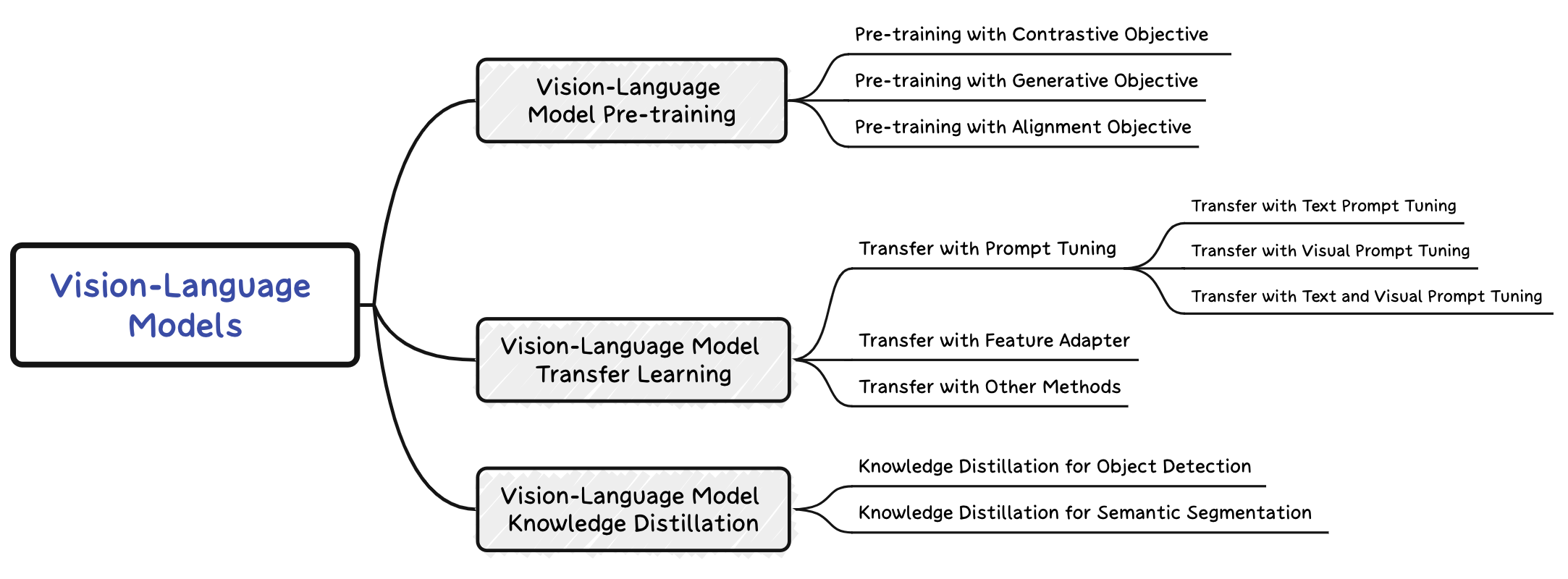
  • 按预训练、迁移学习、知识蒸馏等方向分类整理 VLM 论文
  • 每条条目附论文链接、会议与代码或项目链接
  • 覆盖分类、检测、分割等视觉识别任务
  • 提供 PR 提交格式,方便补充遗漏论文
  • 关联 Awesome-Agentic-MLLMs 等相关综述仓库

容易踩的坑

仓库是论文清单而非可运行代码,没有模型或训练脚本;README 未提供依赖与运行环境说明;补充论文需按 README 给出的表格格式提交 PR
内容由模型根据 README 生成,可能不完整或不准确,以官方文档为准。看原文 README

最近发版

0 个版本

暂无 release 数据(可能没有发版,或尚未同步)。

用户点评

登录用户的真实使用记录,可按版本和硬件筛选
共 0 条

    还没有人点评。第一个说出真实体验的人最有价值。

    README 原文

    未翻译

    Awesome Vision-Language Models Awesome

    This is the repository of Vision Language Models for Vision Tasks: a Survey, a systematic survey of VLM studies in various visual recognition tasks including image classification, object detection, semantic segmentation, etc. For details, please refer to:

    Vision-Language Models for Vision Tasks: A Survey [Paper]

    IEEE Transactions on Pattern Analysis and Machine Intelligence (TPAMI), 2024

    🤩 Our paper is selected into TPAMI Top 50 Popular Paper List !!

    arXiv Maintenance PR's Welcome

    Feel free to pull requests or contact us if you find any related papers that are not included here.

    The process to submit a pull request is as follows:

    • a. Fork the project into your own repository.
    • b. Add the Title, Paper link, Conference, Project/Code link in README.md using the following format:
      |[Title](Paper Link)|Conference|[Code/Project](Code/Project link)|
    
    • c. Submit the pull request to this branch.

    We plan to update the arXiv version of our survey paper soon. If your paper is missing from this repository, feel free to contact us or open an issue!

    🔥 News

    Awesome-Agentic-MLLMs arXiv github

    📅 Last update on 2026/10/02

    VLMs and Synthetic Data
    • [CVPR 2025] Synthetic Data is an Elegant GIFT for Continual Vision-Language Models [Paper][Code]
    • [CVPR 2025] Enhancing Vision-Language Compositional Understanding with Multimodal Synthetic Data [Paper]
    • [OpenReview 2025] A Survey on Bridging VLMs and Synthetic Data [Paper][Code]
    • [CVPR 2025] Synthetic Visual Genome [Paper]
    • [arXiv 2026] Synthetic Visual Genome 2: Extracting Large-scale Spatio-Temporal Scene Graphs from Videos [Paper]
    VLM Pre-training Methods
    • [NeurIPS 2024] PLIP: Language-Image Pre-training for Person Representation Learning [Paper][Code]
    • [NeurIPS 2024] LoTLIP: Improving Language-Image Pre-training for Long Text Understanding [Paper][Code]
    • [NeurIPS 2024] Accelerating Pre-training of Multimodal LLMs via Chain-of-Sight [Paper][Code]
    VLM Transfer Learning Methods
    • [ICCV 2025] One Last Attention for Your Vision-Language Model [Paper][Code]
    • [ICCV 2025] Hierarchical Cross-modal Prompt Learning for Vision-Language Models [Paper][Code]
    • [CVPR 2025] DPC: Dual-Prompt Collaboration for Tuning Vision-Language Models [Paper][Code]
    • [CVPR 2025] O-TPT: Orthogonality Constraints for Calibrating Test-time Prompt Tuning in Vision-Language Models [Paper][Code]
    • [CVPR 2025] R-TPT: Improving Adversarial Robustness of Vision-Language Models through Test-Time Prompt Tuning [Paper][Code]
    • [CVPR 2025] TAPT: Test-Time Adversarial Prompt Tuning for Robust Inference in Vision-Language Models [Paper][Code]
    • [CVPR 2025] Skip Tuning: Pre-trained Vision-Language Models are Effective and Efficient Adapters Themselves [Paper][Code]
    • [CVPR 2025] Adaptive Parameter Selection for Tuning Vision-Language Models [Paper]
    • [CVPR 2025] Task-Aware Clustering for Prompting Vision-Language Models [Paper][Code]
    • [CVPR 2025] Bayesian Test-Time Adaptation for Vision-Language Models [Paper]
    • [CVPR 2025] NLPrompt: Noise-Label Prompt Learning for Vision-Language Models [Paper][Code]
    • [CVPR 2025] Realistic Test-Time Adaptation of Vision-Language Models [Paper][Code]
    • [NeurIPS 2024] ControlMLLM: Training-Free Visual Prompt Learning for Multimodal Large Language Models [Paper][Code]
    • [NeurIPS 2024] Leveraging Hallucinations to Reduce Manual Prompt Dependency in Promptable Segmentation [Paper][Code]
    • [NeurIPS 2024] Visual Fourier Prompt Tuning [Paper][Code]
    • [NeurIPS 2024] Improving Visual Prompt Tuning by Gaussian Neighborhood Minimization for Long-Tailed Visual Recognition [Paper][Code]
    • [NeurIPS 2024] Few-Shot Adversarial Prompt Learning on Vision-Language Models [Paper][Code]
    • [NeurIPS 2024] Visual Prompt Tuning in Null Space for Continual Learning [Paper][Code]
    • [NeurIPS 2024] IPO: Interpretable Prompt Optimization for Vision-Language Models [Paper]
    • [NeurIPS 2024] LoCoOp: Few-Shot Out-of-Distribution Detection via Prompt Learning [Paper][Code]
    VLM Knowledge Distillation for Detection
    • [NeurIPS 2024] Scaling Open-Vocabulary Object Detection [Paper][Code]
    • [NeurIPS 2024] Bridging the Gap between Object and Image-level Representations for Open-Vocabulary Detection [Paper][Code]
    • [NeurIPS 2024] CoDet: Co-Occurrence Guided Region-Word Alignment for Open-Vocabulary Object Detection [Paper][Code]
    VLM Knowledge Distillation for Segmentation
    • [NeurIPS 2024] Relationship Prompt Learning is Enough for Open-Vocabulary Semantic Segmentation [Paper]
    VLM Knowledge Distillation for Other Vision Tasks

    Abstract

    Most visual recognition studies rely heavily on crowd-labelled data in deep neural networks (DNNs) training, and they usually train a DNN for each single visual recognition task, leading to a laborious and time-consuming visual recognition paradigm. To address the two challenges, Vision Language Models (VLMs) have been intensively investigated recently, which learns rich vision-language correlation from web-scale image-text pairs that are almost infinitely available on the Internet and enables zero-shot predictions on various visual recognition tasks with a single VLM. This paper provides a systematic review of visual language models for various visual recognition tasks, including: (1) the background that introduces the development of visual recognition paradigms; (2) the foundations of VLM that summarize the widely-adopted network architectures, pre-training objectives, and downstream tasks; (3) the widely adopted datasets in VLM pre-training and evaluations; (4) the review and categorization of existing VLM pre-training methods, VLM transfer learning methods, and VLM knowledge distillation methods; (5) the benchmarking, analysis and discussion of the reviewed methods; (6) several research challenges and potential research directions that could be pursued in the future VLM studies for visual recognition.

    Citation

    If you find our work useful in your research, please consider citing:

    @article{zhang2024vision,
      title={Vision-language models for vision tasks: A survey},
      author={Zhang, Jingyi and Huang, Jiaxing and Jin, Sheng and Lu, Shijian},
      journal={IEEE Transactions on Pattern Analysis and Machine Intelligence},
      year={2024},
      publisher={IEEE}
    }
    

    Menu

    Datasets

    Datasets for VLM Pre-training

    DatasetYearNum of Image-Text ParisLanguageProject
    SBU Caption20111MEnglishProject
    COCO Caption20161.5MEnglishProject
    Yahoo Flickr Creative Commons 100 Million2016100MEnglishProject
    Visual Genome20175.4MEnglishProject
    Conceptual Captions 3M20183.3MEnglishProject
    Localized Narratives20200.87MEnglishProject
    Conceptual 12M202112MEnglishProject
    Wikipedia-based Image Text202137.6M108 LanguagesProject
    Red Caps202112MEnglishProject
    LAION400M2021400MEnglishProject
    LAION5B20225BOver 100 LanguagesProject
    WuKong2022100MChineseProject
    CLIP2021400MEnglish-
    ALIGN20211.8BEnglish-
    FILIP2021300MEnglish-
    WebLI202212BEnglish-

    Datasets for VLM Evaluation

    Image Classification
    DatasetYearClassesTrainingTestingEvaluation MetricProject
    MNIST19981060,00010,000AccuracyProject
    Caltech-10120041023,0606,085Mean Per ClassProject
    PASCAL VOC 20072007205,0114,95211-point mAPProject
    Oxford 102 Flowers20081022,0406,149Mean Per ClassProject
    CIFAR-1020091050,00010,000AccuracyProject
    CIFAR-100200910050,00010,000AccuracyProject
    ImageNet-1k200910001,281,16750,000AccuracyProject
    SUN397201039719,85019,850AccuracyProject
    SVHN20111073,25726,032AccuracyProject
    STL-102011101,0008,000AccuracyProject
    GTSRB20114326,64012,630AccuracyProject
    KITTI Distance201246,770711AccuracyProject
    IIIT5k2012362,0003,000AccuracyProject
    Oxford-IIIT PETS2012373,6803,669Mean Per ClassProject
    Stanford Cars20131968,1448,041AccuracyProject
    FGVC Aircraft20131006,6673,333Mean Per ClassProject
    Facial Emotion2013832,1403,574AccuracyProject
    Rendered SST2201327,7921,821AccuracyProject
    Describable Textures2014473,7601,880AccuracyProject
    Food-101201410175,75025,250AccuracyProject
    Birdsnap201450042,2832,149AccuracyProject
    RESISC452017453,15025,200AccuracyProject
    CLEVR Counts201782,000500AccuracyProject
    PatchCamelyon20182294,91232,768AccuracyProject
    EuroSAT20191010,0005,000AccuracyProject
    Hateful Memes202028,500500ROC AUCProject
    Country211202121143,20021,100AccuracyProject
    Image-Text Retrieval
    DatasetYearClassesTrainingTestingEvaluation MetricProject
    Flickr30k2014-31,783-RecallProject
    COCO Caption2015-82,7835,000RecallProject
    Action Recognition
    DatasetYearClassesTrainingTestingEvaluation MetricProject
    UCF10120121019,5371,794AccuracyProject
    Kinetics7002019700494,80131,669Mean (top1, top5)Project
    RareAct20201227,607-mWAP, mSAPProject
    Object Detection
    DatasetYearClassesTrainingTestingEvaluation MetricProject
    COCO 2014 Detection20148083,00041,000Box mAPProject
    COCO 2017 Detection201780118,0005,000Box mAPProject
    LVIS20191203118,0005,000Box mAPProject
    ODinW2022314132,41320,070Box mAPProject
    Semantic Segmentation
    DatasetYearClassesTrainingTestingEvaluation MetricProject
    PASCAL VOC 20122012201,4641,449mIoUProject
    PASCAL Content20144594,9985,105mIoUProject
    Cityscapes2016192,975500mIoUProject
    ADE20k201715025,5742,000mIoUProject

    Vision-Language Pre-training Methods

    Pre-training with Contrastive Objective

    PaperPublished inCode/Project
    CLIP: Learning Transferable Visual Models From Natural Language SupervisionICML 2021Code
    ALIGN: Scaling Up Visual and Vision-Language Representation Learning With Noisy Text SupervisionICML 2021-
    OTTER: Data Efficient Language-Supervised Zero-Shot Recognition with Optimal Transport DistillationarXiv 2021Code
    Florence: A New Foundation Model for Computer VisionarXiv 2021-
    RegionClip: Region-based Language-Image PretrainingarXiv 2021Code
    DeCLIP: Supervision Exists Everywhere: A Data Efficient Contrastive Language-Image Pre-training ParadigmICLR 2022Code
    FILIP: Fine-grained Interactive Language-Image Pre-TrainingICLR 2022-
    KELIP: Large-scale Bilingual Language-Image Contrastive LearningICLRW 2022Code
    ZeroVL: Contrastive Vision-Language Pre-training with Limited ResourcesECCV 2022Code
    SLIP: Self-supervision meets Language-Image Pre-trainingECCV 2022Code
    UniCL: Unified Contrastive Learning in Image-Text-Label SpaceCVPR 2022Code
    LiT: Zero-Shot Transfer with Locked-image text TuningCVPR 2022Code
    GroupViT: Semantic Segmentation Emerges from Text SupervisionCVPR 2022Code
    PyramidCLIP: Hierarchical Feature Alignment for Vision-language Model PretrainingNeurIPS 2022-
    UniCLIP: Unified Framework for Contrastive Language-Image Pre-trainingNeurIPS 2022-
    K-LITE: Learning Transferable Visual Models with External KnowledgeNeurIPS 2022Code
    FIBER: Coarse-to-Fine Vision-Language Pre-training with Fusion in the BackboneNeurIPS 2022Code
    Chinese CLIP: Contrastive Vision-Language Pretraining in ChinesearXiv 2022Code
    AltCLIP: Altering the Language Encoder in CLIP for Extended Language CapabilitiesarXiv 2022Code
    SegCLIP: Patch Aggregation with Learnable Centers for Open-Vocabulary Semantic SegmentationarXiv 2022Code
    NLIP: Noise-robust Language-Image Pre-trainingAAAI 2023-
    PaLI: A Jointly-Scaled Multilingual Language-Image ModelICLR 2023Project
    HiCLIP: Contrastive Language-Image Pretraining with Hierarchy-aware AttentionICLR 2023Code
    CLIPPO: Image-and-Language Understanding from Pixels OnlyCVPR 2023Code
    RA-CLIP: Retrieval Augmented Contrastive Language-Image Pre-trainingCVPR 2023-
    DeAR: Debiasing Vision-Language Models with Additive ResidualsCVPR 2023-
    Filtering, Distillation, and Hard Negatives for Vision-Language Pre-TrainingCVPR 2023Code
    LaCLIP: Improving CLIP Training with Language RewritesNeurIPS 2023Code
    ALIP: Adaptive Language-Image Pre-training with Synthetic CaptionICCV 2023Code
    GrowCLIP: Data-aware Automatic Model Growing for Large-scale Contrastive Language-Image Pre-trainingICCV 2023-
    CLIPpy: Perceptual Grouping in Contrastive Vision-Language ModelsICCV 2023-
    ViTamin: Designing Scalable Vision Models in the Vision-Language EraCVPR 2024Code
    Iterated Learning Improves Compositionality in Large Vision-Language ModelsCVPR 2024-
    FairCLIP: Harnessing Fairness in Vision-Language LearningCVPR 2024Code
    Retrieval-Enhanced Contrastive Vision-Text ModelsICLR 2024-
    CLIPS: An Enhanced CLIP Framework for Learning with Synthetic Captions]arXiv 2024Code
    Sigmoid Loss for Language Image Pre-TrainingCVPR 2023Code

    Pre-training with Generative Objective

    PaperPublished inCode/Project
    FLAVA: A Foundational Language And Vision Alignment ModelCVPR 2022Code
    CoCa: Contrastive Captioners are Image-Text Foundation ModelsarXiv 2022Code
    Too Large; Data Reduction for Vision-Language Pre-TrainingarXiv 2023Code
    SAM: Segment AnythingarXiv 2023Code
    SEEM: Segment Everything Everywhere All at OncearXiv 2023Code
    Semantic-SAM: Segment and Recognize Anything at Any GranularityarXiv 2023Code
    Generative Region-Language Pretraining for Open-Ended Object DetectionCVPR 2024Code
    InternVL: Scaling up Vision Foundation Models and Aligning for Generic Visual-Linguistic TasksCVPR 2024Code
    VILA: On Pre-training for Visual Language ModelsCVPR 2024-
    Enhancing Vision-Language Pre-training with Rich SupervisionsCVPR 2024-
    Unified Language-Vision Pretraining in LLM with Dynamic Discrete Visual TokenizationICLR 2024Code
    MMICL: Empowering Vision-language Model with Multi-Modal In-Context LearningICLR 2024Code
    RLAIF-V: Aligning MLLMs through Open-Source AI Feedback for Super GPT-4V TrustworthinessarXiv 2024Code
    RLHF-V: Towards Trustworthy MLLMs via Behavior Alignment from Fine-grained Correctional Human FeedbackCVPR 2024Code
    Efficient Vision-Language Pre-training by Cluster MaskingCVPR 2024Code

    Pre-training with Alignment Objective

    PaperPublished inCode/Project
    GLIP: Grounded Language-Image Pre-trainingCVPR 2022Code
    DetCLIP: Dictionary-Enriched Visual-Concept Paralleled Pre-training for Open-world DetectionNeurIPS 2022-
    nCLIP: Non-Contrastive Learning Meets Language-Image Pre-TrainingCVPR 2023Code
    Do Vision and Language Encoders Represent the World Similarly?CVPR 2024Code
    Non-autoregressive Sequence-to-Sequence Vision-Language ModelsCVPR 2024-
    MMRL: Multi-Modal Representation Learning for Vision-Language ModelsCVPR 2025Code
    HIVE: Hierarchical Pre-Training of Vision Encoders with Large Language ModelsCVPR 2026 WorkshopCode

    Vision-Language Model Transfer Learning Methods

    Transfer with Prompt Tuning

    Transfer with Text Prompt Tuning
    PaperPublished inCode/Project
    CoOp: Learning to Prompt for Vision-Language ModelsIJCV 2022Code
    CoCoOp: Conditional Prompt Learning for Vision-Language ModelsCVPR 2022Code
    ProDA: Prompt Distribution LearningCVPR 2022-
    DenseClip: Language-Guided Dense Prediction with Context-Aware PromptingCVPR 2022Code
    TPT: Test-time prompt tuning for zero-shot generalization in vision-language modelsNeurIPS 2022Code
    DualCoOp: Fast Adaptation to Multi-Label Recognition with Limited AnnotationsNeurIPS 2022Code
    CPL: Counterfactual Prompt Learning for Vision and Language ModelsEMNLP 2022Code
    Bayesian Prompt Learning for Image-Language Model GeneralizationarXiv 2022-
    UPL: Unsupervised Prompt Learning for Vision-Language ModelsarXiv 2022Code
    ProGrad: Prompt-aligned Gradient for Prompt TuningarXiv 2022Code
    SoftCPT: Prompt Tuning with Soft Context Sharing for Vision-Language ModelsarXiv 2022Code
    SubPT: Understanding and Mitigating Overfitting in Prompt Tuning for Vision-Language ModelsTCSVT 2023Code
    LASP: Text-to-Text Optimization for Language-Aware Soft Prompting of Vision & Language ModelsCVPR 2023Code
    LMPT: Prompt Tuning with Class-Specific Embedding Loss for Long-tailed Multi-Label Visual RecognitionACLW 2024Code
    Texts as Images in Prompt Tuning for Multi-Label Image RecognitionCVPR 2023code
    Visual-Language Prompt Tuning with Knowledge-guided Context OptimizationCVPR 2023Code
    Learning to Name Classes for Vision and Language ModelsCVPR 2023-
    PLOT: Prompt Learning with Optimal Transport for Vision-Language ModelsICLR 2023Code
    CuPL: What does a platypus look like? Generating customized prompts for zero-shot image classificationICCV 2023Code
    ProTeCt: Prompt Tuning for Hierarchical ConsistencyarXiv 2023-
    Enhancing CLIP with CLIP: Exploring Pseudolabeling for Limited-Label Prompt TuningarXiv 2023Code
    Why Is Prompt Tuning for Vision-Language Models Robust to Noisy Labels?ICCV 2023Code
    Gradient-Regulated Meta-Prompt Learning for Generalizable Vision-Language ModelsICCV 2023-
    Knowledge-Aware Prompt Tuning for Generalizable Vision-Language ModelsICCV 2023-
    Read-only Prompt Optimization for Vision-Language Few-shot LearningICCV 2023Code
    Bayesian Prompt Learning for Image-Language Model GeneralizationICCV 2023Code
    Distribution-Aware Prompt Tuning for Vision-Language ModelsICCV 2023Code
    LPT: Long-Tailed Prompt Tuning For Image ClassificationICCV 2023Code
    Diverse Data Augmentation with Diffusions for Effective Test-time Prompt TuningICCV 2023Code
    Efficient Test-Time Prompt Tuning for Vision-Language ModelsarXiv 2024-
    Text-driven Prompt Generation for Vision-Language Models in Federated LearningICLR 2024-
    C-TPT: Calibrated Test-Time Prompt Tuning for Vision-Language Models via Text Feature DispersionICLR 2024-
    Prompt Gradient Projection for Continual LearningICLR 2024-
    Nemesis: Normalizing the soft-prompt vectors of vision-language modelsICLR 2024Code
    DePT: Decomposed Prompt Tuning for Parameter-Efficient Fine-tuningICLR 2024Code
    TCP:Textual-based Class-aware Prompt tuning for Visual-Language ModelCVPR 2024Code
    One Prompt Word is Enough to Boost Adversarial Robustness for Pre-trained Vision-Language ModelsCVPR 2024Code
    Any-Shift Prompting for Generalization over DistributionsCVPR 2024-
    Towards Better Vision-Inspired Vision-Language ModelsCVPR 2024-
    Mind the Interference: Retaining Pre-trained Knowledge in Parameter Efficient Continual Learning of Vision-Language ModelsECCV 2024Code
    Historical Test-time Prompt Tuning for Vision Foundation ModelsNeurIPS 2024–
    Transfer with Visual Prompt Tuning
    PaperPublished inCode/Project
    Exploring Visual Prompts for Adapting Large-Scale ModelsarXiv 2022Code
    Retrieval-Enhanced Visual Prompt Learning for Few-shot ClassificationarXiv 2023-
    Fine-Grained Visual PromptingarXiv 2023-
    LoGoPrompt: Synthetic Text Images Can Be Good Visual Prompts for Vision-Language ModelsICCV 2023Code
    Progressive Visual Prompt Learning with Contrastive Feature Re-formationIJCV 2024Code
    Visual In-Context PromptingCVPR 2024Code
    FALIP: Visual Prompt as Foveal Attention Boosts CLIP Zero-Shot PerformanceECCV 2024Code
    Learning to Select Visual In-Context DemonstrationsCVPR 2026 FindingsCode
    Transfer with Text and Visual Prompt Tuning
    PaperPublished inCode/Project
    UPT: Unified Vision and Language Prompt LearningarXiv 2022Code
    MVLPT: Multitask Vision-Language Prompt TuningarXiv 2022Code
    CAVPT: Dual Modality Prompt Tuning for Vision-Language Pre-Trained ModelarXiv 2022Code
    MaPLe: Multi-modal Prompt LearningCVPR 2023Code
    Learning to Prompt Segment Anything ModelsarXiv 2024-
    An Image Is Worth 1000 Lies: Transferability of Adversarial Images across Prompts on Vision-Language ModelsICLR 2024-
    GalLoP: Learning Global and Local Prompts for Vision-Language ModelsECCV 2024-
    CLAP: Isolating Content from Style through Contrastive Learning with Augmented PromptsECCV 2024Code
    Learning to Prompt Segment Anything ModelsarXiv 2024–

    Transfer with Feature Adapter

    PaperPublished inCode/Project
    Clip-Adapter: Better Vision-Language Models with Feature AdaptersarXiv 2021Code
    Tip-Adapte: Training-free Adaption of CLIP for Few-shot ClassificationECCV 2022Code
    SVL-Adapter: Self-Supervised Adapter for Vision-Language Pretrained ModelsBMVC 2022Code
    CLIPPR: Improving Zero-Shot Models with Label Distribution PriorsarXiv 2022Code
    SgVA-CLIP: Semantic-guided Visual Adapting of Vision-Language Models for Few-shot Image ClassificationarXiv 2022-
    SuS-X: Training-Free Name-Only Transfer of Vision-Language ModelsICCV 2023Code
    VL-PET: Vision-and-Language Parameter-Efficient Tuning via Granularity ControlICCV 2023Code
    SAM-Adapter: Adapting SAM in Underperformed Scenes: Camouflage, Shadow, Medical Image Segmentation, and MorearXiv 2023Code
    Segment Anything in High QualityarXiv 2023Code
    HGCLIP: Exploring Vision-Language Models with Graph Representations for Hierarchical UnderstandingCOLING 2025Code
    CLAP: Contrastive Learning with Augmented Prompts for Robustness on Pretrained Vision-Language ModelsarXiv 2023-
    AWT: Transferring Vision-Language Models via Augmentation, Weighting, and TransportationNeurIPS 2024Code
    A Closer Look at the Few-Shot Adaptation of Large Vision-Language ModelsCVPR 2024Code
    Efficient Test-Time Adaptation of Vision-Language ModelsCVPR 2024Code
    Dual Memory Networks: A Versatile Adaptation Approach for Vision-Language ModelsCVPR 2024Code

    Transfer with Other Methods

    PaperPublished inCode/Project
    VT-Clip: Enhancing Vision-Language Models with Visual-guided TextsarXiv 2021-
    Wise-FT: Robust fine-tuning of zero-shot modelsCVPR 2022Code
    MaskCLIP: Extract Free Dense Labels from CLIPECCV 2022Code
    MUST: Masked Unsupervised Self-training for Label-free Image ClassificationICLR 2023Code
    CALIP: Zero-Shot Enhancement of CLIP with Parameter-free AttentionAAAI 2023Code
    Semantic Prompt for Few-Shot Image RecognitionCVPR 2023-
    Prompt, Generate, then Cache: Cascade of Foundation Models makes Strong Few-shot LearnersCVPR 2023Code
    Task Residual for Tuning Vision-Language ModelsCVPR 2023Code
    Deeply Coupled Cross-Modal Prompt LearningACL 2023Code
    Prompt Ensemble Self-training for Open-Vocabulary Domain AdaptationarXiv 2023-
    Personalize Segment Anything Model with One ShotarXiv 2023Code
    Chils: Zero-shot image classification with hierarchical label setsICML 2023Code
    Improving Zero-shot Generalization and Robustness of Multi-modal ModelsCVPR 2023Code
    Exploiting Category Names for Few-Shot Classification with Vision-Language ModelsICLR W 2023-
    Beyond Sole Strength: Customized Ensembles for Generalized Vision-Language ModelsarXiv 2023Code
    Regularized Mask Tuning: Uncovering Hidden Knowledge in Pre-trained Vision-Language ModelsICCV 2023Code
    PromptStyler: Prompt-driven Style Generation for Source-free Domain GeneralizationICCV 2023Code
    PADCLIP: Pseudo-labeling with Adaptive Debiasing in CLIP for Unsupervised Domain AdaptationICCV 2023-
    Black Box Few-Shot Adaptation for Vision-Language modelsICCV 2023Code
    AD-CLIP: Adapting Domains in Prompt Space Using CLIPICCVW 2023-
    Mitigating Hallucination in Large Multi-Modal Models via Robust Instruction TuningarXiv 2023Code
    Language Models as Black-Box Optimizers for Vision-Language ModelsarXiv 2023-
    Matcher: Segment Anything with One Shot Using All-Purpose Feature MatchingICLR 2024Code
    Consistency-guided Prompt Learning for Vision-Language ModelsICLR 2024-
    Efficient Test-Time Adaptation of Vision-Language ModelsCVPR 2024Code
    Dual Memory Networks: A Versatile Adaptation Approach for Vision-Language ModelsCVPR 2024Code
    A Closer Look at the Few-Shot Adaptation of Large Vision-Language ModelsCVPR 2024Code
    Anchor-based Robust Finetuning of Vision-Language ModelsCVPR 2024
    Pre-trained Vision and Language Transformers Are Few-Shot Incremental LearnersCVPR 2024Code

    Vision-Language Model Knowledge Distillation Methods

    Knowledge Distillation for Object Detection

    PaperPublished inCode/Project
    ViLD: Open-vocabulary Object Detection via Vision and Language Knowledge DistillationICLR 2022Code
    DetPro: Learning to Prompt for Open-Vocabulary Object Detection with Vision-Language ModelCVPR 2022Code
    XPM: Open-Vocabulary Instance Segmentation via Robust Cross-Modal Pseudo-LabelingCVPR 2022Code
    Bridging the Gap between Object and Image-level Representations for Open-Vocabulary DetectionNeurIPS 2022Code
    PromptDet: Towards Open-vocabulary Detection using Uncurated ImagesECCV 2022Code
    PB-OVD: Open Vocabulary Object Detection with Pseudo Bounding-Box LabelsECCV 2022Code
    OV-DETR: Open-Vocabulary DETR with Conditional MatchingECCV 2022Code
    Detic: Detecting Twenty-thousand Classes using Image-level SupervisionECCV 2022Code
    OWL-ViT: Simple Open-Vocabulary Object Detection with Vision TransformersECCV 2022Code
    VL-PLM: Exploiting Unlabeled Data with Vision and Language Models for Object DetectionECCV 2022Code
    ZSD-YOLO: Zero-shot Object Detection Through Vision-Language Embedding AlignmentarXiv 2022Code
    HierKD: Open-Vocabulary One-Stage Detection with Hierarchical Visual-Language Knowledge DistillationarXiv 2022Code
    VLDet: Learning Object-Language Alignments for Open-Vocabulary Object DetectionICLR 2023Code
    F-VLM: Open-Vocabulary Object Detection upon Frozen Vision and Language ModelsICLR 2023Code
    CondHead: Learning to Detect and Segment for Open Vocabulary Object DetectionCVPR 2023-
    Aligning Bag of Regions for Open-Vocabulary Object DetectionCVPR 2023Code
    Region-Aware Pretraining for Open-Vocabulary Object Detection with Vision TransformersCVPR 2023Code
    Object-Aware Distillation Pyramid for Open-Vocabulary Object DetectionCVPR 2023Code
    CORA: Adapting CLIP for Open-Vocabulary Detection with Region Prompting and Anchor Pre-MatchingCVPR 2023Code
    DetCLIPv2: Scalable Open-Vocabulary Object Detection Pre-training via Word-Region AlignmentCVPR 2023-
    Detecting Everything in the Open World: Towards Universal Object DetectionCVPR 2023Code
    CapDet: Unifying Dense Captioning and Open-World Detection PretrainingCVPR 2023-
    Contextual Object Detection with Multimodal Large Language ModelsarXiv 2023Code
    Building One-class Detector for Anything: Open-vocabulary Zero-shot OOD Detection Using Text-image ModelsarXiv 2023Code
    EdaDet: Open-Vocabulary Object Detection Using Early Dense AlignmentICCV 2023Code
    Improving Pseudo Labels for Open-Vocabulary Object DetectionarXiv 2023-
    RegionGPT: Towards Region Understanding Vision Language ModelCVPR 2024Code
    LLMs Meet VLMs: Boost Open Vocabulary Object Detection with Fine-grained DescriptorsICLR 2024-
    Ins-DetCLIP: Aligning Detection Model to Follow Human-Language InstructionICLR 2024-
    Open-Vocabulary Object Detection via Language HierarchyNeurIPS 2024–
    DitHub: A Modular Framework for Incremental Open-Vocabulary Object DetectionNeurips 2025Code

    Knowledge Distillation for Semantic Segmentation

    PaperPublished inCode/Project
    SSIW: Semantic Segmentation In-the-Wild Without Seeing Any Segmentation ExamplesarXiv 2021-
    ReCo: Retrieve and Co-segment for Zero-shot TransferNeurIPS 2022Code
    CLIMS: Cross Language Image Matching for Weakly Supervised Semantic SegmentationCVPR 2022Code
    CLIPSeg: Image Segmentation Using Text and Image PromptsCVPR 2022Code
    ZegFormer: Decoupling Zero-Shot Semantic SegmentationCVPR 2022Code
    LSeg: Language-driven Semantic SegmentationICLR 2022Code
    ZSSeg: A Simple Baseline for Open-Vocabulary Semantic Segmentation with Pre-trained Vision-language ModelECCV 2022Code
    OpenSeg: Scaling Open-Vocabulary Image Segmentation with Image-Level LabelsECCV 2022Code
    Fusioner: Open-vocabulary Semantic Segmentation with Frozen Vision-Language ModelsBMVC 2022Code
    OVSeg: Open-Vocabulary Semantic Segmentation with Mask-adapted CLIPCVPR 2023Code
    ZegCLIP: Towards Adapting CLIP for Zero-shot Semantic SegmentationCVPR 2023Code
    CLIP is Also an Efficient Segmenter: A Text-Driven Approach for Weakly Supervised Semantic SegmentationCVPR 2023Code
    FreeSeg: Unified, Universal and Open-Vocabulary Image SegmentationCVPR 2023Code
    Mask-free OVIS: Open-Vocabulary Instance Segmentation without Manual Mask AnnotationsCVPR 2023Code
    Exploring Open-Vocabulary Semantic Segmentation without Human LabelsarXiv 2023-
    OpenVIS: Open-vocabulary Video Instance SegmentationarXiv 2023-
    Segment Anything is A Good Pseudo-label Generator for Weakly Supervised Semantic SegmentationarXiv 2023-
    Segment Anything Model (SAM) Enhanced Pseudo Labels for Weakly Supervised Semantic SegmentationarXiv 2023Code
    Plug-and-Play, Dense-Label-Free Extraction of Open-Vocabulary Semantic Segmentation from Vision-Language ModelsarXiv 2023-
    SegPrompt: Boosting Open-World Segmentation via Category-level Prompt LearningICCV 2023Code
    ICPC: Instance-Conditioned Prompting with Contrastive Learning for Semantic SegmentationarXiv 2023-
    Convolutions Die Hard: Open-Vocabulary Segmentation with Single Frozen Convolutional CLIParXiv 2023Code
    Plug-and-Play, Dense-Label-Free Extraction of Open-Vocabulary Semantic Segmentation from Vision-Language ModelsarXiv 2023-
    CLIPSelf: Vision Transformer Distills Itself for Open-Vocabulary Dense PredictionICLR 2024-

    Knowledge Distillation for Other Tasks

    PaperPublished inCode/Project
    Controlling Vision-Language Models for Universal Image RestorationarXiv 2023Code
    FROSTER: Frozen CLIP Is A Strong Teacher for Open-Vocabulary Action RecognitionICLR 2024Project
    AnomalyCLIP: Object-agnostic Prompt Learning for Zero-shot Anomaly DetectionICLR 2024Code
    EXIF as Language: Learning Cross-Modal Associations Between Images and Camera MetadataCVPR 2023Code

