跑示例需额外安装依赖:pip install .[examples];遇到 safetensors 相关报错需升级 diffusers transformers accelerate scipy ftfy safetensors;README 未说明默认端口或需额外下载模型
transfusion-pytorch
lucidrainsMIT活跃维护用 PyTorch 复现 MetaAI 的 Transfusion:在同一多模态模型里同时预测下一个 token 和扩散生成图像,把语言建模与图像扩散统一到一个 Transformer 中。
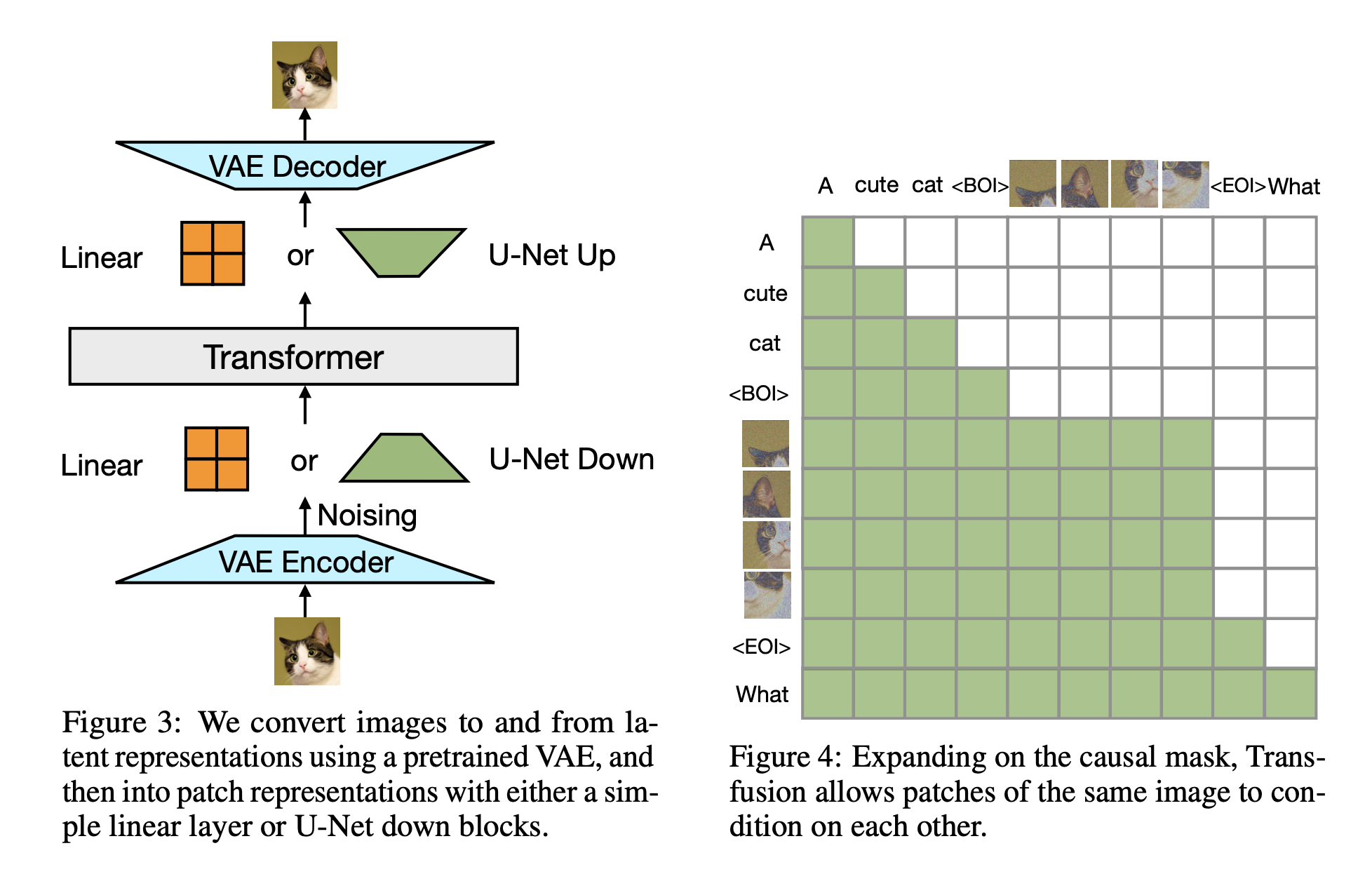
Pytorch implementation of Transfusion, "Predict the Next Token and Diffuse Images with One Multi-Modal Model", from MetaAI
0.16.3发布于 2026-01-27 12:25 UTC1,412star77fork同步于 2026-11-07 07:31 UTC
pip install transfusion-pytorch 硬件要求按 README 说明
README 未说明显存要求;示例中可将模型 .cuda() 运行,但未列出支持的 GPU 厂商或型号
用 PyTorch 实现 Transfusion 多模态模型,文本预测下一 token、图像用流匹配生成
用 PyTorch 复现 MetaAI 的 Transfusion:在同一多模态模型里同时预测下一个 token 和扩散生成图像,把语言建模与图像扩散统一到一个 Transformer 中。
核心能力
- 文本走自回归、模态走流匹配,统一在一个 Transformer 里训练
- 用 torch.long 表示文本、torch.float 表示模态,自动区分类型
- 支持多模态,可为每种模态指定独立 latent 维度和默认形状
- 可挂载自定义 encoder/decoder,自动完成图像编解码
- sample_many 批量并行采样,共享 KV 缓存和 ODE 轨迹
容易踩的坑
内容由模型根据 README 生成,可能不完整或不准确,以官方文档为准。看原文 README
- 0.16.3最新正式版2026-01-27 · 2026-01-27 12:25 UTC
What's Changed
- implement unconditional KV caching by @pranoyr in https://github.com/lucidrains/transfusion-pytorch/pull/50
Full Changelog: https://github.com/lucidrains/transfusion-pytorch/compare/0.16.2...0.16.3
- 0.16.22026-01-23 · 2026-01-23 22:54 UTC
查看更新说明
What's Changed
- match null token sequence length to prompt for correct CFG alignment by @pranoyr in https://github.com/lucidrains/transfusion-pytorch/pull/49
Full Changelog: https://github.com/lucidrains/transfusion-pytorch/compare/0.16.1...0.16.2
- 0.16.12026-01-19 · 2026-01-19 18:11 UTC
查看更新说明
- 0.16.02026-01-19 · 2026-01-19 15:59 UTC
查看更新说明
What's Changed
- added classifier free guidance by @pranoyr in https://github.com/lucidrains/transfusion-pytorch/pull/48
New Contributors
- @pranoyr made their first contribution in https://github.com/lucidrains/transfusion-pytorch/pull/48
Full Changelog: https://github.com/lucidrains/transfusion-pytorch/compare/0.15.3...0.16.0
- 0.15.32026-01-08 · 2026-01-08 15:04 UTC
查看更新说明
用户点评
登录用户的真实使用记录,可按版本和硬件筛选共 0 条
还没有人点评。第一个说出真实体验的人最有价值。
Transfusion - Pytorch
Pytorch implementation of Transfusion, "Predict the Next Token and Diffuse Images with One Multi-Modal Model", from MetaAI.
In this repo, we will substitute diffusion with flow matching given the success of Flux from Black Forest Labs (but will keep the original paper title given Transflow does not have the same ring). This repository will also attempt to extend to any number of modalities.
Appreciation
- Pranoy for adding classifier free guidance!
Install
$ pip install transfusion-pytorch
Usage
One modality, say images
from torch import randint, randn
from transfusion_pytorch import Transfusion

model = Transfusion(
    num_text_tokens = 256,
    dim_latent = 384,
    modality_default_shape = (4,),  # fallback, in the case the language model did not produce a valid modality shape
    transformer = dict(
        dim = 512,
        depth = 8
    )
)

# any torch.long is text, torch.float is modalities

text_and_images = [
    [randint(0, 256, (16,)), randn(4, 384), randint(0, 256, (8,)), randn(6, 384)],
    [randint(0, 256, (16,)), randn(7, 384), randint(0, 256, (5,)), randn(2, 384), randint(0, 256, (9,))]
]

loss = model(text_and_images)

loss.backward()

# after much training

one_multimodal_sample = model.sample()
Multiple different modalities
from torch import randint, randn
from transfusion_pytorch import Transfusion

model = Transfusion(
    num_text_tokens = 256,
    dim_latent = (384, 192),                 # specify multiple latent dimensions
    modality_default_shape = ((4,), (2,)),   # default shapes for first and second modality
    transformer = dict(
        dim = 512,
        depth = 8
    )
)

# then for the Tensors of type float, you can pass a tuple[int, Tensor] and specify the modality index in the first position

# any torch.long is text, torch.float is modalities

text_images_and_audio = [
    [randint(0, 256, (16,)), (0, randn(4, 384)), randint(0, 256, (8,)), (1, randn(6, 192))],
    [randint(0, 256, (16,)), randn(7, 384), randint(0, 256, (5,)), (1, randn(2, 192)), randint(0, 256, (9,))]
]

loss = model(text_images_and_audio)

loss.backward()

# after much training

one_multimodal_sample = model.sample()
Automatically taking care of encoding and decoding of images
import torch
from torch import nn, randint, randn
from transfusion_pytorch import Transfusion, print_modality_sample

mock_encoder = nn.Conv2d(3, 384, 3, padding = 1)
mock_decoder = nn.Conv2d(384, 3, 3, padding = 1)

model = Transfusion(
    num_text_tokens = 12,
    dim_latent = 384,
    channel_first_latent = True,
    modality_default_shape = (4, 4),
    modality_encoder = mock_encoder,
    modality_decoder = mock_decoder,
    transformer = dict(
        dim = 512,
        depth = 8
    )
)

text_and_images = [
    [
        randint(0, 12, (16,)),  # 16 text tokens
        randn(3, 8, 8),         # (8 x 8) 3 channeled image
        randint(0, 12, (8,)),   # 8 text tokens
        randn(3, 7, 7)          # (7 x 7) 3 channeled image
    ],
    [
        randint(0, 12, (16,)),  # 16 text tokens
        randn(3, 8, 5),         # (8 x 5) 3 channeled image
        randint(0, 12, (5,)),   # 5 text tokens
        randn(3, 2, 16),        # (2 x 16) 3 channeled image
        randint(0, 12, (9,))    # 9 text tokens
    ]
]

loss = model(text_and_images)

loss.backward()

# after much training

one_multimodal_sample = model.sample()

print_modality_sample(one_multimodal_sample)
Sampling a batch of interleaved text + modality samples in parallel, with sample_many
sample_many decodes an entire batch of samples concurrently: all samples currently decoding text
share a single kv-cached forward pass, and all samples currently decoding a modality share a single
joint odeint trajectory (one forward pass per ode evaluation, with each sample keeping its own
shape, length and modality type). sample_one walks each sample through the same state machine
serially - sample_many is the batched equivalent.
import torch
from transfusion_pytorch import Transfusion

model = Transfusion(
    num_text_tokens = 256,
    dim_latent = 384,
    modality_default_shape = (4,),
    transformer = dict(
        dim = 512,
        depth = 8
    )
)

# a batch is a list of prompts, each taking the same form as the `prompt` of `sample_one` -
# a list of text tensors / (modality_type, tensor) tuples, a raw tensor or tuple, or `None`

prompts = [
    torch.randint(0, 256, (16,)),                                   # raw text prompt
    (0, torch.randn(4, 384)),                                       # raw modality prompt
    None,                                                           # empty prompt
    [torch.randint(0, 256, (8,)), (0, torch.randn(6, 384))],        # interleaved text + modality
]

samples = model.sample_many(prompts, max_length = 2048, cfg_scale = 3.)
the samples come back as a list of ModalitySamples, one per prompt. the kv cache is always used
(the cache_kv = True code path of sample_one), and each sample keeps its own max length budget,
so one sample finishing early does not hold up the rest of the batch.
To pretrain on language first, just pass in your text as type Int['batch seq']
import torch
from transfusion_pytorch import Transfusion

model = Transfusion(
    num_text_tokens = 256,
    dim_latent = 384,
    transformer = dict(
        dim = 512,
        depth = 8,
    )
).cuda()

text = torch.randint(0, 256, (2, 1024)).cuda()

loss = model(text)
loss.backward()

# after much training

sampled = model.generate_text_only(text[:, :1], 1024)
Examples
To run any of the examples train_{example_name}.py in the project root, simply install dependencies first as so
$ pip install .[examples]
If you run into some weird error with safetensors, run this too
$ pip install -U diffusers transformers accelerate scipy ftfy safetensors
Forcing a modality at the start of generation
To force the first generated thing to be a specific modality - skipping text decoding at the start -
pass force_modality_at_start to sample / sample_many with the modality type, or a
(modality_type, shape) tuple to also force its shape. for example, prompt with some text, then a
video (modality 0, channel first 3d latent), and force a 1d action of chunk length 32 (modality 1):
import torch
from transfusion_pytorch import Transfusion

model = Transfusion(
    num_text_tokens = 256,
    dim_latent = (16, 8),
    modality_default_shape = ((4, 4, 4), (16,)),  # (video, action)
    channel_first_latent = (True, False),
    transformer = dict(
        dim = 512,
        depth = 8
    )
)

# ICL for human to robot - a human demonstrates the task on video, then the robot actions are generated in-context, no finetuning

text = torch.randint(0, 256, (16,))                                 # some text prompt
human_demo_video = torch.randn(16, 4, 4, 4)                         # channel first video latent - (latent dim, frames, height, width)

samples = model.sample_many(
    [[text, (0, human_demo_video)]],                                # one prompt: text, then the human demonstration video
    force_modality_at_start = (1, (32,)),                           # force a 1d robot action chunk of length 32
    return_without_prompt = True,                                   # just the decoded modalities, no prompt
    cfg_scale = 3.,
)

# modality items come back with named attributes - `.modality_type`, `.tensor`, `.loss_weight`

robot_actions = samples[0][0].tensor                                # the forced robot actions, of shape (32, 8)
the batch can mix prompts of different text and video lengths - each sample still gets its forced action in the same shape.
forcing only the modality type (force_modality_at_start = 1) falls back to the modality's default
shape (or fixed_modality_shape).
Citations
@inproceedings{Zhou2024TransfusionPT,
    title  = {Transfusion: Predict the Next Token and Diffuse Images with One Multi-Modal Model},
    author = {Chunting Zhou and Lili Yu and Arun Babu and Kushal Tirumala and Michihiro Yasunaga and Leonid Shamis and Jacob Kahn and Xuezhe Ma and Luke Zettlemoyer and Omer Levy},
    year   = {2024},
    url    = {https://api.semanticscholar.org/CorpusID:271909855}
}
@misc{Rubin2024,
    author  = {Ohad Rubin},
    url     = {https://medium.com/@ohadrubin/exploring-weight-decay-in-layer-normalization-challenges-and-a-reparameterization-solution-ad4d12c24950}
}
@article{Nguyen2024MinPS,
    title   = {Min P Sampling: Balancing Creativity and Coherence at High Temperature},
    author  = {Minh Nguyen and Andrew Baker and Andreas Kirsch and Clement Neo},
    journal = {ArXiv},
    year    = {2024},
    volume  = {abs/2407.01082},
    url     = {https://api.semanticscholar.org/CorpusID:270870613}
}
@article{Bao2022AllAW,
    title   = {All are Worth Words: A ViT Backbone for Diffusion Models},
    author  = {Fan Bao and Shen Nie and Kaiwen Xue and Yue Cao and Chongxuan Li and Hang Su and Jun Zhu},
    journal = {2023 IEEE/CVF Conference on Computer Vision and Pattern Recognition (CVPR)},
    year    = {2022},
    pages   = {22669-22679},
    url     = {https://api.semanticscholar.org/CorpusID:253581703}
}
@inproceedings{Zhao2024MonoFormerOT,
    title     = {MonoFormer: One Transformer for Both Diffusion and Autoregression},
    author    = {Chuyang Zhao and Yuxing Song and Wenhao Wang and Haocheng Feng and Errui Ding and Yifan Sun and Xinyan Xiao and Jingdong Wang},
    year      = {2024},
    url       = {https://api.semanticscholar.org/CorpusID:272832492}
}
@article{Yang2024ConsistencyFM,
    title   = {Consistency Flow Matching: Defining Straight Flows with Velocity Consistency},
    author  = {Ling Yang and Zixiang Zhang and Zhilong Zhang and Xingchao Liu and Minkai Xu and Wentao Zhang and Chenlin Meng and Stefano Ermon and Bin Cui},
    journal = {ArXiv},
    year    = {2024},
    volume  = {abs/2407.02398},
    url     = {https://api.semanticscholar.org/CorpusID:270878436}
}
@inproceedings{Zhou2024ValueRL,
    title   = {Value Residual Learning For Alleviating Attention Concentration In Transformers},
    author  = {Zhanchao Zhou and Tianyi Wu and Zhiyun Jiang and Zhenzhong Lan},
    year    = {2024},
    url     = {https://api.semanticscholar.org/CorpusID:273532030}
}
@inproceedings{Duvvuri2024LASERAW,
    title   = {LASER: Attention with Exponential Transformation},
    author  = {Sai Surya Duvvuri and Inderjit S. Dhillon},
    year    = {2024},
    url     = {https://api.semanticscholar.org/CorpusID:273849947}
}
@inproceedings{Dong2024HymbaAH,
    title   = {Hymba: A Hybrid-head Architecture for Small Language Models},
    author  = {Xin Dong and Y. Fu and Shizhe Diao and Wonmin Byeon and Zijia Chen and Ameya Mahabaleshwarkar and Shih-Yang Liu and Matthijs Van Keirsbilck and Min-Hung Chen and Yoshi Suhara and Yingyan Lin and Jan Kautz and Pavlo Molchanov},
    year    = {2024},
    url     = {https://api.semanticscholar.org/CorpusID:274166163}
@article{Zhu2024HyperConnections,
    title   = {Hyper-Connections},
    author  = {Defa Zhu and Hongzhi Huang and Zihao Huang and Yutao Zeng and Yunyao Mao and Banggu Wu and Qiyang Min and Xun Zhou},
    journal = {ArXiv},
    year    = {2024},
    volume  = {abs/2409.19606},
    url     = {https://api.semanticscholar.org/CorpusID:272987528}
}
@article{Zhu2025FracConnectionsFE,
    title   = {Frac-Connections: Fractional Extension of Hyper-Connections},
    author  = {Defa Zhu and Hongzhi Huang and Jundong Zhou and Zihao Huang and Yutao Zeng and Banggu Wu and Qiyang Min and Xun Zhou},
    journal = {ArXiv},
    year    = {2025},
    volume  = {abs/2503.14125},
    url     = {https://api.semanticscholar.org/CorpusID:277104144}
}
@misc{li2025basicsletdenoisinggenerative,
    title   = {Back to Basics: Let Denoising Generative Models Denoise},
    author  = {Tianhong Li and Kaiming He},
    year    = {2025},
    eprint  = {2511.13720},
    archivePrefix = {arXiv},
    primaryClass = {cs.CV},
    url     = {https://arxiv.org/abs/2511.13720},
}
@misc{chefer2026self,
    title   = {Self-Supervised Flow Matching for Scalable Multi-Modal Synthesis},
    author  = {Hila Chefer and Patrick Esser and Dominik Lorenz and Dustin Podell and Vikash Raja and Vinh Tong and Antonio Torralba and Robin Rombach},
    year    = {2026},
    url     = {https://bfl.ai/research/self-flow},
    note    = {Preprint}
}
@misc{kimiteam2026attentionresiduals,
    title   = {Attention Residuals},
    author  = {Kimi Team and Guangyu Chen and Yu Zhang and Jianlin Su and Weixin Xu and Siyuan Pan and Yaoyu Wang and Yucheng Wang and Guanduo Chen and Bohong Yin and Yutian Chen and Junjie Yan and Ming Wei and Y. Zhang and Fanqing Meng and Chao Hong and Xiaotong Xie and Shaowei Liu and Enzhe Lu and Yunpeng Tai and Yanru Chen and Xin Men and Haiqing Guo and Y. Charles and Haoyu Lu and Lin Sui and Jinguo Zhu and Zaida Zhou and Weiran He and Weixiao Huang and Xinran Xu and Yuzhi Wang and Guokun Lai and Yulun Du and Yuxin Wu and Zhilin Yang and Xinyu Zhou},
    year    = {2026},
    eprint  = {2603.15031},
    archivePrefix = {arXiv},
    primaryClass = {cs.CL},
    url     = {https://arxiv.org/abs/2603.15031},
}
deep-research
dzhng·TypeScript
用搜索引擎、网页抓取和大模型做迭代式深度调研的 AI 研究助手,能自动细化研究方向并深入某个主题,代码实现极简,适合快速上手或二次开发。
深度研究+4论文复现进阶
19889+112.0k2026-04-11 23:58 UTC

CodeFormer
sczhou·Python
基于码本查找 Transformer 的盲人脸修复模型,能在低质量、模糊或退化的人脸图像上恢复清晰细节,适合老照片修复和人脸增强场景。
人脸修复+4论文复现进阶
18222+73.7kv0.1.02025-11-18 12:03 UTC

RD-Agent
microsoft·Python
用 LLM 智能体自动完成数据挖掘、模型训练等研发流程,让 AI 驱动数据驱动的 AI 开发。
智能体+4论文复现硬核
15319+462.0kv1.0.02026-10-21 16:01 UTC
ipatool
majd·Go
命令行工具,可在 App Store 搜索 iOS、macOS 等各平台应用并直接下载 .ipa 或 .pkg 安装包,方便做应用分析、备份和逆向研究。
应用商店下载+4论文复现进阶
12278+801.1kv2.8.02026-11-10 16:52 UTC