TensorFlow 支持标注为 Experimental,建议先读对应 README;ONNX 仅支持作为转换目标,DarkNet 仅支持作为来源;转换前需先用 mmdownload 下载对应框架的预训练模型
MMdnn
microsoftMIT长期未更新在不同深度学习框架之间转换模型并可视化网络结构,支持 Caffe、Keras、MXNet、TensorFlow、PyTorch、ONNX、CoreML 等格式互转。
MMdnn is a set of tools to help users inter-operate among different deep learning frameworks. E.g. model conversion and visualization. Convert models between Caffe, Keras, MXNet, Tensorflow, CNTK, PyTorch Onnx and CoreML.
0.3.1发布于 2020-07-24 06:14 UTC5,803star951fork同步于 2026-11-10 05:34 UTC
pip install mmdnn 硬件要求按 README 说明
README 未说明具体硬件要求;提供 CPU 版 Docker 镜像 mmdnn/mmdnn:cpu.small,可在无 GPU 环境试用
有 Docker 镜像
微软开源的跨框架模型转换与可视化工具,让模型能在不同深度学习框架间迁移部署
在不同深度学习框架之间转换模型并可视化网络结构,支持 Caffe、Keras、MXNet、TensorFlow、PyTorch、ONNX、CoreML 等格式互转。
核心能力
- 通过中间表示格式在框架间转换模型
- 支持 Caffe、Keras、MXNet、TensorFlow、CNTK、PyTorch、CoreML 等
- 转换时生成代码片段便于后续重训练或推理
- 提供本地可视化工具展示网络结构
- 附带模型库和 Android、TensorRT 部署指南
容易踩的坑
内容由模型根据 README 生成,可能不完整或不准确,以官方文档为准。看原文 README
- 0.3.1MMdnn 0.3.1 Release最新正式版2020-07-24 · 2020-07-24 06:14 UTC
Initial support for PyTorch1.5.1 .
- 0.3.0MMdnn 0.3.0 Release2020-05-03 · 2020-05-03 05:48 UTC
查看更新说明
Updated dependencies:
- NumPy 1.15.4 =>1.18.2
- Pillow 5.2.0=>6.2.2
- TensorFlow 1.13.1 =>1.15.2
- Keras 2.2.4 =>2.2.5
- MXNet 1.2.0 =>1.6.0
- CNTK 2.6 =>2.7
- SciPy==1.4.1
- Scikit-image==0.16.2
Bug Fixed and Improvement:
- Fix op [LRN]
- Fix tensorflow_parser[Slice], [DepthwiseConv2dNative]
- Fix caffe_emitter[Relu6]
- Add op [Unpool]
- Add keras [Affine]
- Add tensorflow [AddV2], [FusedBatchNormV3]
- Stability improvements.
Tips:
We recommand Python 3.6 since Python 2 has retired. If you experience incompatibility with other Python 3.x versions, please submit an issue.
- 0.2.5Update Some Packages2019-04-15 · 2019-04-15 05:23 UTC
查看更新说明
Updated dependencies:
Numpy 1.14.5 => 1.15.4
Tensorflow 1.9.0 => 1.13.1
Keras 2.1.6=>2.2.4
CoreML 0.8=> 2.1.0
Cntk 2.5.1=>2.6
MXNet 1.1.0 post0 => 1.2.0
Onnx 1.2.1=>1.4.1
Onnx-tf =>1.2.1(python3), 1.1.2(python2)
Bug Fixes and Improvements:
- Fix Caffe constant emit
- Add visual studio solution file
- Add pytorch_emit [Prelu]
- Add tf_parser & pytorch_emit [Cast]
- Add keras_parser [Conv1DTranspose], [Conv2DTranspose], [Conv3DTranspose]
- 0.2.4Initial support for RNN operators2019-03-03 · 2019-03-03 15:21 UTC
查看更新说明
-
Initial implementation for RNN operators including GRU (Gated Recurrent Unit) cell, LSTM (Long Short-Term Memory) cell (no support for peephole yet) by matching the cell's corresponding pattern and fold them into a fuction or class in target framework.
-
Various fixes and stability improvements.
-
- 0.2.3Support Paddle Parser2019-03-03 · 2019-03-03 15:21 UTC
查看更新说明
用户点评
登录用户的真实使用记录,可按版本和硬件筛选共 0 条
还没有人点评。第一个说出真实体验的人最有价值。
 MMdnn


MMdnn is a comprehensive and cross-framework tool to convert, visualize and diagnose deep learning (DL) models. The "MM" stands for model management, and "dnn" is the acronym of deep neural network.
Major features include:
-
Model Conversion
- We implement a universal converter to convert DL models between frameworks, which means you can train a model with one framework and deploy it with another.
-
Model Retraining
- During the model conversion, we generate some code snippets to simplify later retraining or inference.
-
Model Search & Visualization
- We provide a model collection to help you find some popular models.
- We provide a model visualizer to display the network architecture more intuitively.
-
Model Deployment
Related Projects
Targeting at openness and advancing state-of-art technology, Microsoft Research (MSR) and Microsoft Software Technology Center (STC) had also released few other open source projects:
- OpenPAI : an open source platform that provides complete AI model training and resource management capabilities, it is easy to extend and supports on-premise, cloud and hybrid environments in various scale.
- FrameworkController : an open source general-purpose Kubernetes Pod Controller that orchestrate all kinds of applications on Kubernetes by a single controller.
- NNI : a lightweight but powerful toolkit to help users automate Feature Engineering, Neural Architecture Search, Hyperparameter Tuning and Model Compression.
- NeuronBlocks : an NLP deep learning modeling toolkit that helps engineers to build DNN models like playing Lego. The main goal of this toolkit is to minimize developing cost for NLP deep neural network model building, including both training and inference stages.
- SPTAG : Space Partition Tree And Graph (SPTAG) is an open source library for large scale vector approximate nearest neighbor search scenario.
We encourage researchers, developers and students to leverage these projects to boost their AI / Deep Learning productivity.
Installation
Install manually
You can get a stable version of MMdnn by
pip install mmdnn
And make sure to have Python installed or you can try the newest version by
pip install -U git+https://github.com/Microsoft/MMdnn.git@master
Install with docker image
MMdnn provides a docker image, which packages MMdnn and Deep Learning frameworks that we support as well as other dependencies. You can easily try the image with the following steps:
-
Install Docker Community Edition(CE)
-
Pull MMdnn docker image
docker pull mmdnn/mmdnn:cpu.small -
Run image in an interactive mode
docker run -it mmdnn/mmdnn:cpu.small
Features
Model Conversion
Across the industry and academia, there are a number of existing frameworks available for developers and researchers to design a model, where each framework has its own network structure definition and saving model format. The gaps between frameworks impede the inter-operation of the models.
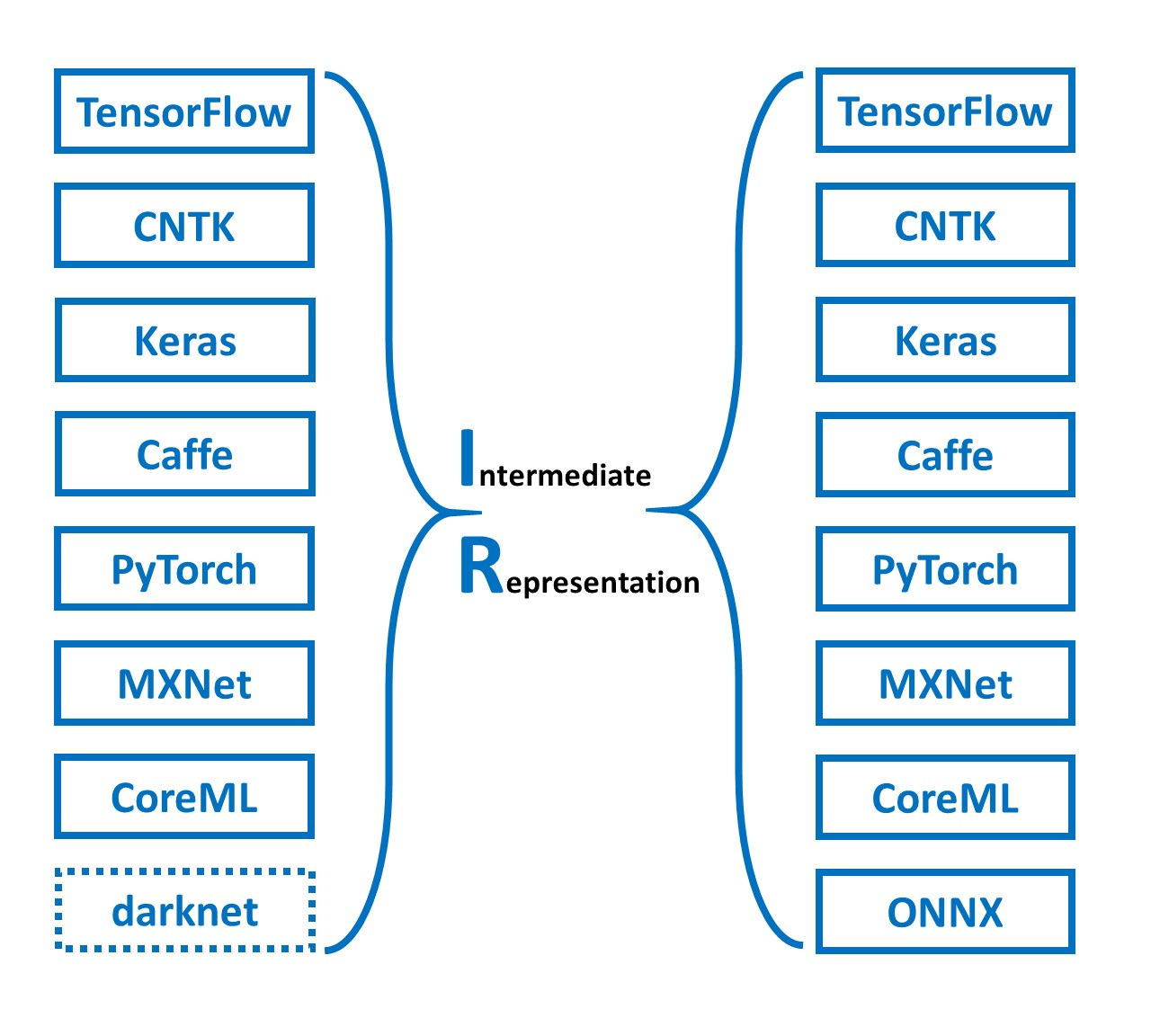
We provide a model converter to help developers convert models between frameworks through an intermediate representation format.
Support frameworks
[Note] You can click the links to get detailed README of each framework.
- Caffe
- Microsoft Cognitive Toolkit (CNTK)
- CoreML
- Keras
- MXNet
- ONNX (Destination only)
- PyTorch
- TensorFlow (Experimental) (We highly recommend you read the README of TensorFlow first)
- DarkNet (Source only, Experiment)
Tested models
The model conversion between currently supported frameworks is tested on some ImageNet models.
| Models | Caffe | Keras | TensorFlow | CNTK | MXNet | PyTorch | CoreML | ONNX |
|---|---|---|---|---|---|---|---|---|
| VGG 19 | √ | √ | √ | √ | √ | √ | √ | √ |
| Inception V1 | √ | √ | √ | √ | √ | √ | √ | √ |
| Inception V3 | √ | √ | √ | √ | √ | √ | √ | √ |
| Inception V4 | √ | √ | √ | o | √ | √ | √ | √ |
| ResNet V1 | × | √ | √ | o | √ | √ | √ | √ |
| ResNet V2 | √ | √ | √ | √ | √ | √ | √ | √ |
| MobileNet V1 | × | √ | √ | o | √ | √ | √ | √ |
| MobileNet V2 | × | √ | √ | o | √ | √ | √ | √ |
| Xception | √ | √ | √ | o | × | √ | √ | √ |
| SqueezeNet | √ | √ | √ | √ | √ | √ | √ | √ |
| DenseNet | √ | √ | √ | √ | √ | √ | √ | √ |
| NASNet | x | √ | √ | o | √ | √ | √ | x |
| ResNext | √ | √ | √ | √ | √ | √ | √ | √ |
| voc FCN | √ | √ | ||||||
| Yolo3 | √ | √ |
Usage
One command to achieve the conversion. Using TensorFlow ResNet V2 152 to PyTorch as our example.
$ mmdownload -f tensorflow -n resnet_v2_152 -o ./
$ mmconvert -sf tensorflow -in imagenet_resnet_v2_152.ckpt.meta -iw imagenet_resnet_v2_152.ckpt --dstNodeName MMdnn_Output -df pytorch -om tf_resnet_to_pth.pth
Done.
On-going frameworks
- Torch7 (help wanted)
- Chainer (help wanted)
On-going Models
- Face Detection
- Semantic Segmentation
- Image Style Transfer
- Object Detection
- RNN
Model Visualization
We provide a local visualizer to display the network architecture of a deep learning model. Please refer to the instruction.
Examples
Official Tutorial
Users' Examples
Contributing
Most contributions require you to agree to a Contributor License Agreement (CLA) declaring that you have the right to and actually do, grant us the rights to use your contribution. For details, visit https://cla.microsoft.com.
When you submit a pull request, a CLA-bot will automatically determine whether you need to provide a CLA and decorate the PR appropriately (e.g., label, comment). Simply follow the instructions provided by the bot. You will only need to do this once across all repos using our CLA.
This project has adopted the Microsoft Open Source Code of Conduct. For more information see the Code of Conduct FAQ or contact [email protected] with any additional questions or comments.
Intermediate Representation
The intermediate representation stores the network architecture in protobuf binary and pre-trained weights in NumPy native format.
[Note!] Currently the IR weights data is in NHWC (channel last) format.
Details are in ops.txt and graph.proto. New operators and any comments are welcome.
Frameworks
We are working on other frameworks conversion and visualization, such as PyTorch, CoreML and so on. We're investigating more RNN related operators. Any contributions and suggestions are welcome! Details in Contribution Guideline.
Authors
Yu Liu (Peking University): Project Developer & Maintainer
Cheng CHEN (Microsoft Research Asia): Caffe, CNTK, CoreML Emitter, Keras, MXNet, TensorFlow
Jiahao YAO (Peking University): CoreML, MXNet Emitter, PyTorch Parser; HomePage
Ru ZHANG (Chinese Academy of Sciences): CoreML Emitter, DarkNet Parser, Keras, TensorFlow frozen graph Parser; Yolo and SSD models; Tests
Yuhao ZHOU (Shanghai Jiao Tong University): MXNet
Tingting QIN (Microsoft Research Asia): Caffe Emitter
Tong ZHAN (Microsoft): ONNX Emitter
Qianwen WANG (Hong Kong University of Science and Technology): Visualization
Acknowledgements
Thanks to Saumitro Dasgupta, the initial code of caffe -> IR converting is references to his project caffe-tensorflow.
License
Licensed under the MIT license.
netron
lutzroeder·JavaScript
把 ONNX、PyTorch、Keras、CoreML 等格式的神经网络模型直接拖进浏览器就能看结构图,排查模型转换和层连接问题很方便。
模型可视化+4格式转换
33670+63.2kv9.3.52026-11-09 12:35 UTC
onnxruntime
microsoft·C++
跨平台高性能推理与训练加速引擎,可直接加载 ONNX 模型,兼容 PyTorch、TensorFlow 等框架导出,解决模型在不同硬件上高效部署的问题。
推理引擎+4格式转换
22271+114.4kv1.30.12026-11-10 05:21 UTC
onnx
onnx·Python
ONNX 是开放的机器学习模型交换格式标准,让 PyTorch、TensorFlow、Keras 等框架训练出的模型能互相转换、跨平台部署。
模型交换格式+4格式转换
21668+54.1kv1.23.22026-11-09 23:01 UTC
magika
google·Rust
用深度学习快速准确地识别文件真实类型,不依赖扩展名,支持 MIME 检测,Rust 实现,可嵌入各类应用做内容安全与文件分类。
文件类型检测+4格式转换
18784+81.2kcli/v1.1.02026-11-09 21:44 UTC