install.sh 会初始化固定版本的 verl 子模块并安装 CUDA 13 技术栈(Torch 2.11.0、SGLang 0.5.13 等),环境不匹配会失败;训练前需先执行 wandb login,自建 W&B 还要设置 WANDB_BASE_URL;main 分支已迁移到基于 VERL agent-loop 的 VAGEN-Lite,需要旧功能得切到 vagen-legacy 分支或旧 tag。
VAGEN
mll-lab-nuMIT活跃维护面向多轮视觉语言模型智能体的世界模型强化学习框架,让 VLM Agent 在交互中通过 RL 训练提升多轮决策能力。
World model reinforcement learning for multi-turn VLM agents. RL for vision framework (NeurIPS 2025).
v25.12.30发布于 2026-02-10 02:33 UTC522star +2 / 7 天63fork同步于 2026-11-10 17:59 UTC
conda create -n vagen python=3.12 -y
conda activate vagen
git clone https://github.com/mll-lab-nu/VAGEN.git
cd VAGEN
bash scripts/install.sh 硬件要求按 README 说明
README 未给出具体显存数值,仅说明需要 Python 3.12 与 CUDA 13 驱动,GPU 选型与显存规模需查阅 Quick Start 文档。
需要 CUDA
训练多轮 VLM 智能体的强化学习框架,用世界模型推理奖励提升视觉任务表现
面向多轮视觉语言模型智能体的世界模型强化学习框架,让 VLM Agent 在交互中通过 RL 训练提升多轮决策能力。
核心能力
- 用 LLM-as-Judge 奖励监督状态估计与状态转移建模
- 将多轮 VLM 任务建模为 POMDP 并做多轮 RL 训练
- 内置 FrozenLake、Sokoban、Navigation、ManiSkill 等环境
- 环境、harness、模型、rollout、评估分层解耦便于替换
- 支持 Qwen2.5-VL、Qwen3-VL、InternVL3.5、GLM-4.6V 等模型
容易踩的坑
内容由模型根据 README 生成,可能不完整或不准确,以官方文档为准。看原文 README
- v25.12.30最新正式版2026-02-10 · 2026-02-10 02:33 UTC
Last Update of the legacy version
用户点评
登录用户的真实使用记录,可按版本和硬件筛选共 0 条
还没有人点评。第一个说出真实体验的人最有价值。
VAGEN is a reinforcement learning (RL) framework that trains multi-turn VLM agents (vision-language model agents) to build an internal world model through explicit visual state reasoning. In addition to task success, VAGEN can reinforce StateEstimation ("what is the current state?") and TransitionModeling ("what comes next?") with an LLM-as-Judge world-modeling reward. The reusable harness, environment, model, rollout, and evaluation boundaries keep those signals independent from the selected training algorithm.
We introduce VAGEN, a multi-turn reinforcement learning framework designed specifically for training vision-language model (VLM) agents. Built upon this framework, we propose World Modeling RL, a novel reinforcement learning approach that significantly improves the multi-turn performance of VLMs by explicitly supervising their worldmodel reasoning process, as shown in Figure 1.
We frame multi-turn VLM agentic tasks as a Partially Observable Markov Decision Process (POMDP), shown in Figure 2.
| Figure 1. Overview of the VAGEN framework. | Figure 2. POMDP formulation of multi-turn VLM agentic tasks. |
News
[2026/08]: Added support for Verl 0.9.0, decoupled the environment and harness layer. This is a major update. The last commit before these changes is here; please check out the tag if you need the previous codebase.
[2026/02] We have migrated the main branch to VAGEN-Lite, a lightweight and clean reimplementation built on VERL agent-loop for easy customization and stable performance. For the previous full-featured release, please visit the vagen-legacy branch.
[2025/12] Introducing VAGEN-Lite: a lightweight and clean reimplementation of VAGEN, built on the VERL agent-loop for easy customization and stable performance.
[2025/09] VAGEN is accepted by Neurips 2025
[2025/04] We've introduced a new modular design for environments and services in VAGEN:
- Enhanced environment framework for easier creation of custom environments
- New service architecture for efficient distributed training
- Check out our new guides:
- Creating Environments: New environment protocol.
- Creating Services: We support hosting environments in a separate process
[2025/03] We release VAGEN, a multi-turn reinforcement learning framework for training VLM Agents!
Installation
Requires Python 3.12 and a CUDA 13 driver. See Quick Start for GPU sizing and a manual install.
conda create -n vagen python=3.12 -y
conda activate vagen
git clone https://github.com/mll-lab-nu/VAGEN.git
cd VAGEN
bash scripts/install.sh  # SGLang 0.5.13 (default)
scripts/install.sh initializes the pinned verl submodule (VAGEN's verl 0.9 fork,
JamesKrW/verl vagen-main) and installs
the CUDA 13 stack: Torch 2.11.0, SGLang 0.5.13, Transformers 5.8.1, and TransferQueue 0.1.9
(used only by trainer.use_v1=true). It is safe to re-run; SKIP_ENGINE=1 keeps and
verifies an existing rollout engine.
To use vLLM instead:
BACKEND=vllm bash scripts/install.sh # vLLM 0.22.0
Do not install vLLM and SGLang in the same environment: they require incompatible
flashinfer builds. Training examples default to SGLang; select vLLM explicitly when
needed.
Supported environments are listed in vagen/configs/env_registry.yaml: Sokoban,
FrozenLake, SpatialGym, PrimitiveSkill, and RemoteEnv (used by Navigation).
Some need their own setup: spatial_gym (dataset download), navigation (AI2-THOR), and primitive_skill (ManiSkill).
Environment responses share one protocol. Structured world-model output is
<perception>...</perception><reasoning>...</reasoning><prediction>...</prediction><answer>...</answer>;
the compact form is <think>...</think><answer>...</answer>. See
Configuration.
Quick Start
wandb login
# Self-hosted W&B:
# WANDB_BASE_URL=https://your-wandb-host wandb login --host https://your-wandb-host
Training
cd VAGEN

# Qwen2.5-VL: concat / no-concat / compact
bash examples/train/sokoban/train_default_gae_qwen25vl3b.sh
bash examples/train/sokoban/train_ppo_no_concat_qwen25vl3b.sh
bash examples/train/sokoban/train_default_gae_compact_qwen25vl3b.sh

# Qwen2.5-VL: default GAE with state reward
bash examples/train/sokoban/train_default_gae_sr_qwen25vl3b.sh

# Qwen3-VL, Qwen3.5 non-thinking, InternVL3.5 and GLM-4.6V-Flash accept
# HARNESS=concat|no_concat|compact (concat is the default).
HARNESS=concat bash examples/train/sokoban/train_default_gae_qwen3vl4b.sh
HARNESS=concat bash examples/train/sokoban/train_default_gae_qwen35_4b.sh
HARNESS=concat bash examples/train/sokoban/train_default_gae_internvl35_2b.sh
HARNESS=concat bash examples/train/sokoban/train_default_gae_glm46v_flash.sh

# Qwen3.5 native thinking (concat)
bash examples/train/sokoban/train_default_gae_qwen35_4b_think.sh

# Validation only, without starting training
bash examples/train/sokoban/train_default_gae_internvl35_2b.sh \
  trainer.val_only=true trainer.save_freq=-1 trainer.test_freq=-1
See Configuration for harnesses, estimators, model-specific flags,
and state-reward settings. Training keeps the established V0 path by default. Append
trainer.use_v1=true to any launcher to select verl V1 colocate_async; see
Colocated asynchronous training for its queue, straggler, and
token-reward contracts.
Evaluation
cd VAGEN

# SGLang (default)
MODEL_PATH=Qwen/Qwen2.5-VL-3B-Instruct \
  bash examples/evaluate/sokoban/sglang/eval_qwen25_vl_3b.sh

# A hosted model on OpenRouter (export OPENROUTER_API_KEY)
bash examples/evaluate/sokoban/run_eval.sh
Each environment provides sglang/ and vllm/ launchers. See
Evaluation for configuration details.
Repository Layout
VAGEN separates stable orchestration from selectable implementations:
vagen/
├── algorithms/              # advantage algorithms and registry
├── envs/                    # environment facade, shared contracts, implementations
├── harness/                 # context-policy facade and implementations
├── models/                  # model-family adaptation
├── rollout/                 # framework-independent episode execution
├── evaluation/              # standalone evaluation and backend plugins
└── training/                # VERL agent-loop and trainer integration
Extension axes use axis/_common/ for shared contracts and one directory per concrete
implementation. Import shared APIs from the axis facade, such as vagen.envs,
vagen.harness, or vagen.algorithms. Training-only integration lives under
vagen.training; framework-independent rollout code lives under vagen.rollout.
Shared environment reward machinery lives under vagen/envs/_common/rewards/, while
an environment-specific reward specification stays beside that environment.
Keep _common limited to contracts and helpers genuinely reused by multiple
implementations. A selectable implementation owns its actual control flow in its own
directory, and cross-package consumers import through the axis facade.
Custom Environment
To train on your own environment, follow the steps below.
1. Create Your Environment Class
-
Import
GymImageEnvfrom the environment facade:from vagen.envs import GymImageEnvThe shared contract lives under
vagen/envs/_common. -
Refer to Sokoban for a full implementation example:
2. Register the Environment
Add your environment entry to:
vagen/configs/env_registry.yaml
3. Create Configuration Files
Prepare training and validation configs:
train.yamlval.yaml
You can follow the Sokoban examples as templates:
4. Create a Training Script
Write your training script based on:
Custom Advantage Estimator
Add an estimator under vagen/algorithms/<name>/ and import it from the
vagen.algorithms facade:
from vagen.algorithms import AdvantageInputs, AdvantageOutputs, advantage_estimator

@advantage_estimator("my_estimator", needs_critic=True)
def my_estimator(inputs: AdvantageInputs):
    returns = inputs.rewards
    advantages = (returns - inputs.values) * inputs.response_mask
    return AdvantageOutputs(advantages=advantages, returns=returns)
Select it in a training command with algorithm.adv_estimator=my_estimator. See
inputs.py for the available inputs and the
implementation directories under vagen/algorithms for examples.
Custom Harness
A harness is the reusable agent loop. It owns the message list, calls
client.create(messages), steps the environment with the returned response, and stops
when the environment terminates or truncates. concat, no_concat, and compact differ
only in how they build that message list.
Anything that subclasses BaseEnv or BaseHarness works in both training and evaluation
without changing either. A harness uses the small create/size client surface and the
environment step contract. It never builds token masks, VERL rows, or reward mappings:
those belong to the inference client and rollout scoring seam.
A harness also doesn't assume the conversation is kept on the client side. That leaves room
to add a backend that keeps it on the server instead (OpenAI's previous_response_id, an
SGLang session, a vLLM prefix cache) without rewriting any harness. No backend shipped today
does that — they all re-send the whole message list every turn.
from vagen.harness import BaseHarness, register_harness

@register_harness("mine")
class MyHarness(BaseHarness):
    #: Whether one episode can end up in more than one row. The trainer asks the harness
    #: rather than keeping a list of the ones it knows, and pairs the estimator accordingly.
    splits_episode_across_rows = True

    async def run_episode(self, client, env):
        observation, _ = await env.reset()
        messages = [await env.system_prompt(), observation]
        while True:
            response = await client.create(messages)
            observation, reward, terminated, truncated, info = await env.step(response)
            if terminated or truncated:
                return
            messages.extend([
                {"role": "assistant", "content": response.text},
                observation,
            ])
Training and evaluation both read a harness key, and both accept either a registered name
or an import path. What differs is who imports your module:
# training -- vagen/configs/vagen_multiturn.yaml, or a -o override
trainer:
  harness: mine
  # verl builds a registry per worker process, so the module has to be imported inside each
  # one. That is what this is for; without it the decorator never runs and the name is
  # unknown:
  #   actor_rollout_ref.model.external_lib=mypkg.harnesses
# evaluation -- examples/evaluate/<env>/config.yaml
envs:
  - name: Sokoban
    harness: mypkg.harnesses:MyHarness   # an import path, not a bare name
In evaluation, use the import path. The @register_harness decorator only runs if
something imports your module, and run_eval has no external_lib setting to make that
happen — so a bare harness: mine fails with:
unknown harness 'mine'; choose from ['compact', 'concat', 'no_concat']
Give the import path instead and VAGEN imports the module itself. This is why the import path is supported at all: a new harness is usually tried in evaluation first, where everything is configured in yaml and no decorator has had a chance to run.
The public contract and registry are exported by vagen/harness, with
shared internals under _common/ and one directory per implementation.
More Customization
See the Documentation for more customization options:
- Custom Filter — Trajectory filtering (e.g., Reward Variance (RV) filter in RAGEN)
- Custom Metric - Add W&B logging metrics
- Configuration - Training configuration reference
Useful Configs
refer to vagen/configs/vagen_multiturn.yaml
No Concat Mode
# Enable no concat mode: input is system prompt + current step observation
trainer:
  harness: no_concat        # concat | no_concat | compact
  model_adapter: auto       # detects qwen | internvl | glm; VERL remains the transport

# no_concat and compact put one episode in several rows, so the advantage estimator has
# to be one that stitches them back together. verl's own `gae`/`grpo` score a row at a
# time and would drop every turn's credit at the row boundary; the trainer refuses that
# pairing at startup rather than training on it.
algorithm:
  adv_estimator: default_gae       # or turn_level_gae | token_level_gae
                                   #    | trajectory_grpo
  # default_gae is the vanilla baseline: the episode's whole reward lumped onto its
  # last token, which is what single-turn RLHF does. It stitches rows like the others,
  # so it stays comparable under no_concat and compact where verl's `gae` would not.
Image Logging
# Warning:
# - If you set a training-data rollout dir AND enable image logging, training images will also be dumped to disk.
#   This can consume a large amount of storage very quickly. Monitor disk usage and consider cleanup/limits.
trainer:
  log_image:
    enable: false      # true can enable saving rollout/validation images to disk
    max_pending: 2     # max concurrent async image dump tasks
    png_compress_level: 0  # PNG compression (0 = fastest, 9 = smallest)
HuggingFace Hub Upload
# export HF_TOKEN=xxx
huggingface_hub:
  hf_save_freq: null   # upload every N steps (must be a multiple of trainer.save_freq); null = disabled
  repo_id: vagen-training   # the shipped default; enabling upload with it unchanged
                          # pushes to a repo of that name under your account
  private: false
Training Data Filtering
filter:
  name: reward_variance_top_p # registered by vagen.training.filters
  filter_kwargs:
    top_p: 0.9
  enable: False # set to true to enable filtering, recommended for GRPO training
Known Issues & Fixes
See docs/issues.md
Citation
If you find our framework and paper useful, we appreciate it if you could cite our work:
@inproceedings{wang2025vagen,
  title={VAGEN: Reinforcing World Model Reasoning for Multi-Turn VLM Agents},
  author={Kangrui Wang and Pingyue Zhang and Zihan Wang and Yaning Gao and Linjie Li and Qineng Wang and Hanyang Chen and Chi Wan and Yiping Lu and Zhengyuan Yang and Lijuan Wang and Ranjay Krishna and Jiajun Wu and Li Fei-Fei and Yejin Choi and Manling Li},
  booktitle={The Thirty-ninth Annual Conference on Neural Information Processing Systems},
  year={2025},
  url={https://arxiv.org/abs/2510.16907}
}

Autoregressive-Models-in-Vision-Survey
ChaofanTao
系统梳理视觉自回归模型的研究综述(TMLR 2025),覆盖图像生成、多模态、点云、运动预测等方向,帮研究者快速理清技术脉络与加速方法。
视觉自回归+4具身智能 / VLA
805232026-05-05 15:14 UTC
rai
RobotecAI·Python
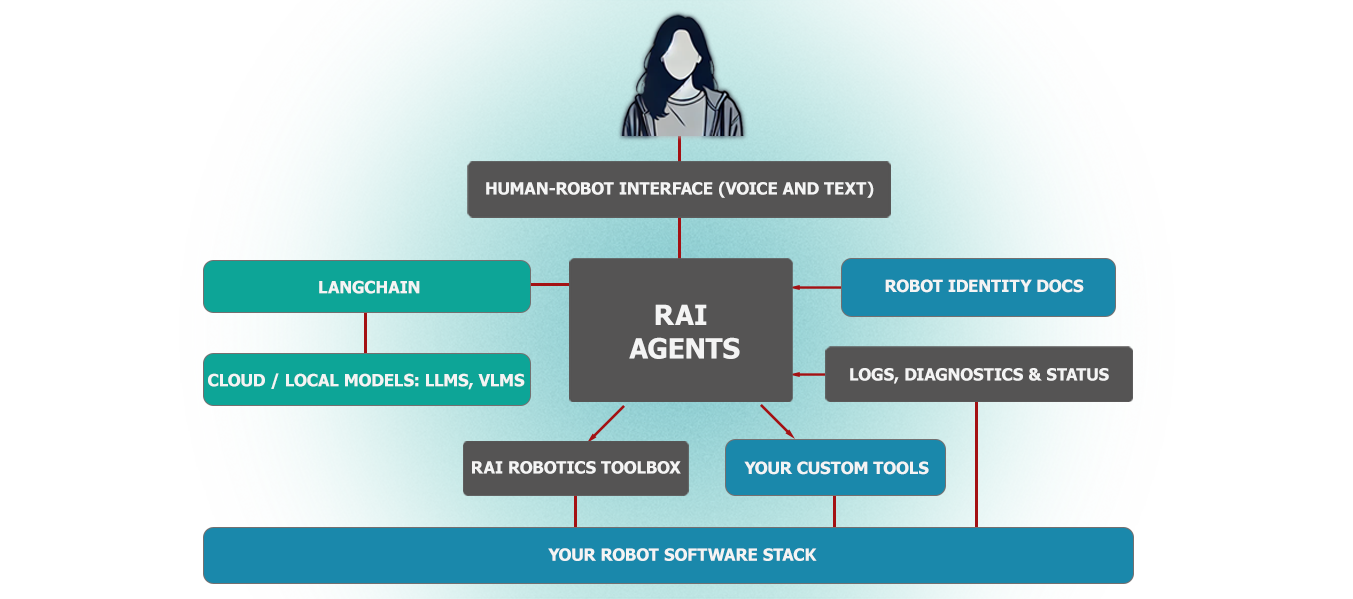
面向物理 AI 机器人的厂商无关智能体框架,基于 ROS 2 工具执行复杂动作、场景任务、自由接口调用、日志摘要和语音交互。
具身智能+4具身智能 / VLA
615+1792.12.42026-11-10 14:56 UTC
RoboBrain
FlagOpen·Python
面向机器人操作任务的统一大脑模型,把抽象指令逐步落到具体动作,配套官方推理代码,可直接用于具身智能研究。
具身智能+4具身智能 / VLA
568442025-10-13 04:14 UTC
Awesome-Embodied-AI
haoranD
整理具身智能方向的论文与行业资源清单,覆盖检测、导航、语言学习等主题,方便快速定位相关研究。
具身智能+4具身智能 / VLA
539292025-06-03 15:13 UTC