默认不安装任何 ONNX Runtime,必须按平台选装 onnx、onnx-gpu 等 extra 才能推理;训练需另装 fast-plate-ocr[train];OCR 只接受已裁剪的车牌图,需先接车牌检测器。
fast-plate-ocr
ankandrewMIT更新放缓轻量级车牌文字识别 OCR 模型,支持 Keras、JAX 和 ONNX Runtime,可快速集成到车牌识别流水线中。
Lightweight & fast OCR models for license plate text recognition.
v1.1.0发布于 2026-03-14 20:22 UTC806star104fork同步于 2026-11-07 07:30 UTC
pip install fast-plate-ocr[onnx-gpu] 硬件要求按 README 说明
README 未给出显存要求;基准测试在 NVIDIA RTX 3090 上完成,推理可走 CPU、NVIDIA CUDA、Intel OpenVINO、Windows DirectML、Qualcomm QNN 等多种执行后端。
需要 CUDA
轻量快速的车牌文字识别 OCR 模型,接在车牌检测器之后对裁剪车牌图做识别
轻量级车牌文字识别 OCR 模型,支持 Keras、JAX 和 ONNX Runtime,可快速集成到车牌识别流水线中。
核心能力
- 基于 CCT 架构提供 XS/S 多档预训练模型
- 用 ONNX Runtime 做优化推理,支持 GPU 加速
- Keras 3 后端可选 TensorFlow、JAX 或 PyTorch 训练
- 支持微调自有数据集并导出 CoreML、TFLite、ONNX
- 可选区域识别头预测车牌所属国家或地区
容易踩的坑
内容由模型根据 README 生成,可能不完整或不准确,以官方文档为准。看原文 README
- v1.1.0fast-plate-ocr 1.1.0最新正式版2026-03-14 · 2026-03-14 20:22 UTC
Highlights
Added
- New
cct-xs-v2-global-modelandcct-s-v2-global-modelwith plate region recognition support for 65+ countries. - Optional region-aware training, validation, and inference flow, including
plate_regiondataset support. - New region evaluation metrics, including
val_region_macro_f1, plus per-region evaluation in validation. - New CCT v2 model configs, parameterized plate configs, and focal loss support for region classification.
- Inference now returns
PlatePrediction, exposing region outputs when available. - Export pipeline improvements for multi-output models, plus support for selecting the ONNX opset version.
- Expanded dataset validation and annotation checks, including region validation and warnings on unexpected columns.
Changed
- V2 pre-trained models were trained on roughly 3x more data than the v1 generation.
- V2 training now includes empty plates built from backgrounds, noise, textures, and other padded-plate negatives.
- Region recognition now includes an
Unknownclass trained mainly with synthetic data. - Updated the new CCT v2 models to use
siluinstead ofgeluto avoid export issues with some library versions. - Added the corrected
attention_layoutbehavior so split projection dimensions are distributed per head instead of reusing the fullprojection_dim. - The shipped v2
xsandspre-trained models both exceed0.99val_region_macro_f1on a held-out validation split with more than114_000samples. - Transformer blocks and training defaults are more configurable, including projection validation, loss weighting, and milder augmentations.
- Inference now removes the pad character by default from decoded output.
- TFLite export now uses LiteRT via
ai-edge-litertfollowing TensorFlow deprecation changes.
Fixed
- Fixed region recognition mismatches during validation.
- Fixed
EarlyStoppingmetric selection when training single-head models. - Fixed learning-rate decay step calculation to account for warmup steps.
Full Changelog: https://github.com/ankandrew/fast-plate-ocr/compare/v1.0.2...v1.1.0
- New
- v1.0.2fast-plate-ocr 1.0.22025-09-06 · 2025-09-06 02:59 UTC
查看更新说明
What's Changed
- Add tutorial for fine-tuning OCR models by @ankandrew in https://github.com/ankandrew/fast-plate-ocr/pull/51
- Migrate to UV by @ankandrew in https://github.com/ankandrew/fast-plate-ocr/pull/54
- Refactor workflows by @ankandrew in https://github.com/ankandrew/fast-plate-ocr/pull/55
- ReLU xs/s model versions by @ankandrew in https://github.com/ankandrew/fast-plate-ocr/pull/59
Full Changelog: https://github.com/ankandrew/fast-plate-ocr/compare/v1.0.1...v1.0.2
- v1.0.1fast-plate-ocr 1.0.12025-07-06 · 2025-07-06 01:22 UTC
查看更新说明
What's Changed
- Update Keras version + docs update by @ankandrew in https://github.com/ankandrew/fast-plate-ocr/pull/50
Full Changelog: https://github.com/ankandrew/fast-plate-ocr/compare/v1.0.0...v1.0.1
- v1.0.0fast-plate-ocr 1.0.02025-06-30 · 2025-06-30 02:53 UTC
查看更新说明
What's Changed
Added
- New XS and S CCT model variants, trained with x3 more data (220k global plates).
- Complete rework of docs, documenting much more everything.
- Inference now works smoothly with different onnxruntime variants like
onnxruntime-gpu,onnxruntime-openvino, etc. - Support for building and customizing CCT (Compact Convolutional Transformer) models from YAML configs.
- New model building logic, allows users to build custom-based architectures while validating it with Pydantic.
- New metric
val_plate_len_acc. - Added support for categorical focal loss.
- Added more test coverage (configs, train scripts, etc.).
- New
validate_dataset.pyscript to help check datasets before training. - Export script now officially supports more formats like TFLite and CoreML.
- New plate config support:
keep_aspect_ratio,interpolation,image_color_modeandpadding_color. - New default augmentation for RGB image mode.
- New default models, trained with much more data.
- Added examples and more docs.
Changed
- Visualize augmentation script now respects config-based preprocessing.
- Improved plate config validation.
ONNXPlateRecognizeris now calledLicensePlateRecognizer.
Full Changelog: https://github.com/ankandrew/fast-plate-ocr/compare/v0.3.0...v1.0.0
- v0.3.0fast-plate-ocr 0.3.02024-12-08 · 2024-12-08 16:42 UTC
查看更新说明
What's Changed
- Add more CI/CD workflows by @ankandrew in https://github.com/ankandrew/fast-plate-ocr/pull/25
- Add more CLI train options by @ankandrew in https://github.com/ankandrew/fast-plate-ocr/pull/27
- New Global model using MobileViTV2 trained with data from +65 countries 🚀 by @ankandrew in https://github.com/ankandrew/fast-plate-ocr/pull/28
Full Changelog: https://github.com/ankandrew/fast-plate-ocr/compare/v0.2.0...v0.3.0
用户点评
登录用户的真实使用记录,可按版本和硬件筛选共 0 条
还没有人点评。第一个说出真实体验的人最有价值。
Fast & Lightweight License Plate OCR






Introduction
Lightweight and fast OCR models for license plate text recognition. You can train models from scratch or use the trained models for inference.
The idea is to use this after a plate object detector, since the OCR expects the cropped plates.
Features
- Keras 3 Backend Support: Train seamlessly using TensorFlow, JAX, or PyTorch backends 🧠
- Efficient Execution: Lightweight models that are cheap to run 💰
- ONNX Runtime Inference: Fast and optimized inference with ONNX runtime ⚡
- User-Friendly CLI: Simplified CLI for training and validating OCR models 🛠️
- Region Recognition (Optional): Predict region/country of the license plate 🌍
- Model HUB: Access to a collection of pre-trained models ready for inference 🌟
- Train/Fine-tune: Easily train or fine-tune your own models 🔧
- Export-Friendly: Export easily to CoreML, TFLite, or ONNX formats 📦
Available Models
Optimized, ready to use models with config files for inference or fine-tuning.
| Model Name | Size | Arch | b=1 Avg. Latency (ms) | Plates/sec (PPS) | Model Config | Plate Config | Val Results |
|---|---|---|---|---|---|---|---|
cct-s-v2-global-model | S | CCT | 0.6758 | 1479.61 | model_config.yaml | plate_config.yaml | results |
cct-xs-v2-global-model | XS | CCT | 0.4664 | 2144.14 | model_config.yaml | plate_config.yaml | results |
cct-s-v1-global-model | S | CCT | 0.5877 | 1701.63 | model_config.yaml | plate_config.yaml | results |
cct-xs-v1-global-model | XS | CCT | 0.3232 | 3094.21 | model_config.yaml | plate_config.yaml | results |
[!TIP] 🚀 Try the above models in Hugging Spaces.
[!NOTE] Benchmark Setup
These results were obtained with:
- Hardware: NVIDIA RTX 3090 GPU
- Execution Providers:
['TensorrtExecutionProvider', 'CUDAExecutionProvider', 'CPUExecutionProvider']- Install dependencies:
pip install fast-plate-ocr[onnx-gpu]
Explore the Model Zoo to see all available models.
Inference
For doing inference, install:
pip install fast-plate-ocr[onnx-gpu]
By default, no ONNX runtime is installed. To run inference, you must install at least one ONNX backend using an appropriate extra.
| Platform/Use Case | Install Command | Notes |
|---|---|---|
| CPU (default) | pip install fast-plate-ocr[onnx] | Cross-platform |
| NVIDIA GPU (CUDA) | pip install fast-plate-ocr[onnx-gpu] | Linux/Windows |
| Intel (OpenVINO) | pip install fast-plate-ocr[onnx-openvino] | Best on Intel CPUs |
| Windows (DirectML) | pip install fast-plate-ocr[onnx-directml] | For DirectML support |
| Qualcomm (QNN) | pip install fast-plate-ocr[onnx-qnn] | Qualcomm chipsets |
Usage
To predict from disk image:
from fast_plate_ocr import LicensePlateRecognizer

m = LicensePlateRecognizer('cct-s-v2-global-model')
print(m.run('test_plate.png'))
If your model includes a region head (and plate_regions is defined in the plate config), predictions
also include region. The region_prob field is populated when return_confidence=True:
from fast_plate_ocr import LicensePlateRecognizer

m = LicensePlateRecognizer('cct-s-v2-global-model')
pred = m.run('test_plate.png', return_confidence=True)[0]
print(pred.region, pred.region_prob)
To run a model benchmark:
from fast_plate_ocr import LicensePlateRecognizer

m = LicensePlateRecognizer('cct-s-v2-global-model')
m.benchmark()
For more examples and the full API, see the Inference Guide and Reference.
Training
You can train models from scratch or fine-tune a pre-trained one using your own license plate dataset.
Install the training dependencies:
pip install fast-plate-ocr[train]
Fine-tuning Tutorial
A complete tutorial notebook is available for fine-tuning a license plate OCR model on your own dataset:
examples/fine_tune_workflow.ipynb. It covers the full workflow, from
preparing your dataset to training and exporting the model.
For full details on data preparation, model configs, fine-tuning, and training commands, check out the docs.
For region recognition and export-friendly activations, use the v2 models.
Contributing
Contributions to the repo are greatly appreciated. Whether it's bug fixes, feature enhancements, or new models, your contributions are warmly welcomed.
To start contributing or to begin development, you can follow these steps:
- Clone repo
git clone https://github.com/ankandrew/fast-plate-ocr.git - Install all dependencies (make sure you have uv installed):
make install - To ensure your changes pass linting and tests before submitting a PR:
make checks
Citations
@article{hassani2021escaping,
    title   = {Escaping the Big Data Paradigm with Compact Transformers},
    author  = {Ali Hassani and Steven Walton and Nikhil Shah and Abulikemu Abuduweili and Jiachen Li and Humphrey Shi},
    year    = 2021,
    url     = {https://arxiv.org/abs/2104.05704},
    eprint  = {2104.05704},
    archiveprefix = {arXiv},
    primaryclass = {cs.CV}
}
PaddleOCR
PaddlePaddle·Python
轻量级 OCR 工具包,能把图片和 PDF 转成结构化数据,支持 100 多种语言,方便接入 LLM 和 RAG 流程。
OCR+4文档解析 / OCR
92537+15112kv3.7.02026-09-16 03:31 UTC

MinerU
opendatalab·Python
把 PDF、Office 等复杂文档转成 LLM 可直接用的 Markdown/JSON,内置版面分析和 OCR,专为 RAG 与 Agent 工作流准备语料。
文档解析+4文档解析 / OCR
83452+1976.9kmineru-4.1.7-released2026-11-10 17:04 UTC
tesseract
tesseract-ocr·C++
老牌开源 OCR 引擎,用 LSTM 识别图片中的文字,支持上百种语言,适合做文档扫描和文本提取。
OCR引擎+4文档解析 / OCR
77449+5011k5.5.42026-11-10 18:26 UTC
docling
docling-project·Python
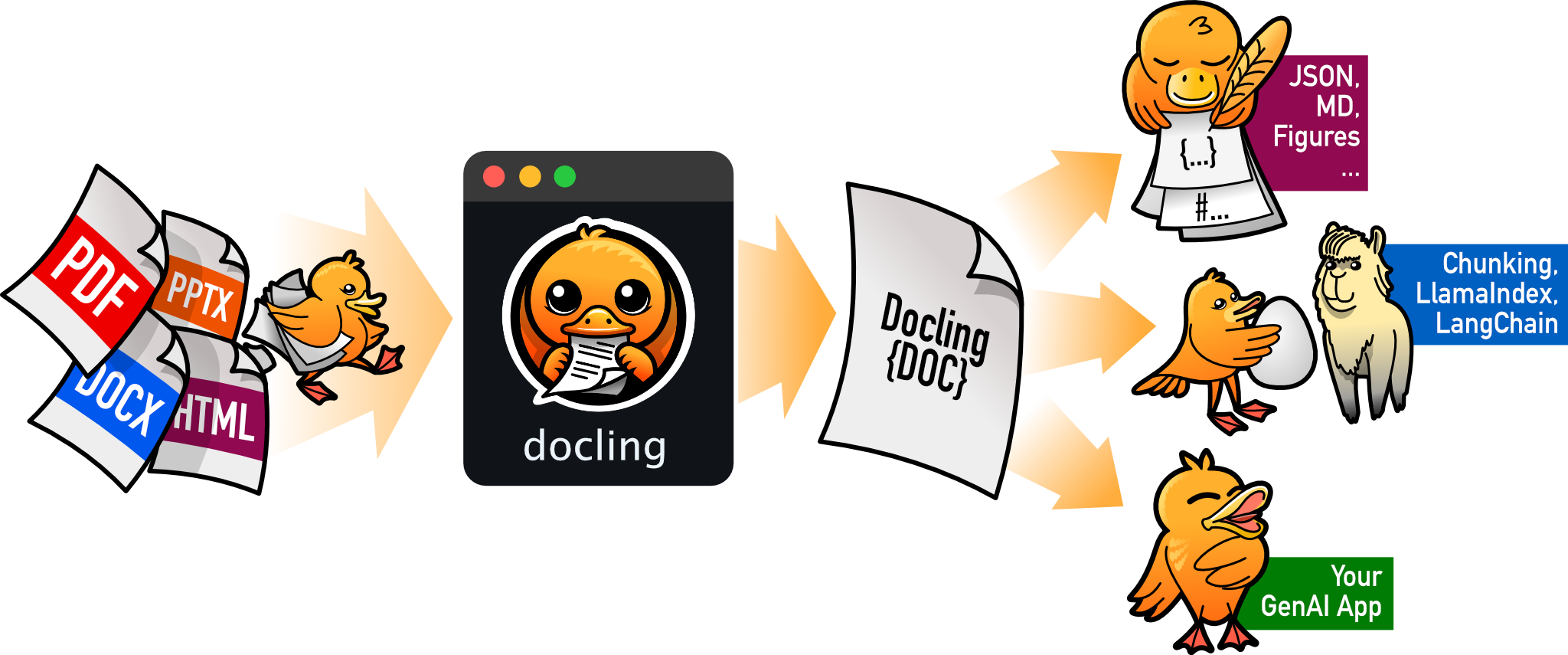
把 PDF、DOCX、HTML 等文档解析成结构化 Markdown 或 JSON,方便喂给大模型和 RAG 流程。
文档解析+4文档解析 / OCR
70395+1555.3kv2.149.02026-11-10 17:59 UTC