训练泛化模型时 batch_size 必须设为 1,微调时才可增大;需自行下载 DTU、Blender、LLFF 等数据集并按示例组织目录;依赖版本锁定较严(Pytorch 1.10.1 + Lightning 1.3.5),版本不符易报错。
mvsnerf
apchenstuMIT长期未更新ICCV 2021 提出的神经渲染方法,能从多视角图像高效重建几何与神经辐射场,用于新视角合成。
[ICCV 2021] Our work presents a novel neural rendering approach that can efficiently reconstruct geometric and neural radiance fields for view synthesis.
暂无版本696star83fork同步于 2026-11-07 07:30 UTC
conda create -n mvsnerf python=3.8
conda activate mvsnerf
pip install torch==1.10.1+cu113 torchvision==0.11.2+cu113 torchaudio==0.10.1+cu113 -f https://download.pytorch.org/whl/cu113/torch_stable.html
pip install pytorch-lightning==1.3.5 imageio pillow scikit-image opencv-python configargparse lpips kornia warmup_scheduler matplotlib test-tube imageio-ffmpeg 硬件要求按 README 说明
README 未明确给出显存要求;训练在单张 RTX 2080Ti 上 6 个 epoch 约需 30 小时,需 CUDA 环境(cu113)。
基于多视角立体视觉的快速可泛化神经辐射场重建,少量图像即可合成新视角
ICCV 2021 提出的神经渲染方法,能从多视角图像高效重建几何与神经辐射场,用于新视角合成。
核心能力
- 用多视角立体视觉构建代价体积,泛化到未见过场景
- 预训练模型可直接推理,无需逐场景从头训练
- 支持在 DTU、Blender、LLFF 数据上微调提升质量
- 提供渲染脚本生成自由视角视频
容易踩的坑
内容由模型根据 README 生成,可能不完整或不准确,以官方文档为准。看原文 README
暂无 release 数据(可能没有发版,或尚未同步)。
用户点评
登录用户的真实使用记录,可按版本和硬件筛选共 0 条
还没有人点评。第一个说出真实体验的人最有价值。
MVSNeRF
Project page | Paper
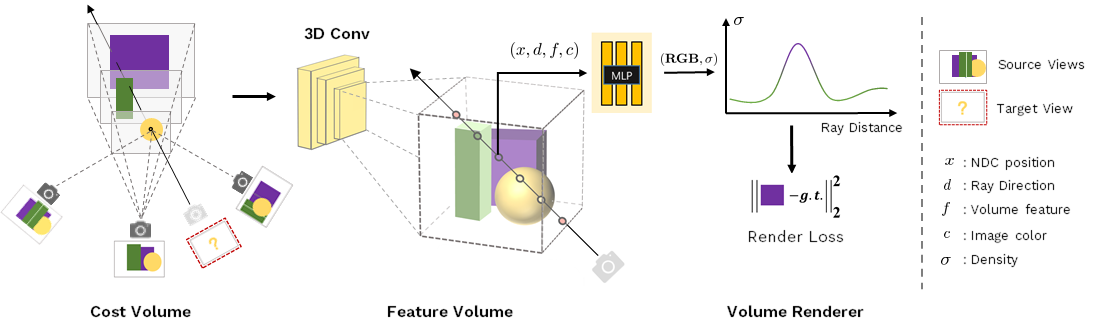
This repository contains a pytorch lightning implementation for the ICCV 2021 paper: MVSNeRF: Fast Generalizable Radiance Field Reconstruction from Multi-View Stereo. Our work present a novel neural rendering approach that can efficiently reconstruct geometric and neural radiance fields for view synthesis, Moreover, if dense images are captured, our estimated radiance field representation can be easily fine-tuned; this leads to fast per-scene reconstruction.

Installation
Tested on Ubuntu 20.04 + Pytorch 1.10.1 + Pytorch Lignting 1.3.5
Install environment:
conda create -n mvsnerf python=3.8
conda activate mvsnerf
pip install torch==1.10.1+cu113 torchvision==0.11.2+cu113 torchaudio==0.10.1+cu113 -f https://download.pytorch.org/whl/cu113/torch_stable.html
pip install pytorch-lightning==1.3.5 imageio pillow scikit-image opencv-python configargparse lpips kornia warmup_scheduler matplotlib test-tube imageio-ffmpeg
Training
Please see each subsection for training on different datasets. Available training datasets:
- DTU
- Blender (Realistic Synthetic)
- LLFF (Real Forward-Facing)
- Your own data (images/intrinsic/extrinsic/nearfar boundles)
DTU dataset
Data download
Download the preprocessed DTU training data and Depth_raw from original MVSNet repo and unzip. We provide a DTU example, please follow the example's folder structure.
Training model
Run
CUDA_VISIBLE_DEVICES=$cuda  python train_mvs_nerf_pl.py \
   --expname $exp_name
   --num_epochs 6
   --use_viewdirs \
   --dataset_name dtu \
   --datadir $DTU_DIR
More options refer to the opt.py, training command example:
CUDA_VISIBLE_DEVICES=0  python train_mvs_nerf_pl.py
    --with_depth  --imgScale_test 1.0 \
    --expname mvs-nerf-is-all-your-need \
    --num_epochs 6 --N_samples 128 --use_viewdirs --batch_size 1024 \
    --dataset_name dtu \
    --datadir path/to/dtu/data \
    --N_vis 6
You may need to add --with_depth if you want to quantity depth during training. --N_vis denotes the validation frequency.
--imgScale_test is the downsample ratio during validation, like 0.5. The training process takes about 30h on single RTX 2080Ti
for 6 epochs.
Important: please always set batch_size to 1 when you are trining a genelize model, you can enlarge it when fine-tuning.
Checkpoint: a pre-trained checkpint is included in ckpts/mvsnerf-v0.tar.
Evaluation: We also provide a rendering and quantity scipt in renderer.ipynb,
and you can also use the run_batch.py if you want to testing or finetuning on different dataset. More results can be found from
Here,
please check your configuration if your rendering result looks absnormal.
Rendering from the trained model should have result like this:

Finetuning
Blender
Data download
Download nerf_synthetic.zip from here
CUDA_VISIBLE_DEVICES=0  python train_mvs_nerf_finetuning_pl.py  \
    --dataset_name blender --datadir /path/to/nerf_synthetic/lego \
    --expname lego-ft  --with_rgb_loss  --batch_size 1024  \
    --num_epochs 1 --imgScale_test 1.0 --white_bkgd  --pad 0 \
    --ckpt ./ckpts/mvsnerf-v0.tar --N_vis 1
LLFF
Data download
Download nerf_llff_data.zip from here
CUDA_VISIBLE_DEVICES=0  python train_mvs_nerf_finetuning_pl.py  \
    --dataset_name llff --datadir /path/to/nerf_llff_data/{scene_name} \
    --expname horns-ft  --with_rgb_loss  --batch_size 1024  \
    --num_epochs 1 --imgScale_test 1.0  --pad 24 \
    --ckpt ./ckpts/mvsnerf-v0.tar --N_vis 1
DTU
CUDA_VISIBLE_DEVICES=0  python train_mvs_nerf_finetuning_pl.py  \
    --dataset_name dtu_ft --datadir /path/to/DTU/mvs_training/dtu/scan1 \
    --expname scan1-ft  --with_rgb_loss  --batch_size 1024  \
    --num_epochs 1 --imgScale_test 1.0   --pad 24 \
    --ckpt ./ckpts/mvsnerf-v0.tar --N_vis 1
Rendering
After training or finetuning, you can render free-viewpoint videos
with the renderer-video.ipynb. if you want to use your own data,
please using the right hand coordinate system (intrinsic, nearfar and extrinsic either with
camera to world or world to camera in opencv format) and modify the rendering scipts.
After 10k iterations (~ 15min), you should have videos like this:

Citation
If you find our code or paper helps, please consider citing:
@article{chen2021mvsnerf,
  title={MVSNeRF: Fast Generalizable Radiance Field Reconstruction from Multi-View Stereo},
  author={Chen, Anpei and Xu, Zexiang and Zhao, Fuqiang and Zhang, Xiaoshuai and Xiang, Fanbo and Yu, Jingyi and Su, Hao},
  journal={arXiv preprint arXiv:2103.15595},
  year={2021}
}
Big thanks to CasMVSNet_pl, our code is partially borrowing from them.
Relevant Works
MVSNet: Depth Inference for Unstructured Multi-view Stereo (ECCV 2018) Yao Yao, Zixin Luo, Shiwei Li, Tian Fang, Long Quan
Cascade Cost Volume for High-Resolution Multi-View Stereo and Stereo Matching (CVPR 2020) Xiaodong Gu, Zhiwen Fan, Zuozhuo Dai, Siyu Zhu, Feitong Tan, Ping Tan
NeRF: Representing Scenes as Neural Radiance Fields for View Synthesis (ECCV 2020) Ben Mildenhall, Pratul P. Srinivasan, Matthew Tancik, Jonathan T. Barron, Ravi Ramamoorthi, Ren Ng
IBRNet: Learning Multi-View Image-Based Rendering (CVPR 2021) Qianqian Wang, Zhicheng Wang, Kyle Genova, Pratul Srinivasan, Howard Zhou, Jonathan T. Barron, Ricardo Martin-Brualla, Noah Snavely, Thomas Funkhouser
PixelNeRF: Neural Radiance Fields from One or Few Images (CVPR 2021) Alex Yu, Vickie Ye, Matthew Tancik, Angjoo Kanazawa

gaussian-splatting
graphdeco-inria·Python
3D Gaussian Splatting 的官方参考实现,用高斯点云做辐射场重建,实现实时可交互的逼真场景渲染。
3D高斯泼溅+43D 重建
24449+173.5k2025-10-17 14:28 UTC
instant-ngp
NVlabs·Cuda
用多分辨率哈希编码把 NeRF、SDF 等神经图形基元的训练从几小时压到几秒,实时渲染三维场景。
神经辐射场+43D 重建
17590+22.1kv2.02026-02-02 12:32 UTC
Open3D
isl-org·C++
Open3D 是一个现代 3D 数据处理库,提供点云、网格、RGB-D 和 3D 可视化等算法与工具,支持 C++ 和 Python,可用于 3D 感知、重建与机器学习研究。
3D数据处理+43D 重建
14191+102.6kv0.20.02026-11-05 18:33 UTC
colmap
colmap·C++
从多张照片重建三维场景的 C++ 工具,集成了运动恢复结构(SfM)和多视图立体(MVS),可输出相机位姿与稠密点云。
三维重建+43D 重建
13192+182.2kdatasets-eth3d-undistorted-v12026-11-10 08:51 UTC